Friends, Romans, Countrymen, lend me a better introductory phrase! I need only to get started, and I will proceed on a ramble of most ramblonic ramifications. According to the online Etymology Dictionary, the word 'ramble' comes from a dutch word meaning the 'nightly wanderings of an amorous cat.' I think this is hilarious, especially since we use the word so much. I really love etymology.
Alright, what's up? Well, on this very day I am going to start a garden at a local community garden. I'm pretty happy about that. I really love gardening, and since I don't have a yard, or even a porch, it will help get me outside. Of course, the weather is heating up, 90 degrees this week, so outside is kind of a shitty place. Still, it's worth it.
In other news, I'm looking forward to playing an adventure game with my best girl. We've picked out Blackwell Legacy, which is supposed to have a good story. I'll let you know how it turns out. She's also a big fan of Mario Kart, and to that end, I've been hunting around for a used Nintendo Wii and copy of Mario Kart Wii (6?). Granted, it's not Mario Kart 8, which is really a fantastic game, it's not a Wii U either, but it's a much cheaper alternative, which fits my budget. I spent $100 on Magic Cards last month, and I really need to take it easy on spending.
Yes, Magic the Gathering has devoured my brain. I play it regularly, I even started a Magic Online account. Magic Online is clunky, but it's nice to have a digital way to organize my cards. The game has a learning curve that could wrap around the world, but I finally feel like I'm catching up to todays standards. It helps that I started listening to the Limited Resources Podcast.
Oh, that's right, I've been consuming other media as well. I'm currently reading 'Never Let Me Go" by Kazuo Ishiguro. He writes a lot of British stuff. This book is the most unusual genre fiction story I've ever read. It's the sort of book that is really easy to spoil, so I'll try not to. There is an air of mystery that pervades early on and carries through the whole book. However, there is also a powerful sense of sentimentality, but I wouldn't say it was sappy. I recommend this book, though it may not be quite what you're used to, if your into Sci Fi and other nerdy things. Nonetheless, I really do recommend giving it a chance.
On a more sci-fi front and center note, Jane and I just finished up "Other Space" a sci-fi comedy released by Yahoo. Yes, even Yahoo has TV now. But Other Space is really funny, and actually tends to contain at least one legit science fiction plot point in every episode. It's a bit like a live-action Futurama. I recommend it and I hope it gets picked up for a second season. The first one is kind of short.
Hmm, yes, I think this may be all the nerd fit to print. Looking forward to Blackwell Legacy and Nintendo Wii! Hasta Pasta,
-D
P.S. I think the entertainment world is long overdue for a sitcom about hens and roosters.

Showing posts with label gardening. Show all posts
Showing posts with label gardening. Show all posts
Friday, May 1, 2015


Tuesday, December 30, 2014
End of The Year - Monthly Update January
 |
| http://memoski.deviantart.com/art/Indie-Collision-447101402 |
I'm noticing that I'm less and less inclined toward playing video games lately. And as this has become the case, I notice I tend to narrow my focus when gaming. I really only play one or two games at a time. And I really want to finish them out and put them to bed. The latest has been starseed pilgrim. I've played this game off and on for a year, and I've gotten close to beating it but dammit if I can't seem to beat the thing! Even now, as I'm typing, I'm wondering if I should give it another shot.
... and yes, I tried, and no, I didn't finish it. So close! arrrgh! I do love that Starseed Pilgrim, though. This game is so challenging and rewarding. I find it can really absorb my attention, and that concentration can be good for me. Just so long as I can put the thing down before I'm pulling too much of my hair out.
I also started playing Chrono Trigger the other day, just to see what it would be like. I was being very good too, playing about 30-60 minutes a night, occasionally skipping some. But the holidays threw that out of whack. A skipped day flows into a couple days visiting family and friends and then suddenly I'm out of the habit. Incidentally, that's exactly how it always goes for me when flossing, exercising and other good habits I want to get into.
 |
| Frog Fractions, seems innocuous enough, but is it really? |
I suppose I should take some time to actually review the year, for this year in review. Wow, a lot can happen in a year. My year in gaming started out strong, with the unique and often hilarious game, The Stanley Parable. Jaconian and I both played this game, and had a blast. I would recommend this game to anyone who has played a lot of video games. I actually had a similar experience playing the flash game Frog Fractions. Though the two games have much different game play, there is a similar sense of parody and tribute to games past. All in all, Frog Fractions was a great time hidden in the guise of a math game.
I should mention that I entered 2014 as a member of our nations unemployed, and it was in this unemployed state that I discovered Zelda Classic, the Legend of Zelda quest editor. Zelda Classic occupied all my attention for a solid month. I had very high hopes. Unfortunately, when I finally got a job, I tapered off on Zelda Classic before being able to produce anything I was really proud of.
My new job was at a garden nursery, so for a while, all I could think about was plants. I stopped gaming almost entirely. Unless you count doggie soccer. I start doing a lot more book reviews, reviewing old games and rambling on about gardening.
Toward the end of the year, I started playing and buying magic cards again, after a many-year hiatus. I still regularly get together with my friends Ghost and Ramsden. It's still really fun, though I sometimes wonder for how much longer.

I think I'll have to call Starseed Pilgrim my game of the year. Even if it didn't come out this year. The point is that this game captured my attention more than any other game I played. I may even have to write another post after I finally beat the thing. Zelda classic comes in second, and would have won if I could have played it more consistently throughout the year. Unfortunately, Zelda classic is a much heavier commitment. The Stanley Parable gets special recognition, and always will.
Looking forward to the new year, I'm mostly thinking about my job and my housing. I don't have any goals related to gaming. And that's just fine. Maybe I'll check a new indie title, or get involved in some multiplayer games. I'll probably do some exploration of the past, probably playstation 1 era. Whatever the case, video games are here for me if I need them, and I wouldn't have it any other way.
-D
P.S. I also want to take a second to say how much I love the MIDI Week Singles column that Jaconian introduced this year. It's such a fun series to follow and to write for, and the possibilities are limitless. There is always something to say on the subject. Jaconian has long been 'tending the fires' of video game music, and his appreciation for the medium cannot be overstated.
Thursday, August 7, 2014
Gardening Game Design, Planning Stages and Replay Value
In my ongoing series of posts about Game Design informed by Gardening, or general Garden Simulation, I have yet to touch on the subject of Pest Management. This is due in part to my own feet-dragging approach to dealing with garden pests in my own garden. Still, as I prepare to break down and buy an insecticidal spray, I reflect on some of the things that have been working so far, and how they might play into a Gardening game.
The first, and most compelling method of pest management comes in the planning stages of gardening. The idea is to grow plants that will attract beneficial insects, which will do the work for you. I've leaned on this approach pretty heavily, however, this came about by happenstance, not by careful planning. Now I obsess about my next garden and how I'm going to plan it better. What's nice about Vegetable gardening is that the plants are all annuals, which will die off after a season, creating an opportunity to start over again. This can be a good thing .
This is very similar to how I've approached Sim City 4. I've made maybe eight different cities in that game. The first was a disaster, and I just ran and hid from the havoc I had unleashed. The second city went much better, but still, I learned some things which I was eager to apply on my next city. By the third city, I hit a plateau, and, try as I might, I couldn't really improve on my model. That didn't stop me from trying a few more times, though. There's something captivating about those beginning stages, designing a layout to avoid typical pitfalls.
I have a similar experience when I play Settler's of Catan. I find that during the early stages of play, I feel compelled to start the game over again - to place my tokens differently, because I know what I did wrong. I wonder if this might be a palpable experience of the oft-talked-about Learning Curve.
Learning can be fun! I said it. But seriously, maybe that's what's going on here. Thinking about Knytt and Starseed Pilgrim, those games had the most delightful learning curves. Starseed is highly cryptic; really all it tells the player about their goal amounts to a hill of beans. Yet, through repeated play, I was able to figure out goals, and increase my skills many fold. This growth in my play experience drove me to begin again time after time, until I hit a plateau and dropped the game. Up to that point, Starseed Pilgrim was a very potent gaming experience.
Knytt lays out very basic goals and controls. Then reward the player with an unfolding world of many environments. The learning curve here is to learn what the purpose of the game really is (hint: to enjoy yourself!) My compulsion to restart Knytt was based on finding out where I could explore that I didn't before. This curve was considerably shorter than Starseed Pilgrim, but still delightful and also free of charge.
Here's a random list of games with Learning Curves I have particularly enjoyed:
Starseed Pilgrim (PC)
Settler's of Catan (Board Game)
Blokus (Board Game)
Tony Hawk's Pro Skater series (Playstation)
Wave Race (N64)
Goldeneye 007 (N64)
Final Fantasy XI (PC)
Okay, those are a few to get the ball rolling. It occurs to me that there are a variety of different Learning Curves of different character. And it is possible to reach the end of a learning curve - the final plateau, so to speak, but how often do we actually get there? There are people who can do things in Street Fighter games that I have never had a hope or a prayer of ever doing. But it seems to me these games boil down to reflexes, rote memorization and practice, practice, practice.
Then on the other hand, there are games that start easy and stay easy, and just amount to a slog from point A to point Z. I felt God of War was kind of like that - good thing the visuals were so great. I've been complaining that games were too easy since the snes days, and it's usually these games that are very easy with one or two tough spots.
What are some of the best Learning Curves you have encountered?
The first, and most compelling method of pest management comes in the planning stages of gardening. The idea is to grow plants that will attract beneficial insects, which will do the work for you. I've leaned on this approach pretty heavily, however, this came about by happenstance, not by careful planning. Now I obsess about my next garden and how I'm going to plan it better. What's nice about Vegetable gardening is that the plants are all annuals, which will die off after a season, creating an opportunity to start over again. This can be a good thing .
This is very similar to how I've approached Sim City 4. I've made maybe eight different cities in that game. The first was a disaster, and I just ran and hid from the havoc I had unleashed. The second city went much better, but still, I learned some things which I was eager to apply on my next city. By the third city, I hit a plateau, and, try as I might, I couldn't really improve on my model. That didn't stop me from trying a few more times, though. There's something captivating about those beginning stages, designing a layout to avoid typical pitfalls.
I have a similar experience when I play Settler's of Catan. I find that during the early stages of play, I feel compelled to start the game over again - to place my tokens differently, because I know what I did wrong. I wonder if this might be a palpable experience of the oft-talked-about Learning Curve.
Learning can be fun! I said it. But seriously, maybe that's what's going on here. Thinking about Knytt and Starseed Pilgrim, those games had the most delightful learning curves. Starseed is highly cryptic; really all it tells the player about their goal amounts to a hill of beans. Yet, through repeated play, I was able to figure out goals, and increase my skills many fold. This growth in my play experience drove me to begin again time after time, until I hit a plateau and dropped the game. Up to that point, Starseed Pilgrim was a very potent gaming experience.
Knytt lays out very basic goals and controls. Then reward the player with an unfolding world of many environments. The learning curve here is to learn what the purpose of the game really is (hint: to enjoy yourself!) My compulsion to restart Knytt was based on finding out where I could explore that I didn't before. This curve was considerably shorter than Starseed Pilgrim, but still delightful and also free of charge.
Here's a random list of games with Learning Curves I have particularly enjoyed:
Starseed Pilgrim (PC)
Settler's of Catan (Board Game)
Blokus (Board Game)
Tony Hawk's Pro Skater series (Playstation)
Wave Race (N64)
Goldeneye 007 (N64)
Final Fantasy XI (PC)
Okay, those are a few to get the ball rolling. It occurs to me that there are a variety of different Learning Curves of different character. And it is possible to reach the end of a learning curve - the final plateau, so to speak, but how often do we actually get there? There are people who can do things in Street Fighter games that I have never had a hope or a prayer of ever doing. But it seems to me these games boil down to reflexes, rote memorization and practice, practice, practice.
Then on the other hand, there are games that start easy and stay easy, and just amount to a slog from point A to point Z. I felt God of War was kind of like that - good thing the visuals were so great. I've been complaining that games were too easy since the snes days, and it's usually these games that are very easy with one or two tough spots.
What are some of the best Learning Curves you have encountered?
Wednesday, July 9, 2014
The Great Garden Nursery Game
 |
| click this totally sweet image to link to the makers page |
It seems to me I am determined to design games based on my life. These days I'm always thinking about Gardening and gaming. To that effect, I was thinking of gamifying my job. That is to say, my job has just a few dynamic elements, but they keep me busy all day.
First there is watering. Plants start to die if they are not watered. Many of them can bounce back without any trouble, but some of them don't bounce back so well. And if they go long enough without water they lose their ability to hold water effectively, thus requiring more water. This also takes place when a plant is in a pot for too long and becomes root bound. In both instances, the plants run out of water quickly. A final thing that happens when a plant is not appropriately watered is that the plant will die partially, and become ugly. Ugly plants don't sell.
It's important to keep the plants healthy. However, the primary reason to keep the plants healthy is so that customers will purchase them. Thusly, customer service takes priority over watering. This conflict of interest can be very challenging, as customers do not respect the greater needs of the nursery, they are singularly focused on their own needs. (there are rare customers who see the bigger picture, and they are wonderful people).
Sometimes customers will simply pick out plants on their own, purchase them, and be on their merry way. Other customers require a great deal of song and dance before they will make a purchase. This comes in the form of simple questions, obscure questions and shopping buddies. Simple questions require only a moment of time, obscure questions require research, and shopping buddies require full devotion of attention for an extended period of time. The flipside of the devotion of time for shopping buddies is that they often will make the biggest purchases.
 |
| Y'know, kinda like this |
When I imagine these systems in the form of a video game, I'm thinking of a one-screen game, with basic pixel art, using color to attach meaning. In the basic stage of the game, you simply have to water all of the plants. Plants are represented by green icons, which, over time, degrade to yellow, red and then brown. If a plant turns yellow, it needs water. The player icon simply has to walk to each yellow plant and press the 'water' action button to resucitate the plant. I imagine little blue and white pixels for water.
If a plant turns red, it has received damage from dehydration, and now is not able to water back up to green. If a plant turns brown, it is dead. Dead plants will not change when watered, and must be removed using the 'deadhead' action button. When a dead plant is removed, it will be replaced, in time, by a new, green plant. However, every new plant results in a negative penalty to the score.
While the player is busy watering plants, customer icons will wander into the screen. I imagine these as shaped and colored differently from the plants, however, with variation. The basic customer will enter the screen, randomly collect green plants, and leave the screen. For every green plant collected, the player gains points, equal to at least double the potential penalty points.
I also imagine different customer behaviors. Some customers target you, and while they are within a certain proximity you are unable to water plants. These customers can be avoided, but may best be dealt with. One customer simply needs to be handle by pressing the action button a few times. Another type will not be shaken, and you must walk across the screen, through the plants, unable to water, but the customer will pick up plants along the way. After the customer has five plants, they will leave, and you can collect your points.
 |
| Maybe something like this, but with higher resolution? |
The goal is very simple, in classic arcade style: gain points. Each stage will have the same time limit. Essentially from open to close. Points carry over from one stage to the next. The game is lost when the player runs out of points. Players are ranked based on the number of stages they can complete, and the highest number of points they can acquire at any one time.
But the dynamics will increase with every level. I imagine a temperature meter, with a low of 70 degrees. The temperature can increase level to level, thus increasing the rate of dryout for the plants. I imagine larger plants which are slower to dry out, but also slower to water. These plants are also worth more points. As you gain in levels, the days get hotter, the customers heavier and the plants larger. You can conceivably go on forever, or until the temperature gets up to 150 degrees and all the plants die instantly. Fun times.
Seems vaguely fun to me. And I get to do it every day in real life! Wow! Anyway, I have no idea why anyone would have read through all that stuff I wrote up there. I just like to come up with basic game ideas and describe them. If I had the attention and dedication, I'd even program them myself. Until that happens, this is what I've got. Sayonara,
-D

Tuesday, July 1, 2014
Monthly Update July

Jimminy Jillickers, another month gone by.
I've been a bad blogger, and I haven't posted much. I blame the heat. It's been hot. June was a hot month, with many days over one hundred degrees. I work outdoors and I have no air conditioning. It tires me out. On top of that, when it's hot, watering the garden becomes a matter of life or death for your plants. I do all my watering by hand, so it's a slow process.
In the heat, my computer has a tendency to just turn itself off when overheated, so sometimes I can't even use the thing until late in the evening. I could play in the morning before work, but I have been wary of getting involved in anything that might absorb too much of my attention before work.
On my to-play list is Among the Sleep, Mirror's Edge and now Skyrim! I'm excited to check out the full game of Among the Sleep, and I've been fighting with Mirror's Edge for some time now. The fighting areas are just so dang hard! Skyrim... well, I think I'll save that for a day when I really want to unplug. I think maybe tomorrow.
On other notes, I finished Scalped. It was pretty good and I recommend it. I also read Cat's Cradle by Kurt Vonnegut. It was also pretty good and I recommend that. Then I decided to stop reading, and I started watching "True Blood."
The first season was actually pretty good, much better than I expected. But after a while, I lost interest. It just sort of boils down to really attractive people with southern accents, convoluted plots and cliffhangers at the end of ever.single.episode. It gets pretty tiresome. The characters are pretty good, but you can get all you need from just one season.
Geez, I really don't have much else to say right now. But I always have something to say, I just can't seem to access it. I guess I'll leave you with 'Game of Thrones if it were on VHS." Alternative Game of Thrones title sequences are a pretty popular thing now, and some of them are pretty cool. This one cracked me up.
The Font, the Headshots (with smiles), the Music. Pretty good stuff.
-D
Wednesday, April 30, 2014
Pruning in the Game of Life
 |
| that's chlorophyll on a leaf! Click for source. |
Meditations on life while pruning away at some plants. I imagine now that I work at a Garden Nursery, I'll be writing more about plants. Today I spent some time pruning away the dead leaves on some of our various shade-loving plants. I reached a fantastic meditative space while doing this.
It's not strictly pruning, and, technically, I don't know much about the subject of pruning (it's not like ignorance has ever stopped me from sharing my opinion before). I guess maybe it's closer to 'dead heading' rose plants, which is the process of cutting away dead blooms. In so doing, you send a message to the plant to give up on those blooms, and concentrate its energy elsewhere. This is what I was thinking of as I was cleaning up these plants. It's like life-coaching for plants. As a human, I can move much quicker than can a plant, and I can sort of force the issue by cutting a little twig or limb off at the source.
Of course, this must be done with the requisite amount of care. Cut away healthy leaves and you may be stunting the plants growth by removing a good source of sunlight catching chlorophyll. The idea is to help the plant with maximum efficiency. A goal that is not unlike the goals in various video games, primarily of the puzzle or RTS variety. These are games that you play to improve and get better at. Your actions become swifter and more efficient. You learn a balance of good resource management and appropriate dexterity, timing and planning for the future.
I also want to take a minute to mention a particular plant I encountered, on which almost no viable leaves remained, except a tiny little red leaf at the core of the plant. I checked with my manager, and he confirmed I should remove all the leaves and leave only the core, and then move it to our plant 'sick bay' for convalescence, mostly because nobody would buy an 8 dollar plant with only one tiny leaf. However, I did get to thinking that in the system of the plant, there is stored energy in the core, so that even when a plant is not able to absorb through its leaves, it can produce new, healthy leaves to start harvesting energy.
I guess its' like in Plants Vs Zombies, if your sunflowers are being chewed on by the zombies, and you lose energy, but you have done a good job of saving up your sun points, so you can make more. I don't entirely like this comparison because I always protect my sunflowers at all cost, and spend all my sun points as quickly as possible.
Either way, I think these cool biological systems write themselves in terms of making video game transliterations. There is, of course, a limit to the amount of depth that you can portray in a viable gaming system, but that's okay. Self imposed limitations, such as scale and time can do a lot to create a fun game.
Water, light, positioning, pruning, time. Resources and gameplay toward a stated goal of maximum flourishing. Yay Gardening game!
-D
Wednesday, April 23, 2014
The Procedural Generation
One of the things I love about the online show Extra Credits is the ways in which it tries to show that the systems in gaming are applicable other places in life. Episodes like Gamifying Education and the Political Incentive series illustrate how, on a fundamental level, Games are just systems with rules, similar to our system of laws and of government. I love this because it shows me that my intimate knowledge of gaming systems has application in a practical way. It's nice to know I've been absorbing useful information by osmosis while also being entertained all these years.
I was thinking about this while working in the garden. Next to riding my bike, and playing sweet puzzle games, gardening is a place where my mind really wanders. I was thinking again about gardening and gaming. I realized that one potentially fatal flaw to this is that game systems are not like life systems. They are human-designed systems, more akin to our system of laws than to biological systems. This isn't necessarily a bad thing, but I think it's important to remember that the complexity of life is infinite or very nearly so, which is radically different from computer systems. Or is it? (sorry I couldn't resist a little cliffhanger statement)
 |
| having issues with blogger video posting at the moment, so click on the image to go to the youtube video |
If you take a moment to view the above video, you will be treated to a nice series of 3-d images. These images include great lighting and water effects, and a cool looking city, and they do get a little boring after a while. But what is really important here is the size of the file used to generate these images: 64 kilobytes.
64k is nothing in todays world of computers. It is the equivilant of a fingernail clipping. The notion that those beautiful images could have come from 64k worth of code blows my mind. In fact, when trying to write about it, I wrote four paragraphs of verbal diarrhea. However, it does occur to me that there is precedent for something so big in such a small package: seeds.
A giant oak tree can come from a single, little acorn. Soak that in for a minute. I think it's important to remember some of these amazing things of the natural world. I'm not about to claim that there is now a computing equivalent of a biological system. But I do think there is now a more accurate picture, which is very exciting! It really makes me wonder how much wasted time and processing space has been spent on inferior methods. Are our current methods more like trying to build a tree out of popsicle sticks? (not that that wouldn't be totally sweet).
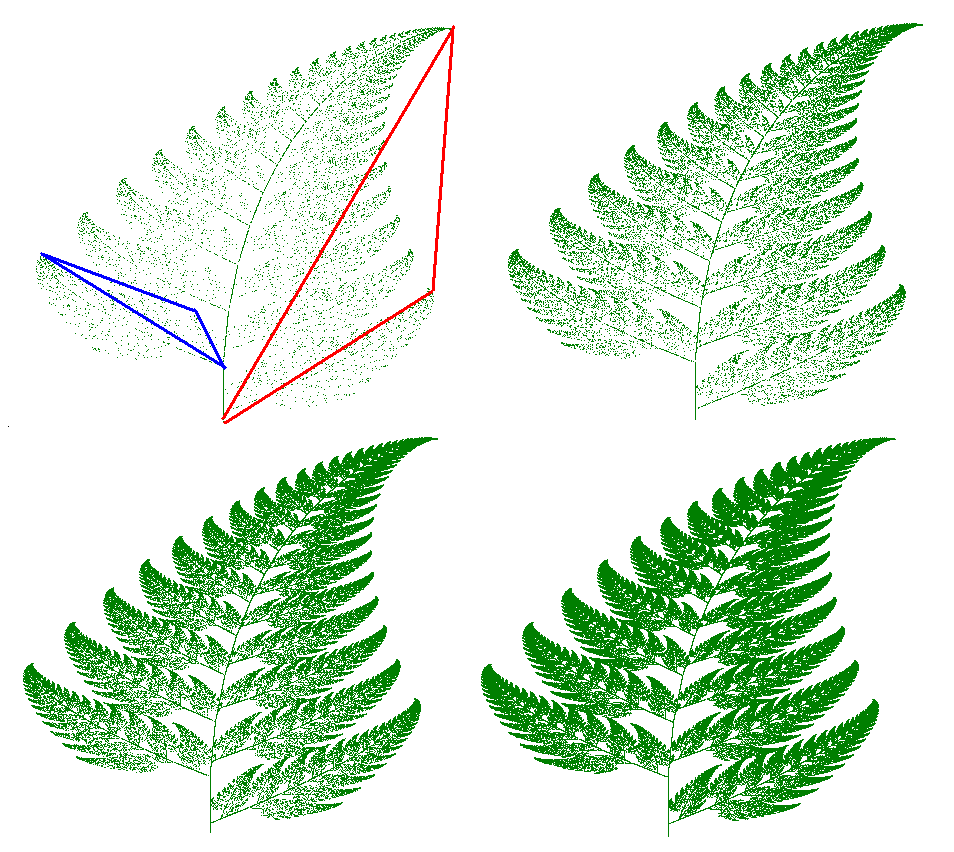
Finally, I'd like to mention that one of the reasons I've been thinking about botany and biological systems is that I got a job at a local garden nursery! I'm very happy to be working again, it keeps me busy and makes me happy - and tires me out. I'm easily the least knowledgeable person on the staff when it comes to plants, so I've got a lot of work to do to increase my competence. Perhaps there is a clue in procedural generation somewhere. I can grow my knowledge like sweet fractal fern. Or something :)
Very happy to chat at you all, have a great day,
-D
P.S. Other games I know of using procedural generation: Rogue and Rogue-Likes, Proteus.
Saturday, July 20, 2013
Game idea: Gardening Simulator
Alright, I've heard of 'Farmville,' so please don't remind me about it. My official stance on Farmville is: I don't care. I don't care about Farmville. I tried to play it for about a day and I stopped caring pretty quickly. Which, of course is the death of any good farm and or garden. You have to care.
I do, however, have a garden in my back yard. I've got tomatoes, basil, marigolds, kale, chard, lemon cucumbers and yellow squash. Or at least, I have the plants for them-- they haven't yielded much in the way of fruits. Anyhow, I enjoy gardening. It really isn't much different from certain types of gaming. I think of tower defense, RTS, and Sim City. You plant your units, you maintain your units against the ravages of enemies, bent on beating them to the ground. Each unit has a different property, and many times they will require certain appropriate conditions to upgrade them and turn out different results.
Gardening is very much like that. The sun, while an important ally, is also an enemy. It will dry out the plants and burn them. You have to keep them steadily supplied with water in order to compensate for the heat of the sun. However, it is important not to over manage the garden. If you water too much, you will rot out the roots, and kill your plants that way. The balance is delicate. I can't say I've seen this feature in an RTS or other sort of game; a way to overwater, or otherwise worry a unit to death.
Oh, here's a two dollar idea for you: an app or a widget or whatever, for your phone or desktop, that is just a houseplant that you have to water. Just a stupid, simple game to keep a person mildly entertained once a day, twice a day, however. The benefit of a computer plant is that you can track your watering schedule. In fact, the system could double as a tracking system for your own watering -- you just have to be consistent about feeding the virtual plant whenever you feed your actual plant. It might work. I certainly know I'm on my computer and phone way more than I spend time with my plants.
Another element of the garden is pests. These buggers are... so buggery! And it's really tough to combat them. Marigolds have the property of being attractive to pests, and hardy. So they can divert some of the bugs to eat them. In addition, plants like Chard can usually take a beating from the slugs and the aphids. They're hard to kill, and usually produce a lot. But still, after all that, the fucking bugs can screw things up for my other plants, the once I want to eventually eat! It's a really tough balance, too, because if you want to eat something, it's really probably not a great idea to cover it in poison. But poison seems like the most effective method of driving the point across to those damned hungry bugs. There's also ladybugs, and apple slices and eggshells and other products. Nothing is perfect though.
And the bane of my existence, there are cats. Fucking stray cats. I love cats, don't get me wrong. I even love strays. But god dammit, I hate cat shit. I hate it in my garden. It smells bad, it's disgusting to think that a cat (probably my cat) is shitting around the tomatoes *I plan to EAT* and to make matters worse, there's toxoplasmagondii. Great. It has a name; why I shouldn't eat plants sitting in cat shit-soaked soil. Apart from 'ewwwww!'
Finally, there's the attention. It is very easy to slip out of consistency with gardening. Simply become distracted for a few days. It's not hard-- I do it all the time. Actually, a gardening tracker app would be useful to me when this happens, because I could pull up my phone and see my thirsty plant, and know it's been three days since I watered. It's not an exact science, but it's pretty darn ballpark.
So that's it for this idea. In summary, I would like a game that combines RTS and Sim City. Choose a plot, clear it, fertilize, plant. Water, fight bugs. Harvest. Find out what you did wrong. Seems pretty simple to me, and I think it's a series of mechanics that can be refined to a deep level. This is why I like the thought of making games: I can combine learning about a thing, with trying to express it using programming systems and graphics. Now I just need to work on that programming... And that graphics.
-D
I do, however, have a garden in my back yard. I've got tomatoes, basil, marigolds, kale, chard, lemon cucumbers and yellow squash. Or at least, I have the plants for them-- they haven't yielded much in the way of fruits. Anyhow, I enjoy gardening. It really isn't much different from certain types of gaming. I think of tower defense, RTS, and Sim City. You plant your units, you maintain your units against the ravages of enemies, bent on beating them to the ground. Each unit has a different property, and many times they will require certain appropriate conditions to upgrade them and turn out different results.
Gardening is very much like that. The sun, while an important ally, is also an enemy. It will dry out the plants and burn them. You have to keep them steadily supplied with water in order to compensate for the heat of the sun. However, it is important not to over manage the garden. If you water too much, you will rot out the roots, and kill your plants that way. The balance is delicate. I can't say I've seen this feature in an RTS or other sort of game; a way to overwater, or otherwise worry a unit to death.
Oh, here's a two dollar idea for you: an app or a widget or whatever, for your phone or desktop, that is just a houseplant that you have to water. Just a stupid, simple game to keep a person mildly entertained once a day, twice a day, however. The benefit of a computer plant is that you can track your watering schedule. In fact, the system could double as a tracking system for your own watering -- you just have to be consistent about feeding the virtual plant whenever you feed your actual plant. It might work. I certainly know I'm on my computer and phone way more than I spend time with my plants.
Another element of the garden is pests. These buggers are... so buggery! And it's really tough to combat them. Marigolds have the property of being attractive to pests, and hardy. So they can divert some of the bugs to eat them. In addition, plants like Chard can usually take a beating from the slugs and the aphids. They're hard to kill, and usually produce a lot. But still, after all that, the fucking bugs can screw things up for my other plants, the once I want to eventually eat! It's a really tough balance, too, because if you want to eat something, it's really probably not a great idea to cover it in poison. But poison seems like the most effective method of driving the point across to those damned hungry bugs. There's also ladybugs, and apple slices and eggshells and other products. Nothing is perfect though.
And the bane of my existence, there are cats. Fucking stray cats. I love cats, don't get me wrong. I even love strays. But god dammit, I hate cat shit. I hate it in my garden. It smells bad, it's disgusting to think that a cat (probably my cat) is shitting around the tomatoes *I plan to EAT* and to make matters worse, there's toxoplasmagondii. Great. It has a name; why I shouldn't eat plants sitting in cat shit-soaked soil. Apart from 'ewwwww!'
Finally, there's the attention. It is very easy to slip out of consistency with gardening. Simply become distracted for a few days. It's not hard-- I do it all the time. Actually, a gardening tracker app would be useful to me when this happens, because I could pull up my phone and see my thirsty plant, and know it's been three days since I watered. It's not an exact science, but it's pretty darn ballpark.
So that's it for this idea. In summary, I would like a game that combines RTS and Sim City. Choose a plot, clear it, fertilize, plant. Water, fight bugs. Harvest. Find out what you did wrong. Seems pretty simple to me, and I think it's a series of mechanics that can be refined to a deep level. This is why I like the thought of making games: I can combine learning about a thing, with trying to express it using programming systems and graphics. Now I just need to work on that programming... And that graphics.
-D
Subscribe to:
Posts (Atom)