Showing posts with label gameknot. Show all posts

Saturday, June 21, 2014

Chess Variants

The more I play, the more I think that Chess may very well be the greatest board game of all time.  As I play, I notice the incredible amount of narrative possibility in a game of chess.  If you stop to analyze and converse about every move in a game, then you can make a story around it.  

You can also use multiple games to make multiple scenarios.  Imagine one board represents two warring countries, while another board represents a single battle.  This is, of course, the obvious example of war and battle.  However, you could say one game represents the actions within a place, such as a high school, and the other board is a given classroom.  And while the pieces are placed in a way where they are opposing one another, the individual pieces may not understand why they are making the moves they are making.  Their awareness might be very limited.

Lately I've noticed a tendency in my play:  I like to move my pawns, and I like to protect my pieces.  Frequently I end up with very complicated boards with lots of pieces in random locations.  This makes it tough to keep track of everything, which can be an advantage or disadvantage depending on the relative skill at spacial management of the players.  I don't claim to have a lot of this skill, but I do like to test it regularly, and I think I may be getting better.

I noticed this because a different game I played involved a lot of trading of pieces, and now the board is nearly bare, but the game seems to be pretty balanced.  It's like we're starting the game with fewer pieces.

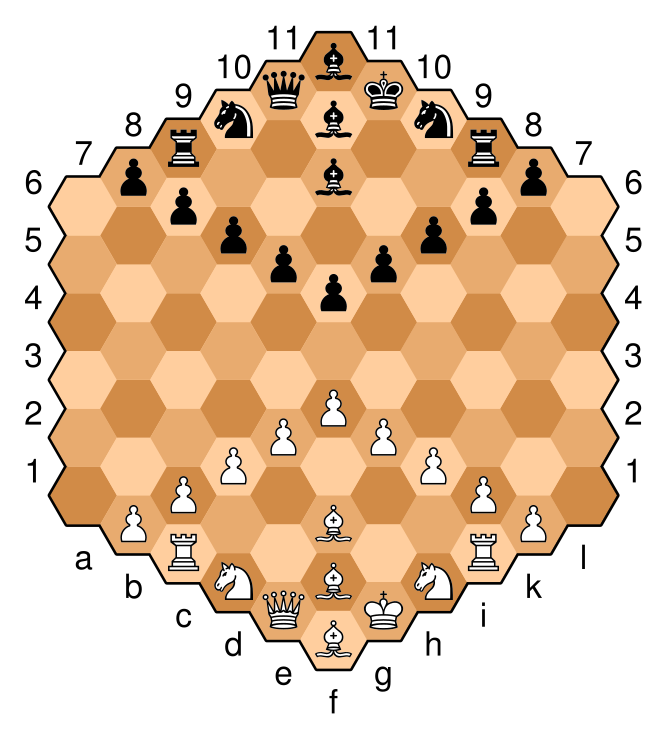
On that note, here are some Chess Variants.  The Wikipedia article on chess variants archives hundreds of different versions of chess.  I want to play them all and invent my own!  Just to see how they turn out.  


Actually, I have participated in the invention of a couple different chess games.  When I was a teenager, my friend Cortez and I made 'super chess' one day, using my giant (32" x 32") chess set. Just for fun, we changed the rules of chess, inflating the abilities of each piece.  Pawns can move like kings, still kill diagonally.  Bishops gained the ability to move to one adjacent space, thus changing which color tile they are on.  The knight can now skip over any number of pieces during the 'L' shape, thus allowing it to make really long moves if there are enough pieces in the way.  And the rooks could explode, killing themselves and all pieces adjacent to them.  We only played 'super chess' a couple of times, and it was fun, and strategy was completely out the window.  

Another time, my friend Ghost and I worked out a game that we ended up calling 'Samurai Showdown' in which we used a chess board and index cards to create a combat game involving fantasy classes.  This game was more akin to Final Fantasy Tactics, as each player had two actions: movement and attack. Free movement within a number of steps, attack and defense power.  Unfortunately, we balanced the game such that the Samurai was the only character with greater attack than defense, resulting in every game coming down to a battle of Samurai.  

A final Chess Variant came from a roommate of mine, who invented Beer Chess.  The rooks were replaced with beers, and the owner must drink the rooks when they are captured.  The deviousness of this game is that my roommate would be really really drunk when we started, and I would feel very guilty making him drink more, and this affected my strategy.  

As a past time, Chess Variants are a lot of fun, and I am happy to be reminded of the possibilities.  I think I will buy my chess sets in pairs from now on.  The game of chess has enough depth in it to survive and thrive on a world-scale for hundreds of years.  People know this game so well, that there is a book containing every move ever made in professional play.  That's a lot of play testing and also a lot of narrative possibility.  But with dozens of available Chess Variants, and hundreds more possible, there are that many more narratives to explore.  Perhaps most will self-destruct, as our Samurai Showdown version did.  But the search has its own rewards of joy and entertainment.  

-D


Saturday, January 5, 2013

Web CHESS


Please note: My esteemed colleague and co-blogger, life-partner J.Conian has been out for a bit, while his computer rehabs from its drinking problem.  In the meantime, I'm going to talk about chess and count the days until he returns to regular posting.


So, there's this chess website:  www.gameknot.com that I play a lot, and have been playing for several years.  My sister tykedyke turned me on to it.  It's pretty fun, and I've been playing chess a lot these days.  I'm sure there are a million and one online chess websites, but this is the one I use.   

The way it works is that players have anywhere from 2 to 14 days to make a move.  A player may participate in many different games simultaneously.  There are enough other users so that I usually have about five or so active games. I like this system, in part because I am compelled to view games in terms of 'one move at a time.'  Very often when it is my turn, I've forgotten what is happening in a given game, so I have to analyze the board and make my move all over again.  I feel like this is improving my chess playing skills.  But with a handful of games running at once, I usually don't have to wait long to take my turn on one of them.

Gameknot.com is a membership based site, and you will need to create a profile to play. Membership is free, but they've got two pay-membership levels: gold and silver. Basic 'free' memberships allow you to run a bunch of games, but only by joining other games already proposed by other players.  When a game is proposed it appears in a queue, and is marked 'looking for a challenger.' A player may join any number of these. With free membership, you are only able to submit one game at a time of your own.  I never find this to be a problem, as there are always a bunch of players waiting for opponents. Silver and Gold memberships allow you to propose as many games as you like, and perhaps some other perks that I don't know about yet.  I briefly had a silver membership, when I was feeling generous, but that didn't last long, and budget cuts set me back to the free membership.  

Another element of the player profile is that there is a point system that evaluates your ranking within the community. Everyone starts with a rating of 1200, and you gain and lose points as you win and lose games.  The points lost or gained are adjusted based on the difference between your total points and your opponents total points.  My current point count is 1065, and if I beat a player with 1300 points, I'm sure to get a big bonus.  But if I lose to that same player, I shouldn't lose too many points.  However, if I play an opponent with 935 points, the point ratio will be reversed, and I'll stand to lose more, and gain less.  I started with 1200 at first like everyone else, and was quickly knocked way down.  I think I bottomed out somewhere in the 700s, at which point I began my slow climb back up. 

My one concern about using video-chess is that I am becoming spoiled with the overhead view and flat pieces.  It is much clearer to me than playing on an actual board with actual pieces.  I find my brain gets more scrambled when I play real chess, and I am much more likely to overlook pieces.  That said, I still overlook plenty when playing chess on gameknot. 

Final notes:  There are tournaments and other special events, but I've never participated in these.  There are also daily chess puzzles, if that's your thing. Also, there is a sort of instant messenger client attached to every game, allowing you to talk to your opponent.  I rarely use this.  You can also create a friends list; I haven't done that either.  But it's never too late to start!  I just now requested friendship from my sister, tykedyke, after probably five years of using gameknot.

if you ever want to play a game of chess, my screenname is: drpottsiv


-D