When Turok the Dinosaur Hunter came out, there really weren't very many first person shooters (FPS) available for consoles. And, compared to today, there weren't very many FPS in existence. Turok was the first in the genre to be released for the Nintendo 64. It featured over-the-top violence, combat vs dinosaurs and really cool weapons. However, I think the most important feature, and most innovative, was the map overlay.
Unlike other common map features, which might require you to pause the game and bring up a subscreen, or be confined to a circle in the corner of the screen, Turok's map was drawn over the screen while you played. The small arrow representing the player was located in the center of the screen, and could also perform the role of an aiming reticle.
Oddly enough, the method never seemed to take, and I don't know of any games outside the Turok series that used this map style since. I really love this map. When I play Turok, I find a really cool mental zone where I'm watching the scenery and watching the map at the same time. It's almost like playing two games simultaneously, and it's really cool.
It helps that Turok is full of wide open spaces not too many enemies. When I get into that meditative zone, it doesn't seem to take that long to traverse the enormous levels.
As a sequel, Dragon Warrior 2 was a game that delivered. Nowhere is this more clear than the Overworld map. Allow me to... illustrate (pun intended.) Have a look at this:
In that little box there, is the original map from DW1. Yes, not only did Dragon Warrior 2 introduce Enemy Groupings, a party of three characters to play and a ship to cross the sea, but it also expanded the world map, so greatly that the entire map of the original game is able to fit in one corner of our new, expanded world. Each one of these additional continents is full of towns and dungeons for you to explore. You just can't beat that.
Enix could easily have invented a new world, of comparable size to the original. They could have introduced new features, or simple shuffled around the old ones. Instead they built a much larger world around the location of the original map, the inclusion of which is not only great for the sense of scale, but also a sense of time and history (Dragon Warrior 2 takes place 100 years after the first game).
-D
P.S. There is some loss of detail between the two maps. The continent of Alefgard is actually slightly smaller than in the first game. Hills no longer slow you down as you walk. But these losses are small in comparison to the amount of real estate you gain.
Dragon Warrior was released in the US in 1989 for the Nintendo Entertainment System [NES]. It was my first real taste of RPG gaming, and I enjoyed it thoroughly, whiling away many hours in the world of Alefgard. While I completed the game more than once, many times I would play through only a portion of the game, walking the same areas, collecting the same item, defeating the dragon and rescuing the princess. Repeat. In my inaugural edition of the Video Game Maps segment, I'm actually going to focus on two games: Dragon Warrior and Dragon Warrior 2*
Here is a map of Alefgard, the world of Dragon Warrior:
Cool enough world, several continental shapes, complete with geographic obstacles, and town tiles dotting the landscape. This seminal RPG took plenty of time to fight through. Cleverly, the designers placed a key item at the furthest point counter clockwise from the start, only to send you back the other direction to get to the final battle. The difficulty of the enemies increases as you travel further from your starting point. Because you had limited supplies, it was necessary to return to towns periodically to resupply your healing items and magic points. This leads to retreading a lot of ground, and an intimate familiarity with the landscape. I can still, at a glance, pick out the little patch of woods where you harvest gold from the appropriately named Gold Man.
Dragon Warrior featured a few landscape details. Water, can't walk on that. Grass, standard
walking speed. Hills, slow walking speed. Swamp, damage every step.
Mountains were impassable. Desert and forest were just like grass, as I recall.
However, in addition to appearance and walk-speed changes, different enemy encounters were often triggered by changes in landscape tiles. There is a really cool map with enemy overlay that you should definitely check out if it sounds interesting to you. That map and many other Dragon Warrior details can be found at The Almighty Guru.
While assembling this post, I have enjoyed reveling in all these delightful details and memories. Dragon Warrior is truly a game near and dear to my heart, and I must restrain my enthusiasm in order to stay on topic. In my next edition of Video Game Maps, I will feature one of the best sequels of all time: Dragon Warrior 2.
-D
*please note: I will be using the name 'Dragon Warrior' as opposed to 'Dragon Quest' because the games that I played, way back in the 80s, were called 'Dragon Warrior.'
I've been thinking about maps lately. Fictional maps, specifically. Great fantasy authors like J RR Tolkein, L Frank Baum, George RR Martin and a newcomer named Ian Silva -- have grasped the power of maps to draw a viewer in and to lend a new dimension to a fictional world. I'd like to draw special attention to Ian Silva's Maps as they are the only one of this small collection that are of a Modern design, but they also contain a history of a fictional society, and 100 years of baseball records.
In the case of video games, maps come in different forms. Overworld maps in RPG games are the most prevalent, where players will navigate the continental structures of the given video game world. The navigation of an overworld is often aided by a sub-map which displays the entire planet, highlighting the players current position in a 'you are here' style.
There are also Dungeon maps, made popular in the first Legend of Zelda. And there is another style of map which you can find on a website I just found, called VGMaps.com - The Video Game Atlas. This website uses screen captures to map out entire games, from the NES, SNES and even Nintendo 64, among others. The database is extensive, and if you were a former Nintendo Power subscriber, you might lose some time wandering through their library.
VGMaps is an old site, it just celebrated its Tenth Anniversary. It reminds me of the old internet, when commercial interests hadn't moved in, and everything you could find was put there by dedicated people, doing it out of love. I miss that internet, but I don't think it's ever coming back. Still, there are sites like VGMaps, more like outposts in deep space, or oases in the desert. Or something.
Anyhow, go have a look, have fun. They're doing a Map of the Month thing, and the one for December is from a Japanese Sequel to Paladin's Quest that I never heard of. Enjoy
-D
So, given I'm not really playing any other games at the moment, (though I did take some time out to play Among the Sleep - it's awesome!) I'm just going to continue talking about Ultima for a while. This series gets a lot of love on the Internet- mostly for the PC versions, though the NES versions of Ultima III and IV get their fair share as well. Which I appreciate, since the NES version of Ultima III is the one with which I have the most experience.
I want to take a
moment to site a couple of significant elements outside the challenge of the game.
First is the party construction. In Exodus, you are allowed up to 20 characters,
each of which can be custom created. You form a party of four of these
characters each time you play. These characters level up independently
during play. This element really lent itself to some of the household participation I experienced with this game, as 20 characters was more
than enough for everyone in my family to have their own party of four.
That way we could contribute to a greater whole, while still remaining
independent. And we could just have fun creating custom characters and
stocking the barracks, as it were. That way different classes can be
available to the main players who are out accomplishing goals and
progressing through the game.
Another thing I'd like
to point out is the music. I think it's pretty damn good for an NES game. The
songs tend to be long and varied, much more so that their
contemporaries. There aren't a lot of tracks in total. I think that Exodus is often forgotten about in the annals of NES music.
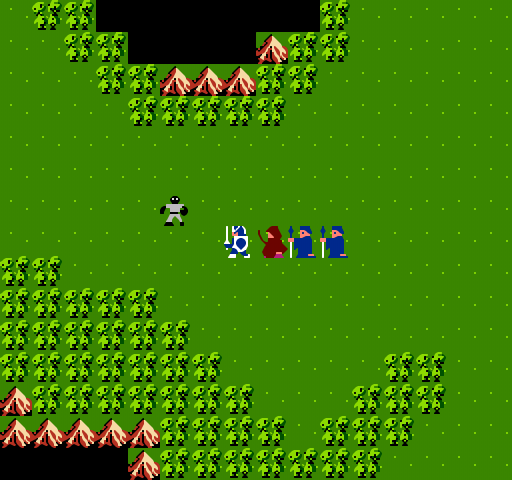
Finally, the graphics.
Sure, they're pretty crappy (though still way nicer than the PC version
IMO). But one graphic design element that I really like is the line of
site shadowing. Opaque objects such as walls, or mountains or deep
woods, will hide portions of the screen in shadow, because they cannot
be seen through, so the characters don't know what's on the other side.
I think this really deepens the sense of exploration in the game. I'd
love to see what Final Fantasy, or even better, Dragon Warrior would
play like with this design aesthetic.
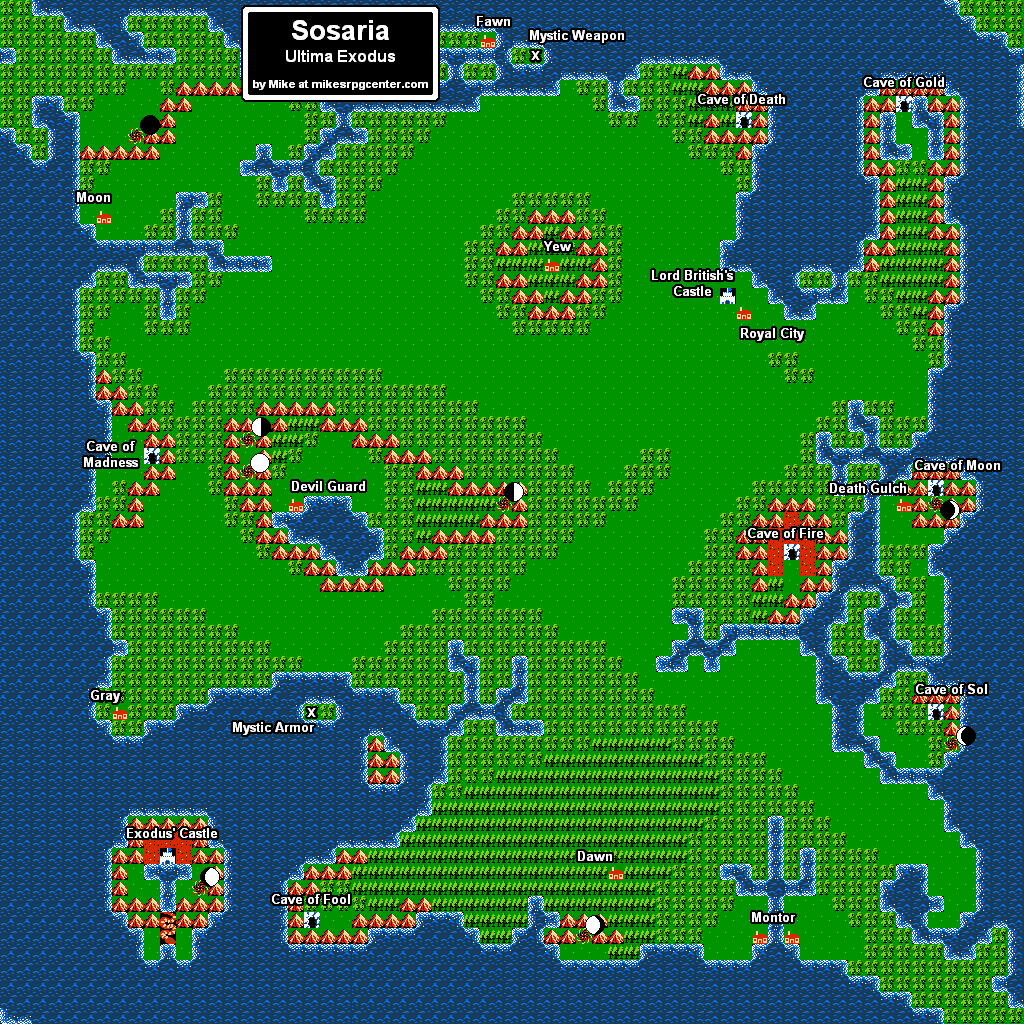
In parallel to that, I'd
also like to point out that the general map design in Exodus is nice.
There is a progression of wilderness that informs travel decisions.
The party starts out in a plain, where movement is unhindered. Winding
rivers creep in from the sides. Bordering the plain is some heavy
growth roughage, where movement gets a bit slower, making the party more
vulnerable to attack. Beyond the roughage is deep forest, which
obscures visibility and beyond that are impassible mountains.
I feel a definite sense
of danger the farther I wander outside of the open plain. However, it
is clear that I will need to explore the darker, more confined spaces of
the game if I am ever to get anywhere. I think these elements add up to a more active world map, rather than a passive one of many of Exodus' NES contemporaries. Though the Exodus map is rather small, in comparison.
Exodus is not without its many flaws. Of which, I forgive all. I am happily biased, and give the game the benefit of the doubt at every turn. After all, this was an important and formative game for me, and I wouldn't have it any other way. But hey, just for fun, I'll list a few of these flaws and make excuses for each of them.
Most of the character classes aren't worth playing. But they're still fun to build, and I appreciate having the option to explore the strengths and weaknesses of a class. The map is small, but well designed. The objectives are confusing, but the challenge to explore is its own reward. The story is non-existent, sort of. The difficulty at times seems as though its from bad design. Which is in the eye of the beholder, bad design can be viewed as another challenge to be overcome, if you so choose. And I do.
-D
Read Part 1 of my Ultima Exodus review.