Showing posts with label science fiction. Show all posts
Monday, June 15, 2015
TV Review: Farscape - season 1
Want some more Star Wars in your Star Trek? Then Farscape is the show for you. I'm assuming you not have already watched it, given it began its four-year run in 1999.
Farscape is an Australian/American production from the Jim Henson company. It may be worth noting that Brian Henson, son of legendary puppeteer Jim Henson, is the co-producer of the show. Farscape features a wide array of creative alien muppets, two of which are show regulars. It took me a little while to get used to the puppetry, but now I can't imagine the show without them. Additionally, Farscape features a great cast of unknown actors and some imaginative writing.
I'd classify the title as science-fantasy, rather than science fiction, but in the first season, the writers do play around with some great sci-fi concepts like time loops and multiple dimensions not to mention Moya, the living starship which is the primary setting for the action. The episodes that drew me in were more abstract and science fiction based, but as the show progressed, I grew to love the characters and be invested in them, Moya included. I suppose it's worth comparing the show to other shows like Firefly or Cowboy Bebop, in that Farscape is heavily character-driven, and the characters are all good-hearted outlaws.
I'd say my favorite characters at this time are Aeryn-Sun, the Peacekeeper and D'Argo, the Luxan. When I first saw D'Argo, I have to admit that I thought he was just some kind of knock-off Klingon. But even if that is what he were, he is still an excellent character, and well performed. D'Argo is a Warrior, but he is also a deeply caring person. Aeryn is a military grunt who shows signs of character growth that are intriguing. Because she lived a highly regimented life, being an outlaw makes for a tough transition.
From what I've heard, this show gets even better as it progresses, though I have really enjoyed it in the first season. It's a science fiction show with a lot of heart, that's not afraid to get weird. I recommend it to any fans of science fiction television looking for a new/old show to watch.
-D
Monday, April 20, 2015
First Impressions: Dead Space 2 (PC)
I've started Dead Space 2 twice. The first time, I made it 1h48m in then discovered that the Dead Space 2 game sold through Steam comes with three DLC packs pre-installed, which I did not know about, although it does not contain the Severed DLC which is a standalone prequel to Dead Space 2; Severed was apparently only released on PS3 and XBox 360 with no word as to a PC release. The reason I restarted was because I had thought that all of the free items in the store (as a result of the DLC weapon/armor packs) were supposed to be there and I equipped myself to the teeth right before a mini-boss fight. I would rather not play the game that way, so I started over with the intent of only buying items from the store as they become available in-game.
Dead Space 2 is fun at the present. There are a number of jump scares with necromorphs bursting through walls or environmental elements springing to life as you walk by, minding your own business. There are a number of modifications from the original Dead Space that I feel like I have to come to terms with in order to fully like this game.
The first major change is that the game is no longer told in separate chapters. In the first game, each time you boarded a tram to a different part of the USG Ishimura, you began a new chapter and you knew what your objective was. In DS2, at least up to chapter 4, you are following the guidance of a voice on the other end of your radio as you make your way through Titan Station (built around the remnants of Saturn's moon Titan) with no clear break between chapters. I recall seeing a "Chapter 2" pop up at one point, but I have not seen anything to denote that I had entered a chapter 3 or 4. I personally liked the individual chapters as part of a larger whole that made up the first game as well as the mobile game. The current less structured narrative makes me feel like I am just going from one area to another and killing hordes of necromorphs along the way, because that is what you are supposed to be doing in a video game.
I do like the present variety in necromorphs compared to those in DS1. It would make sense too (does it really!?) that not all off the mutated/transfigured humans would look like the same sprinting blood thirsty brute. You are on a space station that is full of residential living areas as well as industrial, religious and private sectors so the population is going to be different, which is something that I appreciate.
Maybe it's just me, but so far, I am getting a very Bioshock feeling from wandering around the Titan Station residential and commercial areas. It could be due to wandering through living quarters and that a space station with super-security-gorilla-glass would be somewhat akin to the glass used in an underwater city and the necromorphs are more perverted than the splicers, but they are still often sprinting monsters that jump out and want to annihilate you just because you have a prettier face. The point is, I don't want to be playing Bioshock, I want to play the sequel to Dead Space and I am not getting that feeling with only four hours in.
I was talking to Conklederp the other day about this and I decided that I am going to reserve my final judgement of the game until after I reach the end. I am still enjoying the game, despite how I have sounded through half of this article and I am also interested to find out if I have been intentionally mislead and that my impressions of the game will change later on. I am also interested to see how the previous stories from Dead Space: Aftermath, Ignition and Mobile all fit together and how they are presented, if at all, in this game that is a cumulation of all of those individual parts.
~JWfW/JDub/Jaconian
I Awake From Madness
![]() |
| Always be wary when the best items for sale are free. |
The first major change is that the game is no longer told in separate chapters. In the first game, each time you boarded a tram to a different part of the USG Ishimura, you began a new chapter and you knew what your objective was. In DS2, at least up to chapter 4, you are following the guidance of a voice on the other end of your radio as you make your way through Titan Station (built around the remnants of Saturn's moon Titan) with no clear break between chapters. I recall seeing a "Chapter 2" pop up at one point, but I have not seen anything to denote that I had entered a chapter 3 or 4. I personally liked the individual chapters as part of a larger whole that made up the first game as well as the mobile game. The current less structured narrative makes me feel like I am just going from one area to another and killing hordes of necromorphs along the way, because that is what you are supposed to be doing in a video game.
![]() |
| "Oh hai dere!" |
Maybe it's just me, but so far, I am getting a very Bioshock feeling from wandering around the Titan Station residential and commercial areas. It could be due to wandering through living quarters and that a space station with super-security-gorilla-glass would be somewhat akin to the glass used in an underwater city and the necromorphs are more perverted than the splicers, but they are still often sprinting monsters that jump out and want to annihilate you just because you have a prettier face. The point is, I don't want to be playing Bioshock, I want to play the sequel to Dead Space and I am not getting that feeling with only four hours in.
![]() |
| A physical representation of a Marker that size is never a good thing to come across in this universe. |
~JWfW/JDub/Jaconian
I Awake From Madness
Monday, April 6, 2015
Book Review: Dead Space: Catalyst
Dead Space: Catalyst is the second book written by American novelist Brian K. Evenson who had previously written Dead Space: Martyr, being the first in the chronological timeline for the Dead Space universe. And since we are bringing up chronology, let us put the books into context with the first game.
2214 - 2215: Dead Space: Martyr
2285 - Events in Dead Space: Catalyst take place, although since the book spans roughly 25 years, it can be assumed (Yes? No? Maybe?) that the events at the end of the book take place in 2285.
So as you can see, if you are looking to read about Issac Clarke's back story, or about what happened on the USG Ishimura during its 60 years in service before it came to Aegis VII or anyone/thing else directly connected with the what you played in the first Dead Space game, then you might be a bit disappointed.All of this aside, I thought Cataclysm was a well told story that was very well written. As I stated at the end of my review of Martyr, I am now even more interested in reading other works by Mr. Evenson, although I am afraid that it would be like reading anything else that George R. R. Martin has written that was not A Song of Ice and Fire related. I guess I would just like to read more of what Mr. Evenson has to say about the Dead Space universe.
What will follow from here may contain spoilers to both this book as well as the first game. Y'all have been warned.
Dead Space: Cataclysm follows the lives of two brothers, Istvan and Jensi Sato from their early teenage years, up through, what I would assume to be their early thirties. While reading the book, I cannot recall having any issues with Jensi Sato, the main protagonist and how the reader is introduced to the majority of events in the book. Looking back now, while I still do not have any real issues, I think I feel that Jensi existed primarily to take characters to important events and to be witness to what happens to Istvan. But that is the way some narratives work, that is how this narrative worked and it worked well to serve its purpose.
With Istvan Sato, I really felt that B. K. Evenson really excelled as an author. At least in the first half of the book. I am not one to diagnose anyone with any type of developmental disability, which is the extent to which Istvan's "mental problems" are described in the book. In the story, Jensi never states if his brother was diagnosed with any type of disorder or developmental disability, but Istvan's rational for seeing patterns or wanting objects to be in a particular order struck me as exhibiting actions similar to those who find themselves on the autistic spectrum. How Mr. Evenson justified Istvan's actions to himself was instrumental for allowing the reader to (hopefully) understand why Istvan was acting the way he was, that he was not the bad guy. It was just that people did not understand the obvious reasons why he did the things he was doing and he personally could not understand why it was not at all obvious to them as well.
One thing that always strikes me with a series that involves really bad things that always seem to be happening, especially when events are instigated by people, is why they keep letting these events happen over and over. This was a question that I had after finishing the first Dead Space game regarding the devotion of Unitologists. When your religious icon/object only seems to reanimate corpses into horrible machines of whirling death, why keep worshiping it and how did/would the church maintain its status as a powerful growing religion? Seriously, how/why do people keep seeing The Marker as a benevolent source of do-gooding? I feel this is where Brian Evenson has really excelled both in Martyr and in Catalyst. A lot of characters, when the story is being told from their perspective have said that the appearance of loved ones creates a overwhelming feeling of contentment and that they may be doing something unrelated to the knife in their hands that ends up killing them.
The last act of the book is where Dead Space the game comes into the story telling; as in necromorphs. Everything leading up to Act III is primarily character development with premonitions of all the bad things that I have come to expect from the video game franchise. I imagine this is where some people who want to read a written down account of the game, but this is a different medium all together where you can do things you cannot do elsewhere. Reading about someones inner thoughts and the reasons why they are jabbing a fork into their face while mumbling something about their grandmother whom they loved as a child is easier in book form than it is in any other format.
Going through the first Dead Space again after having read the first two books gives the characters in the game a lot more depth that I had not realized was not there. When I come across someone banging their head against a wall or slitting their own neck with a surgical saw, I no longer wonder why they would do this. Now I wonder who they were seeing that "convinced" them that doing this particular act was what The Marker wanted. Having read both Martyr and Cataclysm only fleshes out the Dead Space universe and, I feel, has only made the games better.
If you are not into science fiction, then this book probably is not for you. But, as a well written semi-psychological look at someone with a "mental disorder" who you might end up feeling for by the end all of which takes place in a science fiction setting, then you might find yourself reading a good book.
~JWfW/JDub/Jaconian
Deep In The Shadows You Won't Find Peace
If you are not into science fiction, then this book probably is not for you. But, as a well written semi-psychological look at someone with a "mental disorder" who you might end up feeling for by the end all of which takes place in a science fiction setting, then you might find yourself reading a good book.
~JWfW/JDub/Jaconian
Deep In The Shadows You Won't Find Peace
Saturday, May 10, 2014
First Impressions: The Mote in God's Eye (Book Review)
The Mote in God's Eye was written in 1974 by Larry Niven and Jerry Pournelle. There are 560 pages in the paperback edition I checked out from the library. I chose this book based on some echo of a memory that it was a significant sci fi book that maybe I'd like to read. The cover has praise from Robert Heinlein (Stranger in a Strange Land, Starship Troopers) and is described as 'the acknowledged masterpiece' of the team, a story of Mankind's first contact with an Alien Species.
This is an interesting book, different from what I usually read. It's really detail oriented, and military oriented, which sometimes makes it hard to read. It can be little bit of a slog. But when I am able to hang in there, there's some really cool sci fi. It reminds me a lot of Star Trek, there's even a Scottish chief engineer (...and a Scottish midshipman and Scottish Ensign, and an entire planet of New Scotland).
As in any good science fiction, there is fictional technology involved. The important technology to the human race is hinged around what is essentially warp drive, and a force field which helps to cool down the ship upon return from warp drive. These are the defining technologies of the human race, and enabled interstellar travel and colonization. Beyond that, there are lots of primitive mechanical technologies that seem pretty simplistic next to a different interstellar sci-fi world, like Star Trek. No transporters, inertial dampeners or tractor beams to be found.
In addition, the social development in the book is highly limited. As opposed to a world like Star Trek, the Navy is made up entirely of Men. The same can be said for the science teams. As of this point in the book, there is only one Human female in the story and at least a dozen named Male characters. At times it seems as though this book has more in common with a classic seafaring novel of the 18th or 19th century, (never my favorite genre) as opposed to a progressive science fiction series like Star Trek.
Some of the character's assumptions about the aliens are pretty boneheaded as well, they keep assuming they are mutations or somehow crippled. But it is fun to hear them be so far off the mark, and sit, smug in my assurance that the writers will reveal the truth to be much more interesting.
I am about a hundred and fifty pages in, however, and things have gotten really interesting. The high level of detail is an asset when talking about a new species of Intelligent Life. They deeply consider the alien's physiology, technology and social order. The writers release information slowly, leaving me hungry to learn more. The detailed treatment of the scientific exploration of a new intelligent species along with their careful unfolding of such information helps me to get through their, otherwise unappealing and rather primitive sci fi world.
This book isn't quite what I'm used to. I am eager to read more, but they are dragging it out a bit.
-D
This is an interesting book, different from what I usually read. It's really detail oriented, and military oriented, which sometimes makes it hard to read. It can be little bit of a slog. But when I am able to hang in there, there's some really cool sci fi. It reminds me a lot of Star Trek, there's even a Scottish chief engineer (...and a Scottish midshipman and Scottish Ensign, and an entire planet of New Scotland).
As in any good science fiction, there is fictional technology involved. The important technology to the human race is hinged around what is essentially warp drive, and a force field which helps to cool down the ship upon return from warp drive. These are the defining technologies of the human race, and enabled interstellar travel and colonization. Beyond that, there are lots of primitive mechanical technologies that seem pretty simplistic next to a different interstellar sci-fi world, like Star Trek. No transporters, inertial dampeners or tractor beams to be found.
In addition, the social development in the book is highly limited. As opposed to a world like Star Trek, the Navy is made up entirely of Men. The same can be said for the science teams. As of this point in the book, there is only one Human female in the story and at least a dozen named Male characters. At times it seems as though this book has more in common with a classic seafaring novel of the 18th or 19th century, (never my favorite genre) as opposed to a progressive science fiction series like Star Trek.
Some of the character's assumptions about the aliens are pretty boneheaded as well, they keep assuming they are mutations or somehow crippled. But it is fun to hear them be so far off the mark, and sit, smug in my assurance that the writers will reveal the truth to be much more interesting.
I am about a hundred and fifty pages in, however, and things have gotten really interesting. The high level of detail is an asset when talking about a new species of Intelligent Life. They deeply consider the alien's physiology, technology and social order. The writers release information slowly, leaving me hungry to learn more. The detailed treatment of the scientific exploration of a new intelligent species along with their careful unfolding of such information helps me to get through their, otherwise unappealing and rather primitive sci fi world.
This book isn't quite what I'm used to. I am eager to read more, but they are dragging it out a bit.
-D
Saturday, February 15, 2014
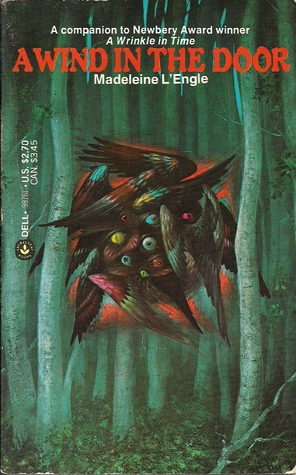
Book Review: A Wind in the Door
I was inspired to read this book when my friend Abazaba expressed interest in re-reading the full 'Wrinkle in Time' series by Madeline Le'Engel. We had both read the first book when we were young, and were curious about the series following. I found both the first book and 'A Wind in The Door,' the second book, at Beers Books, our local used bookstore. At one dollar apiece, I could not pass them up. So I gave my friend the first while I read this one.
In brief synopsis, the Wrinkle In Time series follows young teenager Meg Murry, her little brother Charles Wallace and the rest of her family as they go through a series of adventures with magical beings. The stories always begin at their home in the north eastern United States, but span across the length and breadth of the universe. The first book focuses on folding space to cross great distances, and A Wind in the Door focuses on the unification of all creatures great and small, from the sub-microscopic to the galactic.
This book contains some really cool science fiction ideas. Le'Engel discusses concepts of scale in a really intriguing way. When talking about scale in terms of Astronomy and Chemistry, the sizes involved are beyond basic human comprehension. We have to think long and hard to really understand that we are just a speck of dust in a sunbeam.
Le'Engel tries to connect the tiniest of the tiny - a cell within a cell within a cell, with the largest of the large: A solar system within a galaxy within a universe. She pulls this off masterfully, through a bit of metaphysics and storytelling that tickles the mind and the soul. The notion that a human can be a universe to a mitochondrion, which is a solar system for Farandolae is fantastic, and she even tries to work together the idea of communication between these massively different bodies. She uses metaphysical 'kything' to bridge this gap, which is akin to telepathy, and reminds me a bit of 'Groking' (Stranger in a Strange land, Heinlein).
As a reader, I am already prepared to accept these concepts and imagine them, so I'm not sure of how good a job Le'Engle does of describing them to a layperson. In fact, there are portions of the book that I think are pretty well ham-fisted. I suppose this is due in part to this being a children's book, where things are best presented in a simple way, and in short-run. But it's not the science fiction or the metaphysics that is troubling to me, it's the storytelling.
There are unbelievable and frightening characters, whom the children of the story are compelled to just 'trust' instantly because of some sort of spiritual energy coming from them. This is a problematic issue for me. On the one hand, I love the innocence of it, the cleverness of the character design, and the guts to make a sympathetic character have a frightening appearance. But on the other hand, as a reader, I do not immediately trust the characters, and I'm essentially forced to do so because the narrator insists on it. I don't really like that. This is what I mean by ham fisted. Perhaps with a bit more time to flesh the world out, I may have synced up with the characters.
I think it's awesome that Le'Engel was inspired by Mitochondria. And I do find comfort in her unified theory of love. The respectful synthesis of science and spirituality is a lovely thing. I think I would enjoy these concepts adapted to an older audience, with more elegant storytelling. I recommend a Wind In the Door to anyone who likes science fiction. I think it is the best in a very original series.
-D
Monday, August 26, 2013
Book Review: Dead Space: Martyr
Dead Space: Martyr is a novel written by American author Brian Evenson that chronicles the finding of the Black Marker and the "rise" of Michael Altman culminating in his founding of the Unitology religion. The book takes place in the early 2200's, roughly 300 years before the events in the first Dead Space game.
I really enjoyed this book, despite the obvious stigma of a book being written that was based from a video game. Keep in mind that I don't really have a problem with this media even though I don't have a real history with fiction based from a pre-existing movie or video game. I never read any of the Star Wars books. I had no interest in any of the Star Trek fictions and I'm not a real fan of fan-fiction. I understand their appeal, it's just not for me. On the other hand, I do read the comics that continue the twice cancelled show Jericho and I am two thirds of the way through the Chronicles of the Shadow War trilogy that takes place after the film Willow.
With all of that in mind, when I found out that there were novels that took place in the Dead Space universe, I was mildly intrigued. I loved the universe and the lore that I was introduced to in the first Dead Space game so the desire to find out more about this storyline was very tempting. I was, however, a little trepidatious about the quality of the books. I will admit that I was skeptical about how well the books would be written. If the story would be just a wordier rehash of the games (having only played the first game mind you). That was when I resorted to a resource that I rarely ever use.
I looked at reviews of the books, specifically Martyr on Amazon's page. I don't often look at book reviews and I can't really say why. (Is it hypocritical then that I'm writing one now?) I feel like there are people who will love a book, people who like it, and people who don't. And reading about someone not liking a book won't mean that it's a bad book, just that that one person didn't like it. What other books don't they like. What other books do they like? I feel like I want to know their background as a person before knowing if their review of a book will be relevant to my own tastes in books. Obviously I'm not going to actually do all of that background research on a single person before seriously considering their review, that's just too much work and I'm just too damn lazy.
So the reviews that I had looked up for Martyr were very favorable, and having now finished the book myself, I can agree on a number of points. First and foremost being that it is a very well written book. I was a little concerned during the first sentence when I was questioning if the author should have used "dove" instead of "dived." Once I got beyond that, I was able to fully enjoy both the story and the complexity of the overall story.
Dead Space: Martyr is basically the origin-messiah story of Unitologist founder Michael Altman. If you think of it as an author being told to write a Jesus Christ story in 374 pages and keep it interesting for the target audience who have most likely already played any one of the existing games, that's quite a feat. The story that B.K. Everson wrote was a good one. I was entertained throughout and once the book began to turn into an almost play-by-play of Dead Space footage, I could forgive this quick turn of events. Having already gone through Dead Space, I knew immediately which of the necromorphs were being described, the way they moved/attacked so I had a pretty good image of incidences in the book. I don't know what those passages would be like for someone who has never played any of the games.
I will say that the end of the book came up on me rather abruptly. I wish that there was an additional 50 pages that took place before Altman's martyrdom took place. There were a number of times that I thought I could see the direction Evenson wanted to take with Altman's supposed founding of Unitology that just didn't pay off in the end. Even interactions with some of the necromorphs I thought were playing a larger role than just a monster in the way. In the later chapters of the book, various characters are found to be using plasma-based tools/weapons that may not seem out of place in the 2200, but the fact that in 300 years, nearly the same tools are being used. You'd think that some advancements would be made by 2500 or maybe they should not have existed yet in 2200. One character does use a chainsaw (a nod to Doom maybe?), but it makes sense where it was introduced and it's application.
In the end, how successful was the book? Successful enough for me to have purchased the next book in the Dead Space chronology which was also written by B.K. Evenson, Catalyst. Additionally, I am now interested in reading other works that Mr. Evenson. Success.
~JWfW/JDub/Jaconian
Friday, July 12, 2013
First Impressions: Infinite Space (DS)
Infinite Space is a game that came out back in 2009, developed by Nude Maker and Platinum Games and published by SEGA. I recall finding out about the game from an article in the December 2009 issue of Nintendo Power. The glowing praise from the article coupled with seeing Vorlynx play hours on Eve Online and explaining game mechanics (despite my general dislike of MMORPG's), I really wanted to play Infinite Space.
Being the person that I am, I naturally waited too long before picking the game up and it seemed to fall into relative obscurity. I was able to find it on eBay, but the frequent "RARE" or "Out of Print!" tag that went along with the game's title always seem to drive up the cost of the game. While living in Northern California, any Gamestop that carried Infinite Space always seemed to be just far enough away that made the idea of travelling 100 miles round trip, just too damn far. For a while I'd given up ever trying to locate a reasonably priced copy of Infinite Space until one afternoon I was in a Gamestop up here in Oregon and happened to see a used copy for ~$12. I snatched that up faster than something that snatches up things really fast.
Presently I have put in 4h38m of play time and 6h21m of game time. Why the discrepancy? Because there have been times when I've been forced into combat and didn't come out alive, which was usually 20 minutes after having saved. I also started the game twice. The first time was shortly after I brought it home and played for about 30 minutes. A couple of weeks ago I came back to it and rather than try and figure out what I was doing, I just started over.
Right now in the game, I really feel like I'm playing a video game version of Firefly that was done better than a licensed Firefly game could pull off. In general terms, you are the pilot of a spaceship that you purchase after hawking a family heirloom. As the game progresses, you come upon new ships to purchase/acquire and are able to establish/build your crew by assigning them to positions that they are best suited for (each character has individual stats such as Engineering, Command, Medical, et cetera). I am travelling from planet-to-planet looking for work from bartenders. Thankfully my ships are refuelled/repaired every time I dock with a station while orbiting a planet free of charge, otherwise it would be too much like Firefly.
One thing about the game that stuck in my mind was that it apparently had a very steep learning curve. Like the harmonica, it's easy to learn to play, but you'd better learn quickly or you'll find yourself in a battle of the bands against John Popper if you're not careful. Or if you haven't saved in the last 30 minutes. This has happened to me a couple of times. Each time you come across a planet, you have the option to save. While travelling to other planets, celestial objects, you have a chance/risk of running across hostiles. Most of the time you have the option of battling x number of ships or escaping. A few times I've been forced into battle against people I am assuming are pirates and I cannot escape. Each time was following a battle that I was able to win although suffered plenty of damage to my ship, thus my ship was destroyed along with the money and experience I gained from the previous successful battle.
That's the thing with this game, you have to pay attention. During the battle sequences, you may be battling three other vessels who are all equipped differently and have differing ranges of fire. The battle screen is set up as such:
The vertically slashed area at the top shows the position of your ship (green bullet shape) to the enemy ship (yellow /green/red bullet shape) that you are currently focused on (which is selected at the top of the bottom screen), regardless if the ship you've selected is the closer of the x number of ships to you. The green/yellow/red meter shows which type of attacks you can perform on the ship you've selected, but only if they are within range; if you're not in range, you can't attack.
Within this linear space, you can move your ship forward or backward to put yourself within range or move yourself out of range of the ship that you've selected, all the while keeping in mind that the ships that you're not focusing on fighting can still fire at you if you are within their range, which is not displayed.
At the point I am at in the game, I do not have the special "Spcl1" command or the "Melee" option available to me. In fact, I just learned "Command 2" which allows me to have more than one ship under my command while in combat.
As I look this over, I can see that I would still have a lot to cover, even in a Full Review and I may have to break that up into two parts, like I did with The World Ends With You posts.
The last thing I will bring up is the music. The music itself is pretty good, about what you would expect from a science-fiction outer space RPG. The sound quality though seems a bit lacking. The music and sound effects often sound like there is a layer of static in the forefront. I only really notice this staticiness when I'm playing the game around people and I feel like I have to apologize for the strange noises emanating from my non-phone-gaming device.
So yes, I am currently very happy with my purchase of Infinite Space, even if it was published without blast processing. It's a very fun space RPG that is consistently reminding me of Firefly, and even if Kaylee isn't my chief engineer, at least I haven't come across any Reavers.
~JWfW/JDub/Jaconian
Monday, July 1, 2013
Full Review: The Starship Damrey (3DS)
I saw The Starship Damrey sitting all by itself a while ago in the Nintendo eShop. The title by itself sounded interesting, but it was the description of the game that caught my attention. I was told that The Starship Damrey was essentially a point-and-click game, but you are given no introduction. “With no tutorials, explanations, or hints provided, the game was created with the intent that self-discovery and experimentation be an integral part of the experience.” How to do things is all learned by "doing" in this game. As the disclaimer for the game says:
There are no explanations as to what button does what, the game is all trial and error. I realize that can be a turn off to some gamers, but to me it was a selling point. That's what I like, that the developers, Level 5 (Professor Layton series, Ni No Kuni: Wrath of the White Witch), have faith that the player will know what to do and if they don't that they will not be afraid to experiment. Now, with all that in mind, let's get down to our review.
Gameplay
The Starship Damrey is basically an old fashioned point-and-click game, like Shadowgate or Deja-vu, with the main difference is that you play in a three dimensional environment. The majority of the game is spent controlling a robot via remote with audio/video capabilities. You are able to "point-and-click" various objects around the ship although where you're going and what your mission is, is pretty much unknown for most of the game. One major departure from other point-and-click games is that the robot you control is only able to hold one item at a time. This might seem like a hinderance, but the issue only comes up once or twice in the game where you wish you could just learn to hold three things with your mechanized arm/hand.
There was one point in the game where I couldn't figure out how to "click" something that I knew I needed to click and had to look it up on gamefaqs, but I don't see it any differently than if I had asked a friend, "Hey, how do I do this one thing that I can't seem to do?"
Story
I'm going to leave this section almost blank as finding out the story is part of the game and the experience. I will say that the story is pretty well done for a short-ish three hour game. I will say though that the story was pretty engaging and everything that I initially had questions about while playing the game were answered by the end. Like, why the hell are you stuck in a box for the whole game?
There were only two instances during the whole game that I was forgetting about the story because I couldn't figure out what to do. It did take me out of the game as I started thinking about the mechanics of the game and tried to think like a game designer, such as "Now what would be the purpose of having a robot carry around a cookie tin filled with oil? If I were a game designer, where would I want the player to put this?" I'm not going to cite the game for that as it's supposed to be difficult and there were times when I went around to every room I could access and looking at every screen/view I could, trying to figure out what to do with that damned oil. Eventually I did figure it out (on my own) and felt very accomplished once I located, um, what it was that I was supposed to locate.
Graphics
I thought the graphics in the game looked great. I was very impressed, considering it was an $8 download game, albeit from a reputed developer like Level 5.
I don't know really what else to add about how the graphics were/looked. I was impressed; I thought they looked good; I felt the art fit the world and didn't seem out of place. It was a good looking game.
3D Effectiveness
The 3D effects in the game never felt overdone, blurry or even out of place. There wasn't anything that was flying out of the screen at you and I felt having the 3D slider at 50-75% helped to add depth (pun not intended) to the visuals. The game could be played just fine without the 3D effect turned on.
Most of the effect was in the visual screen of the robot in the foreground with the environment pushed out in the background.
Music/Sound
There is a very distinct lack of music in The Starship Damrey, which works very well. With the exception of one or two musical cues, all the sound in the game is ambient background noise and practical sounds. Everything that makes noise in the game sounds how I imagine a robot aboard a space vessel would sound. It was a pretty minimalist score.
Final Thoughts
I really enjoyed The Starship Damrey. It was a fun game that updated a style of gameplay that isn't made too much anymore. Because games of the early '80s had many limitations, point-and-click were pretty common, so to find that type of game today and not only looks great and plays great, but also expects a lot from the player and doesn't treat them like a novice, that's something that I really like both about the game and Level 5.
~JWfW/JDub/Jaconian
Friday, June 28, 2013
Full Review: Moon (DS)
I finally finished Renegade Kids' Moon a couple of weeks ago, shortly after I finished my initial review of the game and I wanted to have some time between that post and this. Because this is all very important information and why y'all're here. Now down to brass tacks.
Graphics
I found the graphics to be very good, considering that the game came out on the DS back in 2009. Obviously one should not be expecting 2009 PC quality graphics such as F.E.A.R. 2 or Borderlands. Keeping the platform in mind, Moon looks damn fine. Throughout the game, I did not notice any break in the graphics and there was no fog obscuring enemies in the far off distance. Moon also apparently touts a 60 fps frame rate, so if you're at all concerned that your eyes aren't being used to their fullest potential, you'll have no concerns here.
Gameplay
Moon plays like an FPS should on the DS and I feel it plays even better with the joystick. About halfway through the game I realized I was using the joystick as opposed to the directional pad, tried using the d-pad and quickly went back to the joystick. Moving with the joystick and looking around with the stylus on the touch screen was a very natural feeling. Firing with L button was a very natural choice. Switching between weapons (or choosing to use the Remote Access Droid) pauses the game, but only while the stylus is still touching the screen. If Moon had come out on the 3DS, the d-pad could have been used to cycle through your weapons, but since that's a moot point, there's no point in making an issue about it.
One thing that I had issues with (issue as in my ability as opposed to a problem with the game) was aiming at enemies at a distance. Even with non-automatic weapons such as the Huon Pistol, aiming at a moving target can be frustrating. I would also like to note that in the couple of missions that require you to drive the resident moon-mobile, I'm not a great driver. "Looking" is directed by moving the turret mounted on the tankified-moon-mobile while the d-pad/joystick control the direction of the vehicle. I often felt like Caboose trying to drive Sheila.
Again, Wikipedia notes that Moon is criticized for it's lack of multiplayer, but I personally don't feel that not having a multiplayer function hurts the game, this is of course comes from someone who doesn't play many multiplayer games.
Story
The story in Moon is of the kind that reveals itself over the course of the game. Early on, I got the feeling that I (the character) is some sort of astronaut-army-jarhead with the security clearance of a janitor. You know you're on the moon and that there are other soldiers/astronauts in your platoon, but that's about it. Oh, and initially why you're on the moon. But, then shit starts to hit the fan at an incredible rate.
Backstory/history in the game is found out through various computer terminals throughout the game and for most of the game I wondered why each computer screen only had a couple sentences of information and nothing else. This question was answered very late in the game, but not so late that I called bullshit on the whole thing.
At the end of the game, the story does give way to a potential sequel, which would be great to see on the 3DS and there have been whisperings about Renegade Kid working on another FPS for the 3DS.
In short and without giving anything (else) away, I really enjoyed the story. It worked for the game that it came from. Would it work in a book? Maybe. Would it work in a movie? Probably not without some retooling from Renegade Kid as opposed to a Hollywood exec. who knows more about science fiction than the people who created the game. Sarcasm.
Music
The music, composed by Gareth Vilday is very fitting for the game. Some stages the music consists of ambient background sounds/noises and other stages has pulsing bass notes that work their way into a melody of sorts. Often times the music sounds like it's being pumped through a headset in an astronauts helmet (as if I really know what that sounds like) and while the quality itself isn't all that great, it still works. I was never once distracted by the melodies or the quality of the music. It fits the game very well.
Final Thoughts
I had a lot of fun playing Moon. Conklederp will also tell you that I swore a lot while playing Moon. Both statements are true. Most of the swearing occurred while facing the Guardian II & III or which I did have to pseudo-cheat and look up information on youtube and gamefaqs. After I don't know how many gos at the respective Guardian, I didn't know what I was doing wrong. Turns out I just needed to used different weapons at different times, so basically stuff that I never did during the regular stages. I used the same tactic when going up against the final boss. Only after watching a couple of videos on youtube, I actually managed to get the boss stuck behind a pillar and in a way that it couldn't hit me with it's cannon
The boss was nice enough to give me time to get my phone (without pausing as I was afraid that if I paused it would "unlock" him/her/it) and take three pictures (this is the clearest). Shortly after this picture though, the boss finally moved and managed to take about half my life before I was able to kill it. You can't see it in this picture, but his life was a very (very) tiny flashing red sliver of pixel while my life is at full.
All-in-all, I put in 12 hours 46 minutes into the game, which I feel is a solid amount of time for an FPS, especially one on a portable device.In closing, if you're looking for a good solid FPS for the DS/3DS, pick up Moon at your local Gamestop or on eBay or Amazon.
~JWfW/JDub/Jaconian
Show Me The Way To The Next Whiskey Bar
Graphics
I found the graphics to be very good, considering that the game came out on the DS back in 2009. Obviously one should not be expecting 2009 PC quality graphics such as F.E.A.R. 2 or Borderlands. Keeping the platform in mind, Moon looks damn fine. Throughout the game, I did not notice any break in the graphics and there was no fog obscuring enemies in the far off distance. Moon also apparently touts a 60 fps frame rate, so if you're at all concerned that your eyes aren't being used to their fullest potential, you'll have no concerns here.
Gameplay
Moon plays like an FPS should on the DS and I feel it plays even better with the joystick. About halfway through the game I realized I was using the joystick as opposed to the directional pad, tried using the d-pad and quickly went back to the joystick. Moving with the joystick and looking around with the stylus on the touch screen was a very natural feeling. Firing with L button was a very natural choice. Switching between weapons (or choosing to use the Remote Access Droid) pauses the game, but only while the stylus is still touching the screen. If Moon had come out on the 3DS, the d-pad could have been used to cycle through your weapons, but since that's a moot point, there's no point in making an issue about it.
One thing that I had issues with (issue as in my ability as opposed to a problem with the game) was aiming at enemies at a distance. Even with non-automatic weapons such as the Huon Pistol, aiming at a moving target can be frustrating. I would also like to note that in the couple of missions that require you to drive the resident moon-mobile, I'm not a great driver. "Looking" is directed by moving the turret mounted on the tankified-moon-mobile while the d-pad/joystick control the direction of the vehicle. I often felt like Caboose trying to drive Sheila.
Again, Wikipedia notes that Moon is criticized for it's lack of multiplayer, but I personally don't feel that not having a multiplayer function hurts the game, this is of course comes from someone who doesn't play many multiplayer games.
Story
The story in Moon is of the kind that reveals itself over the course of the game. Early on, I got the feeling that I (the character) is some sort of astronaut-army-jarhead with the security clearance of a janitor. You know you're on the moon and that there are other soldiers/astronauts in your platoon, but that's about it. Oh, and initially why you're on the moon. But, then shit starts to hit the fan at an incredible rate.
Backstory/history in the game is found out through various computer terminals throughout the game and for most of the game I wondered why each computer screen only had a couple sentences of information and nothing else. This question was answered very late in the game, but not so late that I called bullshit on the whole thing.
At the end of the game, the story does give way to a potential sequel, which would be great to see on the 3DS and there have been whisperings about Renegade Kid working on another FPS for the 3DS.
In short and without giving anything (else) away, I really enjoyed the story. It worked for the game that it came from. Would it work in a book? Maybe. Would it work in a movie? Probably not without some retooling from Renegade Kid as opposed to a Hollywood exec. who knows more about science fiction than the people who created the game. Sarcasm.
Music
The music, composed by Gareth Vilday is very fitting for the game. Some stages the music consists of ambient background sounds/noises and other stages has pulsing bass notes that work their way into a melody of sorts. Often times the music sounds like it's being pumped through a headset in an astronauts helmet (as if I really know what that sounds like) and while the quality itself isn't all that great, it still works. I was never once distracted by the melodies or the quality of the music. It fits the game very well.
Final Thoughts
I had a lot of fun playing Moon. Conklederp will also tell you that I swore a lot while playing Moon. Both statements are true. Most of the swearing occurred while facing the Guardian II & III or which I did have to pseudo-cheat and look up information on youtube and gamefaqs. After I don't know how many gos at the respective Guardian, I didn't know what I was doing wrong. Turns out I just needed to used different weapons at different times, so basically stuff that I never did during the regular stages. I used the same tactic when going up against the final boss. Only after watching a couple of videos on youtube, I actually managed to get the boss stuck behind a pillar and in a way that it couldn't hit me with it's cannon
![]() |
| Life Pro-Tip: Don't Taunt The Game's End Boss. |
All-in-all, I put in 12 hours 46 minutes into the game, which I feel is a solid amount of time for an FPS, especially one on a portable device.In closing, if you're looking for a good solid FPS for the DS/3DS, pick up Moon at your local Gamestop or on eBay or Amazon.
~JWfW/JDub/Jaconian
Show Me The Way To The Next Whiskey Bar
Subscribe to:
Posts (Atom)