Showing posts with label Nerd. Show all posts

Monday, March 30, 2015

Star Trek: the Next Generation story arcs


I have the unusual opportunity to show Star Trek: TNG to a willing viewer who is otherwise unfamiliar with the series.  Yes, she's caught some episodes over the years, but only a handful.  Suffice it to say, I'm excited by the prospect.

Now, what we will likely do is to eventually watch the show from the beginning, but I've been given license to cherry pick some good episodes just to get a feel for the show.  I insisted on this, because the first season is just so godawful, I wouldn't want to lose her before she’s even begun.  Granted, we will be watching episodes from the first season, because there are plot points that you can’t avoid, such as the introduction of Q, Lore and the death of Tasha Yar.   But I hope to leave season 1 behind asap.

In the meantime, I’ve been having fun reviewing old episodes.  I love TNG.  So very, very much.  One thing I noticed from viewing the episodes in one big list, is that, while TNG didn’t have seasonal story arcs, as are popular in shows these days, they did have a great number of story threads working their way through the show.   And many of these stories are interconnected.  The Borg, for example, overlap with both Q and Lore.  But Lore also overlaps with the Crystalline Entity.  I’ve been having a great time stitching these episodes together.  Driven only by my initial fanaticism, I've managed to construct the following story arcs:

  • The Borg/Lore/Crystaline entity
  • Worf/Durass/Alexander/Deanna Troi
  • Tasha Yar/Sela/Spock


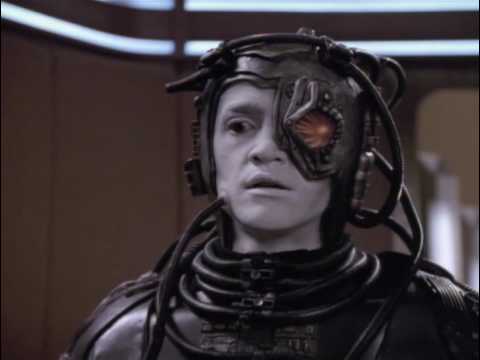
The Borg are an absolute must.  They're easily the biggest bad in the TNG universe.  The Tasha Yar story is the trickiest, as she was around for most of the first season, but it was a bad season.  It’s important to familiarize the viewer with her character in order to get the proper effect of her death and rebirth.  This is especially true in the episode ‘Yesterdays Enterprise’ wherein she receives another shot at life, and it is that element of the story which is so key to the episodes emotional impact.  Not to mention that the events of that episode lead to the birth of Sela.  Sela crosses over nicely with Worf’s Redemption story and with Spock’s reintroduction.  And of course, I'm looking for any excuse to include Spock.

And then there's the inclusion of the Troi/Worf romance, which may just be me being indulgent.  The writers drew those characters very slowly together, mostly through their mutual work with Worf's son Alexander.  But the growth of these two characters reached a head by the show's end, and I always loved that relationship.  


Granted, the more generous and inclusive I get with these storylines, the longer they get, and the more inclusive I'm driven to be.  This must be what it's like to invite people to a wedding.  If I include him, then I have to include her, and if I include both of them, then I have to include these other five.  
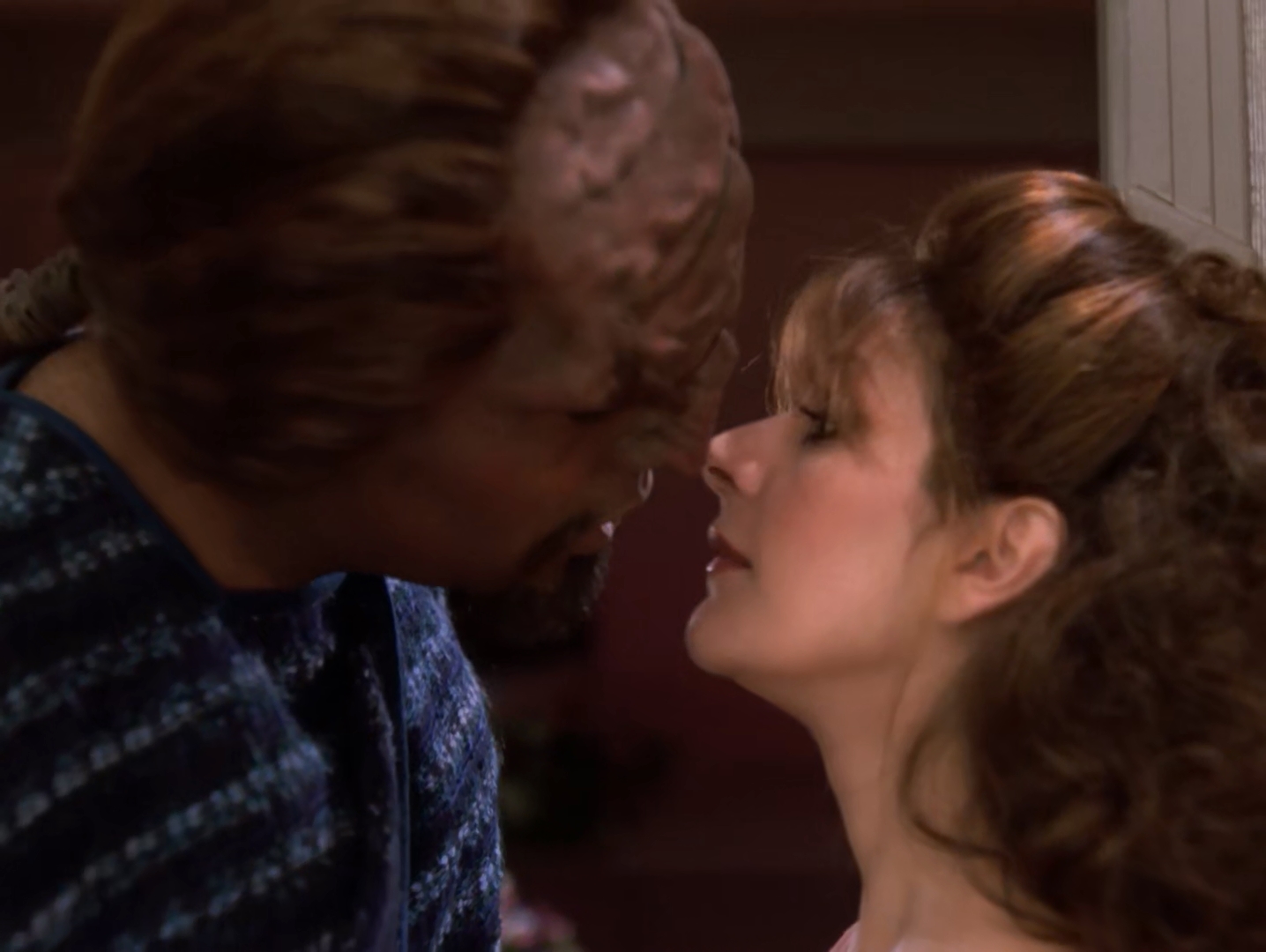
Sooo much subtle buildup to this scene

Still, in some cases, episodes aren't best shown right next to one another, so it's good to have some padding in between.  For example, QWho and Best of Both Worlds.  While they are the two episodes featuring the Borg in chronological order, there is supposed to have been an entire year between the two episodes, the time it takes for the Borg to travel from the Delta Quadrant to the Alpha Quadrant.  This time is important, because the Borg go from a distant, looming threat to an immediate danger of catastrophic proportions, with just enough time in between to get comfortable in the idea that maybe we aren't all going to die.   So, in order to solve this problem of padding between episodes without including a bunch of irrelevant or mediocre episodes, I would combine arcs.  

So far, I'm looking at 37 episodes, a bit more than a season's worth.  I could easily trim this down to 26 episodes, the length of a full season.  I've marked certain standalone episodes on the list below.  I chose to include these because they expand on existing themes, but aren't strictly necessary.  


So, without further ado, below are my personally constructed Star Trek the Next Generation story arcs.  Again, it is important to note that this is really just based on a fairly quick review of the episode list.  As time goes by, I may expand or pare down these arcs, in addition to adding others I haven't included (the Cardassians come to mind).  I plan to use these arcs to pick a series of stand-alone episodes outside of major story arcs.  

The season number and episode is listed to the right of each entry.  The episodes that are not strictly necessary are marked with an asterisk.  I included the first and last episodes as bookends.


  1. *Encounter at Farpoint- 1:1, 1:2
  2. *The Naked Now- 1:3
  3. Datalore- 1:13
  4. Skin of Evil- 1:23
  5. *Measure of a Man- 2:9
  6. QWho- 2:16
  7. The Emissary- 2:20
  8. Yesterday’s Enterprise- 3:15
  9. *The Offspring- 3:16
  10. Sins of the Father- 3:17
  11. *Sarek- 3:23
  12. Best of Both Worlds- 1 & 2 3:26, 4:1
  13. Family- 4:2
  14. Brothers- 4:3
  15. Reunion- 4:7
  16. Mind’s Eye- 4:24
  17. Redemption- 1&2 4:26,4:27
  18. Silicon Avatar- 5:4
  19. Unification- 1&2 5:7, 5:8
  20. *Ethics- 5:16
  21. *Cost of Living- 5:20
  22. I, Borg- 5:23
  23. *A Fistful of Datas- 6:8
  24. Birthright- 1 & 2 6:16, 6:17
  25. Descent 1&2- 6:26, 7:1
  26. *Parallels- 7:11
  27. *Eye of the Beholder- 7:18
  28. *All Good Things 1&2- 7:25, 7:26


 Listed by Arc:
*Encounter at Farpoint  1:1, 1:2

Borg/Data/Lore/Crystalline Entity  -  13 eps

Datalore  1:13
*Measure of a Man 2:9
QWho  2:16
*The Offspring 3:16
Best of Both Worlds 1 & 2 3:26, 4:1
Family 4:2
Brothers 4:3
Silicon Avatar  5:4
I, Borg  5:23
*Birthright 1  6:16
Descent 1&2  6:26, 7:1


Yar/Sela/Spock  8 eps
*The Naked Now  1:3
Skin of Evil  1:23
Yesterday’s Enterprise  3:15
*Sarek  3:23
Mind’s Eye  4:24
Redemption 2 5:1
Unification  1&2 5:7, 5:8


Worf/Duras/Troi - 12 eps
The Emissary  2:20
Sins of the Father 3:17
*Family 4:2
Reunion  4:7
Redemption  1&2 4:26,4:27
*Ethics  5:16
*Cost of Living  5:20
*A Fistful of Datas  6:8
Birthright 1 & 2  6:16, 6:17
*Parallels  7:11
*Eye of the Beholder 7:18

*All Good Things 1&2  7:25, 7:26


-D

P.S.  I think this might be the nerdiest post I've ever posted

Saturday, September 7, 2013

IRL vs gaming vs challenge vs fun

Typing about my imaginary Gardening game got me thinking about other In Real Life (IRL) activities that may be simulated in games.  There are some obvious ones:  Racing, for example.  I hear that Grand Tourismo series, and its competitors, are all about the ultra-realism in terms of physics.  I hear that Mario Kart is all about ultra realism in terms of fun.  I think they both succeed in their own ways.

But In Real Life, things are always way different from games.  For example:  In games, the risk-reward system is... well, skewed.  When you wreck your car, even in the most realistic of all racers - you don't die.  You don't break your pinky finger.  You're not even scarred for life!  Hell, for that matter, you probably get a continue or something.  This is an extreme example.

It's not just video games. In baseball, for another hyperbolic example, you aren't ritually executed when you are thrown out at first.  This is good, because being thrown out at first happens a LOT.  Hundreds of times every day during the regular season.  But playing baseball is WAY harder than playing video games.  Then again, it pays better, I think.  

But I guess I mostly want to talk about challenge.  There's a pretty fun article about challenging games over at Gamasutra.  I've been enjoying it.  It's got a lot of tasty retro stuff that I love.  It's a long article- thankfully presented in ten tasty bites- I've been reading it over a series of days.  It emphasizes skill building, and expertise at different games. I think I'm more interested in the quality of challenge in games, than the amount of challenge.

Sometimes the challenge is in achieving a perfect balance.  And that balance can be elusive. Following the garden example, proper watering is a real problem when nurturing a plant.  You can fuss with a plant so much that you kill it.  Smothering can be as bad as neglect.  It is this way in other IRL activities, like cooking.  There is also a fine balance struck with cooking.  You can definitely worry a dish into mediocrity, when leaving it alone may have produced something fantastic.  I do this all the time.  Are there any games that demonstrate this sort of delicate balance?

I guess I'm looking for something like this in gaming.  And as I'm typing, I thought of an interesting idea: Achievements .  That is to say, what if a game was released with no achievements whatsoever, and the achievements were submitted by players after they had made them.  Just submit a screencap, and the game moderators will decide if it is a worthy achievement.  Then keep a directory of them.  That could be fun.  Has a game done this yet?  I bet team fortress 2 has.  It seems like the kind of game that would do that.  Anyhow, I'm stumbling into seriously out of touch zone, so I should shut up.

But yeah, it's fairly obvious why many IRL features aren't included in games.  They don't sound fun at all.  Like, for example, the RPG trope of 'life points' and 'potions.'   Got a gaping wound in your belly?  Down a couple potions, you'll be fine.  Life doesn't even closely resemble that.  Most of us don't deal with gaping wounds, just scratches and tiredness.  Food helps, and caffeine, but there are no potions.   There is Nothing that works like that.  

And, like I said, it doesn't sound fun to have to rest your RPG characters because they're tired from walking around all day.  A game where your characters need Exercise, a balanced diet and plenty of rest. BO-ring.  And yet, somehow it sounds interesting to me, to balance the in-game system with more realistic needs.  I often find myself contemplating Player Stat and Item systems for imaginary RPGs that are more realistic, somehow.  I think this means I am a giant nerd

-D

Sunday, April 21, 2013

The Question of Geek or It's all Geek to Me - a response

 This post is a response to my blogging colleague and good friend's post:  What does it mean to you?

I think part of the problem presented by the meaning of Geek is connected to what Felicia Day presents as a concern: that Geek has become over-commercialized.  It's like Geeks were these rare and beautiful jewels, who were content to sparkle and be pretty and perhaps be set into the inlay on an elder blade, or curse a hapless treasure hunter.  But what ended up happening is that the world of business discovered that these jewels have monetary value, and can be traded for bucks.  And now they are circulating, and circulating. What once had to be stolen from a crypt in the amazon is now available for $4.99 on amazon.com. 

And to make matters worse: when something that used to be precious is now a commodity, it's hard not to begin to question authenticity.  I think this is where the phrase 'you're not a real...' - something or other - comes in.  There is a fear of receiving the fools gold of geekdom.  It's a legitimate concern, though I think some take it too far. 

I feel a certain frustration when I hear people toss around 'Geek' like it's something to be proud of.  It's hard to see that something that felt very costly to me as a youth claimed loudly as an adult.  However, I don't really think it's appropriate to publicly question someone's authenticity as a person, either.  That can be harmful.  Besides, for all the rejection I felt when I was young, I had at least an equal amount of connection-  I never went to a Star Trek convention alone.  

Now that I'm a grown up, with an adult life and adult job, the labels Geek and Nerd don't worry me too much anymore.  It's my 'adult' concerns that eat up the majority of my attention and identity. Or maybe I've just gotten really good at hiding it.  I certainly understand why it is a concern for Felicia Day, who has named her channel 'Geek and Sundry.'  If the term 'Geek' becomes watered down, where will that leave Felicia?  

I once read an article, way back when smartphones hadn't invaded, Steam really hadn't caught on, and Futurama was still canceled.  The author of this article had firm definitions of Nerd and Geek.  In it, they defined the Geek as the tinkerer, the one who could figure out how things work, who knew the computer coding language, who could do the advanced math, applied or no.  And the Nerd was the collector.  The one who consumed vast quantities of media and knowledge, and had it all organized, but didn't necessarily have any practical use for it. 

I think a dork was somewhere in between.  If there was a label that I identify with on the Nerd Continuum, I think it would be dork.  I just don't get it, I don't really mind that I don't get it, and I really hope you leave me alone about how I don't get it.  I do like stuff though, and if you ask about it, I will totally tell you all about it.  I guess it's kind of like Aspberger's Syndrome, which is on the chopping block for the DSM V.  Did I just wrinkle your brain? No?  Oh.  okay. 

I can't help but think I'm forgetting something.  I thought long and hard about this subject all day.  I guess I don't have to cover everything in just one try.  Anyway, Geek = label given to me as a kid.  Bitterness.  As adult it is now a good classification... whaaa?   The end. 

-D

Currently Playing: Final Fantasy II (NES)

Classify this.  Or just check the page out, it makes me feel better about things.


Friday, April 12, 2013

What Does It Mean To You?

I figured I had better put this post up before it becomes irrelevant, although talking about what a word means to ones self can't really become irrelevant.  A couple of weeks ago, Felicia Day posted an update to her Youtube channel, Geek & Sundry, she rhetorically asked what "geek" meant to her.  There she listed off a few descriptive words like "Outsider, Dreamer, Creator, Rebel, Fighter" versus what she feels the word Geek has taken on in the larger media, such as "Cliche, Monetize, Brand, Exploit."

I liked a lot of what she had to say, but I kept in mind that she was saying what geek meant to her.  I didn't feel like she was saying that "This is what Geek means and this is how the world should see it.  Now!"  That point of view would go against the whole point of her video, that "it's a person who dares to love something that isn't conventional" and that "your judgement is not my problem."  That I like, and that's as a whole is what I took away from her two and-a-half minutes.

This brings me to my next point, although it's less of a point and more like a "bullet point."  A lot of people have their own definition of what a geek is and what constitutes that that person sitting by themselves over there is a geek.  Or how about a nerd?  Earlier this year, Portlandia made a mock PSA that was about the word and association of "Nerd."  This type of "thing" could be made for just about any group who feels that their moniker has either been used incorrectly or abused by any other group.  I'm not saying that such corrections are unwarranted, I guess, something, I don't know.  And what makes someone a geek and not a nerd or vice versa?  Likewise, what makes one person a gamer and someone accusing someone else that they aren't because of X, Y and R?

And now I've tread into very dangerous and accusatory ground.

I feel it all comes down to labeling.  One person's labels may not coincide with another person's and that person may already have negative connotations towards any one of labels you throw at them.  Hippie?  Metalhead?  Hipster?  Gamer? Golfer?  Secretary?  Tea Bagger?  Chances are you formed what you personally feel is a stereotypical image of what that person looks and possibly acts like. Is it the right or wrong view of that person?  Is your view politically correct?  Does your view of any of the above possibly conflict with someone else' view?

And you know what, I'm guilty of it too.  I've said, "Fucking hipster" to myself while driving and have been cut off by a person riding a fixed gear bike on the 33rd block of Hawthorne.  In a very similar light, I'm as guilty as the girl scoffing at the guy sitting on a bus playing a game on his PSP Vita and thinks "stupid nerd" when he doesn't move allowing her to sit in the last open seat on the bus.  This idea of visual perceptions of people reminds me that I want to talk a little bit more about this, but I will save that for it's own post.

But going back to what "geek" means to Felicia Day, myself or you the reader, it's a potentially touchy topic. I could say, let it mean whatever you want it to mean for you, then someone else could say that "you can't just assign any meaning you want to geek, that's not how language works!  You can't say that "bacon" now means "french fries covered in cheese curds and brown sauce" because that's it's own thing already."

So where does that leave us?  This discussion isn't going to be solved in a single article or blog post, or youtube video and I don't think it really needs to be "solved."  It just is.  And who am I to come to such ambiguous conclusions?

I'm a person who loves video games (RPG, FPS, Survival Horror, Puzzle, Racing, Action, Flight Simulators, Adventure, Platformers, Point-And-Click, Simulation), music {Metal [Gothic Doom, Progressive, Doom, Death, Battle, Epic Heathen, Melodic Death, Black, Symphonic Black, Blackened Death, Meloic Black, Power, Folk (Scandinavian, Russian, Celtic), Pirate, Viking], Rock, Hard Rock, Movie Soundtracks, Video Game Soundtracks, Broadway Musicals (not a fan of Cats or Rent), Classical, Baroque, Folk [Irish, Scottish, Russian], Klezmer, Parodies, Classic Rock, Indie Rock, Latin Pop, Punk, Alternative Rock, Grunge Rock}, reading [Science Fiction, Fantasy, Horror, Mystery, Fiction, Historical Fiction, Apocalyptic Fiction, Contemporary Fiction, Mythology (Celtic, Norse)], painting (Miniatures, Ceramic Figurines), watching movies [Horror, Science Fiction, Fantasy, Dystopian, Comedy. . .

Under what category would I be placed?

~JWfW/JDub/Jaconian
The Likes Of Us All