Wednesday, March 27, 2013

A Boy and His Blob: OverClocked Remix


OverClocked Remix
I don't really have a full post, but I have been sitting on this link for a while. It's a page dedicated to compiling remixes of video game music. The archive is massive and growing all the time.  I particularly like that you can sort by system and by game.

The above video is a remix of the main theme of A Boy and His Blob.  I chose it because it's a great remix, and A Boy and his Blob is sort of our 'patron nes game' here at Two Boys and Their Blog. (get it?) 

Give it a listen, tell me what you think.  

Monday, March 25, 2013

Full Review: Organ Trail - Directors Cut (PC)


First off, I'm going to have to try very hard not to inundate this post with pictures every other paragraph, but I will be putting up a handful of pictures, because it'll help illustrate some stuff.  And now, a picture of a station wagon fording a mob of zombies:
Professional Driver on a Closed Course: Do Not Try This at Home.
Organ Trail - Director's Cut is an awesome game and I would say "primarily if you were alive in the 80's and played Oregon Trail on an old black and green computer", but this game is so much fun that it probably doesn't matter which decade you hit puberty in, it's a really fun game.  Unless you only like games that have cutting edge graphics, spoken dialogue and requires the use of at least ten keyboard buttons or a gaming controller.  If you're one of those people, keep reading and send me your rants care of "I don't."

That being said, here's another picture, this one of your station wagon at the beginning of the trip:
It's not a spoiler if it happens in the prologue.
If you don't know the "dysentery" reference, then you truly haven't lived.  Or had dysentery, which I thankfully haven't as it doesn't sound all that fun.

So Organ Trail - Director's Cut, a game from The Men Who Wear Many Hats is a brilliant parody of the Oregon Trail computer game  by MECC, specifically the version that came out in 1985 for the Apple II.  Everything from bringing along supplies that fit in with a zombie apocalypse road trip (fuel, food, ammo, car parts, et cetera) have been included to mimic the original supplies (oxen, food, ammo, wagon parts, et cetera).  The story for the game is pretty simple too, if you haven't already figured it out.  Zombie apocalypse throughout the United States.  You hear that there's a "Safe Haven" somewhere on the west coast (and the location is about where Oregon City is actually located).

Upon my first playthrough, the biggest problem I has was how to shoot the gun.  I should also mention that the controls for the game are somewhat simple, despite the contradiction with the previous sentence.  Most of the game is played with the mouse, pointing and clicking.  During scavenging excursions, you move around with the WASD keys although the game allows to be played with only the mouse, but I've refrained as I like the handling of the WASD keys.  The firing of the gun, again, is where I had the most difficulty at first.  The game tells you that when you want to shoot, you have to "pull back to aim - release to shoot," which itself sounds pretty intuitive, but I couldn't get the hang of it at first.  Here's a handy picture with notation on how shooting works:
It's a quick diagram, not an instructional diagram from the NRA.
So you have to click in front of you and pull back until the arrow is behind your character.  You then aim as if you were steering a boat, in that left is right and right is left.  It's like you're holding the butt of the gun and aiming that way instead of moving the barrel.  On my second playthrough though, I felt a lot more comfortable with aiming and shooting.  So much so that I felt I could go up against Medium level of zombie activity and hold my own.  The second time I was able to make it as far as Safe Haven although I died in the final encounter/challenge (no spoilers).

The entire game took me about two hours from start to finish, although a large part of that for me was spent on the side of the road waiting for someone to show up and trade me anything I had for some fuel, which I had run out of.  No, I wasn't an idiot, but there were some random encounters where I lost fuel, such as "A fuel can went missing" or something along those lines.  And for random encounters, there are all sorts to be had.  From coming across tombstones along the side of the road, helping (or not) stranded survivors or people farting in the car.  
There are also plenty of pop culture references to various zombie fare media.  From Evil Dead, Left 4 Dead, Zombieland and Shaun of the Dead (only to name a quick few), the game has a great sense of humor and knows their audience.  And you may have also noticed in the farting picture that there's the Twitter logo in the upper right hand corner.  Anytime during the game, you can tweet (from your own Twitter account) what is happening.  I found this to be a smart marketing strategy, especially over this last weekend at PAX East, of which Organ Trail was part of the PAX10, a group of independently developed games picked by Penny-Arcade to showcase during the expo.  It'll be interesting to see how long tweets from the game will be made within the next year.

I feel like I can't do a review of a game without talking about the music, which in Organ Trail was composed by Ben Crossbones.  The music for the most part is what you would expect to hear from a mock up of a 1985 computer game.  I say "for the most part" because the songs start off with standard chip-tunes style instrumentation (bleeps, tones and static sounds) and after about a minute, a more MIDI sounding bass and drums will come in, if anything to remind you that you are not in fact, living in 1985, but 28 years in the future.  Yes, it's been that long.

If you haven't guessed already by now, I highly recommend purchasing this game.  If you are in lack of funds, you can always just visit The Men Who Wear Many Hats' website where you can play a free flash version of the game.  The controls and some of the place/location cards are missing and the set up is all keyboard based, but the heart of the game is still there.  Plus it's free so it's kind of hard to gripe about a free version of a great game.  And while you're there, you can also check out some of the other games that TMWWMH have come out with over the years.

Have at.

~JWfW/JDub/Jaconian
We'll Be Together Again


Or maybe not. . .

Saturday, March 23, 2013

First Impressions: Thomas was Alone

In one sentence, my first impression of Thomas was Alone: 

"What if Winnie the Pooh author A.A. Milne had raised his son Christopher Robin playing on an early 1980s computer instead of wandering their country home in East Sussex?"  


Thanks to Destructoid for this image.  http://bulk2.destructoid.com/ul/230948-review-thomas-was-alone/Clipboard22-620x.jpg

Thomas was Alone is adorable, to say the least.  The soundtrack is lush.  The narrator is entertaining.  And the graphics are simply beautiful.  

I have an affection for minimalist game design, as my love of games like VVVVVV, Proteus and even Angry Birds can attest.  Thomas was Alone is fantastically minimalist and yet contains plenty of heart.  The main characters are a series of rectangles, each with slightly different abilities; helping them to work together to overcome obstacles, solve puzzles and complete levels.  The controls are a very basic: left, right, jump and switch character.  Each level is accompanied by a narrator, describing the inner monologues of the characters involved.

This narration does a lot to drive the action forward.  I played through to level 3.6 on my first play, and had to make a conscious effort to put the controller down.  The narrative, graphics and game mechanics are all tied together, as the different quadrangles' personalities are informed by their shape and their abilities.  At this point in the game, I'm particularly fond of Chris and Thomas' relationship; as Chris is frequently dependent on Thomas to get around, and that flies in the face of his general bitterness and resentment.  Adorable.  

Other Notes:  
I originally thought that the soundtrack was a little overbearing, but that subsided after passing the initial practice stages.  Also, turning the BGM down to 0.9 volume.  Now I think it is perfect. 

The gameplay is straightforward platforming.  The only issue I ran into was switching between characters, but I will easily resolve that issue with practice, and by reprogramming my controller.  

I'm already full of goofy ideas to improve this game - which is how you know I really love it.  Multiplayer option and level editor for starters.  Great for a sequel or expansion... =D

In honor of Jaconian's Birthday, Thomas was Alone, Proteus and a whole slew of indie games are on sale at Steam.  If you're a Steam user, you probably already know this, but if not, this may be a good week to become one.  Sale Ends 3/29.  

-D

Friday, March 22, 2013

First Impressions: BIT.TRIP.SAGA (3DS) Part II: Runner, Fate & Flux

This is Part II of a two part review of the BIT.TRIP.SAGA game by Gaijin Games for the Nintendo 3DS.  Part I of the review can be read here, which covered the first three games in the series, BEAT, CORE and VOID, while this review will cover RUNNER, FATE and FLUX.


My review of RUNNER will be solely from the perspective of the 3DS game and not comparing it to the PC or Wii edition.  I will mention, however, that I was a little bit weary about purchasing BIT.TRIP.SAGA because of some negative reviews on Amazon.com about lagging in RUNNER and comparing to how it played against both the Wii and PC versions.  I will say that I have not experienced any lag or skipping frame rates in either 3D or 2D mode.  I typically play with the 3D slider set at about 75% of the way up, unless I'm too distracted by  all the bits and debris flying at the screen and then I'll turn in either down or off.  I will also add that when first playing this on the PC, I felt that it would be an amazing experience on the 3DS and I feel that I was very much right.

All that aside, RUNNER is a great game with an amazing soundtrack.  The game plays like a rail-platformer set to music.  Whenever you miss a jump, run into a wall, get hit by flying beats or fall down a pit, you don't die, the music doesn't stop, you just get flung back to the beginning of the level, all with the music continuously playing.  One might find this to be tedious, having to start over because you were hit by a stray beat, but for me, I feel motivated to play more to hear the music increase in complexity.

Like any platformer, some levels are harder and/or longer than others and there are times when I feel too frustrated and have to switch to another game or just shut the 3DS completely, but that doesn't happen very much.

FATE plays like another throw back to older shooter arcade-style games like Gradius or 1942.  The big difference, is that while it is a rail-shooter, it's more of a double rail shooter.  You're propelled through the level, but you're also attached to a track, all the while shooting enemies and obstacles earning points and replenishing health.

This game is played with a combination of the joystick, moving back and forth along the track and the stylus, which is what you use to aim your rapid-fire projectiles at anything that might be combustible on screen.  When not shooting, you're able to move a lot faster along the track, which I really only did to grab a power up that was floating away.

The music in FATE I probably noticed the least of all the games.  It's not that so much that I didn't enjoy or that didn't pick up on it, more like I was as aware of how the game play was affecting the music.

Like all the other games though, FATE is an exceedingly challenging game and again, like all the other games, I seem to have hit a very hard, tall wall with the second stage.  Is it impossible?  No, but it's going to take a lot of playing to figure it out and make my way through to another fun/frustrating boss fight.

FATE, the last game in the BIT.TRIP series is a throwback to the first game, BEAT.  It's a pong-style game, but the paddle is on the right hand side of the screen.  Other than that, the game plays pretty much the same as BEAT.  But, there are some little differences.

The first difference, is that like RUNNER and unlike BEAT, you have unlimited lives.  You can mess up as many times and not make it out of the Nether and you'll have to start the level from the beginning or from your last checkpoint.  On some level this is a nice bonus, but in some ways, I get tired of constantly messing up in a specific area and just wish the game would tell me by way of a "Game Over" that I need to play something else for a bit.

The second difference is that the beats you hit back don't make any noise or build upon the music until after they hit the left side of the screen.  This can be a little bit distracting as it almost feels like a lag, but because that's the way this game is designed, it's only disorienting for the first couple of beats during the beginning, when the song is just starting.

The third difference is that the beats like to play with you.  A series of them will come flying towards you, then about two-thirds of the way across the screen, they will start spiraling, fracture and you'll have to hit them, alternating between top and bottom of the screen.  It's crazy times like this that the beats seem to be random, but there is always a pattern and it's just something you have to learn or follow Peppy and just trust your instincts.


In conclusion, yes, these are pretty difficult games.  Have you tried playing Mega Man 2 or Ninja Gaiden?  Those aren't easy games (but they do look easy if you watch No Hit Speed Runs), but they're still a lot of fun to play, and that's exactly what Gaijin Games and Aksys Games have put together here.  Here you have six great games that play very well on the 3DS, with great, sometime subtle, sometimes distracting 3D effects, but that's all part of the experience.  If you could power through all six games in 3 hours, where would the fun be?  I've spent just over seven hours and am on the second stage in each game and while I've hit the aforementioned wall, the difficulty won't keep me from trying to find a way to climb, dig or smash my way through to the next massive wall.

~JWfW/JDub/Jaconian
I Can Almost See What I'm Fighting For

Tuesday, March 19, 2013

I'm in love with my own ideas: Proteus

What?  Another Proteus post?  Geez, will this guy shut up about that game?  No.  I won't.  From reading the comments on the Steam message boards, Proteus appears to be a very divisive game.  People seem to love it, or hate it.  I'm glad that I love it.


Like other games I've loved - playing Proteus has given me ideas for a sequel or for a variation on the theme.  I think this is just the best thing a game can do for me.  I enjoy the experience of playing, and I come out of it with new ideas.  I tend to find I am sometimes very hard on the games that I love, but this is mostly because I am inspired by the gameplay and it sends my imagination running wild.  By explaining all of the ways in which a game can be 'better,'  I don't mean to denigrate the game itself.  For without the original game, I would never have felt this inspiration to begin with. And for all I know, my ideas could never be practically implemented.  But, given that I'm in love with my own ideas, I'm still going to share them with you.  

I'd love it if I could play Proteus co-op.  However, this would be a big change, as the game is first person, and you can't see yourself.  But if there were another player, you'd probably have to have a visual representation of said player.  This could be problematic, as the environment is so carefully crafted and balanced that a potentially erratic element of another player could mess up the vibe.  But maybe it wouldn't.  I'm going to proceed as though co-op play is an option.

I should mention that it seems pretty clear to me that the intention behind Proteus is to deliver a solitary experience, somewhat reminiscent of Transcendentalist writer Henry David Thoreau's: Walden.  However, these ideas aren't really for Proteus itself, which is fine just the way it is, but ideas for an imaginary sequel or alternate game, inspired by the gameplay and design for Proteus. Moving on- with multiplayer Proteus ideas...  

Based on the way that the game of Proteus chooses not to say anything directly- no dialogue, no score, no clear goals-- I would want to copy the "journey" style of online co-op play and have no direct chat, only different sorts of audio and visual signals you can relay to one another.  (jumping, spinning, rolling of the third type) Not to mention, in Journey, there is no co-dependence.  In that game, the other players are just there to work in tandem and keep each other company.  I believe this element would honor the gameplay of Proteus while expanding and changing it to include a second player. 

Or perhaps the players would be invisible to one another, and could only be seen by their effects on the island.  Causing frogs to jump, stones to hum, and the like.  This could help players to create a sense of mystery and randomness for one another by indirectly affecting the other's play.  

I suppose another expansion on the co-op idea would be the ability to lay out easter eggs for friends.  To create a custom island with player-designed easter eggs.  That would be a nice thing and fun, too.  Like a greeting card.  Examples of this element include The Anna Anthropy Occupy game - Keep Me Occupied, and Inside a Star Filled Sky -  both these games allow the player to plant flags.

One more thing I would like to see is expansion of the island area in general.  One of the most exciting parts of Proteus is when I realize that I've found something I didn't know was there.  However, by now I wonder if I've seen all there is to see.  It seems to me that I've discovered the outer limits of the game, so now I'm left with the inner limits, so to speak.  I'd like it if the outer limits seemed a bit larger, to preserve the mystery and sense of expansiveness.  If additional players were included, this may become a requirement.  

I suppose when introduced to a new and desirable gaming experience it is only natural that I should want more, more and more.  Most especially, I want to share Proteus with others, it doesn't even have to be my friends and loved ones, just anyone who will appreciate it.  I think that Ed Key and David Kanoga really achieved something great with this game.  So, despite these ideas for changing this game, I don't have any expectations that there will be a sequel.  However, I do expect to hear some 'inspired by' comments with regard to Proteus, and that suits me just fine.  

-D


Monday, March 18, 2013

First Impressions: BIT.TRIP.SAGA (3DS) Part I: Beat, Core & Void


BIT.TRIP.SAGA is an amazing compilation of the first six games in the BIT.TRIP series developed by Gaijin Games and released by Aksys, with Runner2 having been released a few weeks ago at the end of February (2013).  Additionally, as all the games in this series are available on various platforms, my review will only focus on how they play on the 3DS without comparing how they play on any other platform. Additionally, since this game is broken down into six separate games, I will review them as such although I will be covering the first three games in the series, Beat, Core and Void now and Part II of this review (Friday Edition) will cover Runner, Fate and Flux.

Beat is the first game in the series, pseudo featuring Commander Video.  Beat plays a lot like Pong on steroids and a healthy dose of crack.  You're a paddle on the left side of the screen hitting back balls/pixels of various sizes, colors and sounds against an invisible foe who has an infinite supply of said ball/pixels.  The game can be controlled with either the stylus or the joystick, although I can't see using the joystick for some of the precise movements that are required for the game.  I'm sure there are people out there who prefer the joystick, but this guy, not at all.

After you successfully hit back enough beats and you fill up a meter at the top of the screen, you advance from HYPER to MEGA, MEGA to SUPER, and SUPER to ULTRA, which means that the music becomes more complex and more catchy, you also receive an increased score multiplyer, but that almost seems secondary while being assaulted relentlessly by a near never ending supply of beats.  It also means that the game tries to mess with you more, distracting you from successfully hitting back the beats.  For example, once you start playing MEGA, every time a beat bounces of anything, little pixel fireworks emit from the beat.  Eventually your screen can be filled with very distracting pixels, although it's still very possible to un-focus your eyes and yet, still focus on the beats that are flying at you.

The 3D effect in this game is subtle, focusing mainly on the score and information above the main game play.  The background, which is usually rotating scenes of interstellar-ness.  I've only run into a couple instances when the 3D effect became distracting, but I felt that that was part of the game, that that was it's intended purpose.  The music too blends in very well the action, which is not at all distracting.

After about nine stages, there is a Boss battle, which are fun and aggravating at the same time.  I've only made it past the first boss and to about the third or forth stage in the second level.  I die every time and by "die," I mean that I let too many beats past the paddle.

Core is the second game in the series and so far, the most difficult of the games in the collection.  In this game, you play as a "Plus" sign in the center of the screen and try to "catch" beats as the come flying at/past you.  To "catch" these beats, you hold the directional pad in the direction to create a net-like-thing then activate the net by pressing "A."  The net is only active for the 1/2 second after/while you press A.

In Core, I've found that I have a very hard time keeping up with the beats as they come flying toward the net area and activating the net in time.  I frequently find myself about a half second behind and my brain cannot keep up with where I'm supposed to have the net activated.

The 3D effect, from what I've been able to tell, is not very noticeable, although maybe that's because I'm too focused on not dying faster than I actually am.  This is definitely going to be a game that will take a lot of patience and practice, if I don't get too frustrated.

Void, being the third installment in the series and I feel that, aside from maybe Runner, is the most original game here.  In Void you play as a black hole, "void" type object, absorbing black beats that fly across the screen while avoiding white beats.  As you collect the black beats, your black ball/hole/void grows in size, making it easier to catch black beats, but harder to avoid white beats.  But that's where the "pop" comes in.

Did I forget to mention the "pop" ability?  Popping is what you do when you feel like you've become too big to avoid the white beats and it makes you your default size.  Popping also advances the music, adding additional tones and rhythms to the beats when they're absorbed, as well as progressing through the HYPER - MEGA - SUPER - ULTRA levels of personal development.

The 3D effect is pretty minimal, bringing out the void and beats while keeping the score, which scrolls in the background throughout the game separate and the ever changing color background in the very background.  So you have three distinct and noticeable layers.

I can still only get to stage 1-3 consistently and end up dying in roughly the same place each time.  It's only a little bit frustrating, but no more than say, frequently dying during Mega Man 2.


Up until now, I haven't brought up a feature in these games called the "Nether."  The Nether is exactly what it sounds like, a nether region apart from the main game, but the same at the same time.  In every game, except Runner, you are seamlessly sent to the Nether when you either miss too many beats (some of the games have a meter that fills up, which will decrease down to HYPER and then to Nether) or come in contact with too many negative/white beats in the case of Void.  The Nether plays exactly as the game you're currently playing except that that all color is gone except black and white.  All music is stopped as well except for a simple "beep" noise when you collect/hit a beat.  After enough successful hits, you're returned to the game, again seamlessly.  It's a pretty cool idea and executed really well.

Part II's review (up on Friday March 22nd) will cover the next three games that come packed with BIT.TRIP.SAGA, being Runner, Fate and Flux, so look for that article to come out sometime on Friday.  Happy Monday everyone.

~JWfW/JDub/Jaconian
Beating Emptiness

Sunday, March 17, 2013

Emulator Hour: Faxanadu (NES)


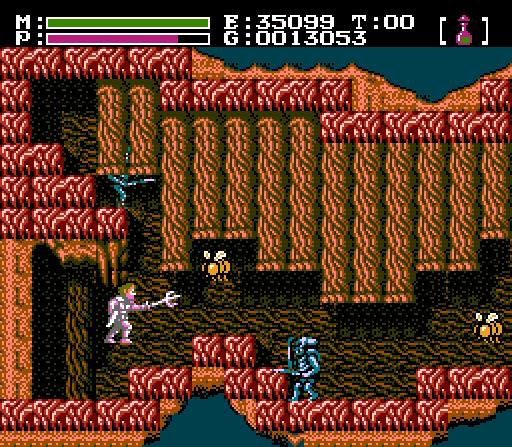
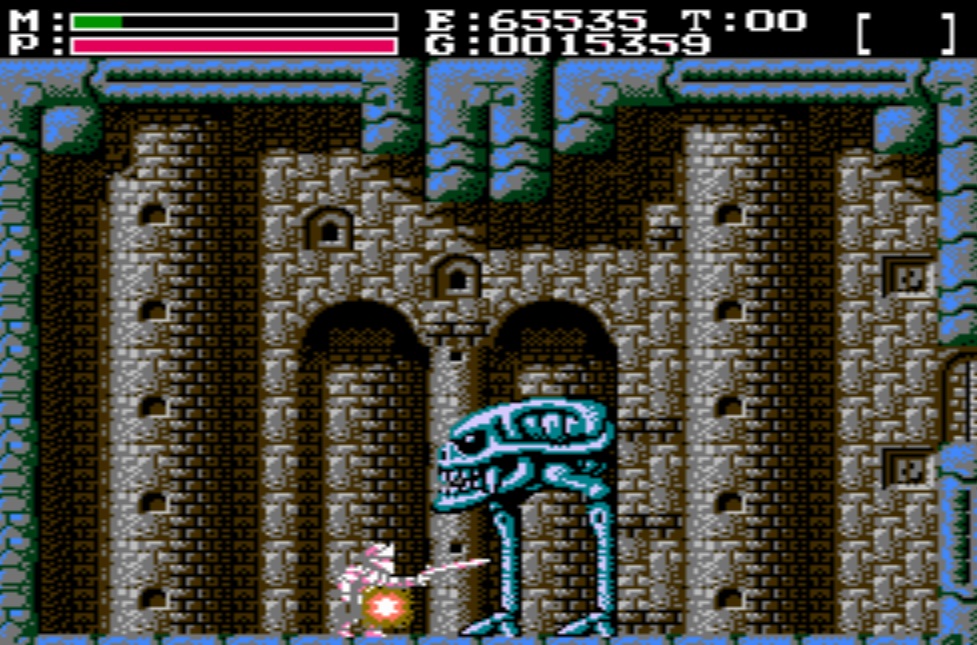
Why do I love Faxanadu so much?  It's one of my favorite games for the NES that I never owned.  I've spent some time thinking about this game, and I think that the graphics are one of my favorite parts of Faxanadu.  They may not seem like much at first glance, but I think they contribute strongly to my reason for carrying a torch for this game.  In addition, the soundtrack is one of the most interesting from the NES era.  

Below I show a progression of some of the different pallets and musical themes from Faxanadu.  The game's action starts at the base of the World Tree, travels up the tree a bit, goes inside the tree, comes back out, then ends up in the branches.  I love the idea of fighting through a giant tree.  This is a game that warrants a good remake.  Emphasis on good.


Muddy brown brick and a sky with a greenish hue characterize the town Eolis, cut off from their source of water and life.  
Eolis theme.  


The contrast is kicked up at the trunk; bright orange and green dominate, with a deep blue sky. The music picks up a bit.  


Purple foggy good times.  This was the furthest I ever made it on a rental. Delightfully spooky musical accompaniment.  
Mist Theme


Here we are in a branch of the great world tree. The music gets a bit more serious in tone. 
World of Branch Theme


Somehow there's a stone dungeon in the branches of this tree.  Another new pallet.  The music is a variation on the previous dungeon theme.  
Labrynth Theme

Saturday, March 16, 2013

Drinking Quest 3: Nectar of the Gods

Copyright: Canada ~ Her Royal Majesty, The Queen of England


I don't know when it was that I first found out about Drinking Quest.  I think it might have actually been one of those "customized" adds on the right hand side of the screen while I was browsing facebook.  I don't even remember what made me click on the link, but I did and I'm pretty thankful that I did too.

Drinking Quest is the brainchild of Jason Anarchy, both of whom are based in Canada.  So, if you're looking to purchase said quest, you'll be converting your native currency to Canadian dollars, unless you already live in Canada.  Enough of the brass tacks though, Drinking Quest is a card game set in a fictional fantasy world where you have to. . . um, do stuff and drink while doing it.  It's all very non-complicated and it all sounds like fun as I have admittingly not played any of the games.  I have however played both Munchkin and Dungeons & Dragons (as well as Advanced Dungeons & Dragons, Drunk Dungeons & Dragons and Editions 2, 3, 3.5 and 4), so I feel somewhat qualified to plug these beautiful Canadians.

Now this is where the above mentioned link comes in, when I clicked the aforementioned advertisement, it took me to Indiegogo, which is kind of like Kickstarter, except that it isn't.  That's the only difference that I've noticed.  Maybe there are more differences, but I haven't found them yet, mainly because I haven't looked.  It turns out that Drinking Quest has had two previous iterations prior to Drinking Quest 3: Nectar of the Gods, which they are trying to crowdfund up to their initial goal of $11,500 Canadian (that's $11,280.04 US).  The video up on their Indiegogo page is below to give you an idea of how these people seem to have done a great job blending Dungeons & Dragons and Canada (the drinking game, not the country, although that too I guess, considering that is the game's origin):

Looking at their Indiegogo page, I really feel the best option, if you have the money, is the $65 ($85 with shipping) option, which earns/gives/buys you hard copies of all three games.  Volume 1 is currently sold out and not available on their website, so the only way to acquire Volume 1, is by helping them reach their goal of $11,500, of which they are 73.8% complete and there are still 24 days left in their campaign.

That's all I will say, which has been a bit.  I'll probably go help fund them sometime within the week but they definitely seem to be on their way towards reaching their goal and that's mainly what this is all about: people doing something they love and having like-minded people helping out.

~JWfW/JDub/Jaconian
Another Brick in Hadrian's Wall