Saturday, February 15, 2014

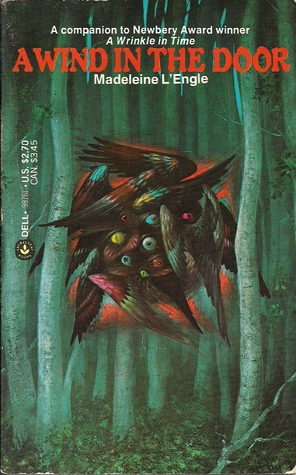
Book Review: A Wind in the Door


I was inspired to read this book when my friend Abazaba expressed interest in re-reading the full 'Wrinkle in Time' series by Madeline Le'Engel.  We had both read the first book when we were young, and were curious about the series following.  I found both the first book and 'A Wind in The Door,'  the second book, at Beers Books, our local used bookstore.  At one dollar apiece, I could not pass them up.  So I gave my friend the first while I read this one.   

In brief synopsis, the Wrinkle In Time series follows young teenager Meg Murry, her little brother Charles Wallace and the rest of her family as they go through a series of adventures with magical beings. The stories always begin at their home in the north eastern United States, but span across the length and breadth of the universe.  The first book focuses on folding space to cross great distances, and A Wind in the Door focuses on the unification of all creatures great and small, from the sub-microscopic to the galactic.

This book contains some really cool science fiction ideas.  Le'Engel discusses concepts of scale in a really intriguing way.  When talking about scale in terms of Astronomy and Chemistry, the sizes involved are beyond basic human comprehension.  We have to think long and hard to really understand that we are just a speck of dust in a sunbeam.  

Le'Engel tries to connect the tiniest of the tiny - a cell within a cell within a cell, with the largest of the large:  A solar system within a galaxy within a universe.  She pulls this off masterfully, through a bit of metaphysics and storytelling that tickles the mind and the soul.  The notion that a human can be a universe to a mitochondrion, which is a solar system for Farandolae  is fantastic, and she even tries to work together the idea of communication between these massively different bodies.  She uses metaphysical 'kything' to bridge this gap, which is akin to telepathy, and reminds me a bit of 'Groking' (Stranger in a Strange land, Heinlein). 

As a reader, I am already prepared to accept these concepts and imagine them, so I'm not sure of how good a job Le'Engle does of describing them to a layperson.  In fact, there are portions of the book that I think are pretty well ham-fisted.  I suppose this is due in part to this being a children's book, where things are best presented in a simple way, and in short-run.  But it's not the science fiction or the metaphysics that is troubling to me, it's the storytelling.

There are unbelievable and frightening characters, whom the children of the story are compelled to just 'trust' instantly because of some sort of spiritual energy coming from them.  This is a problematic issue for me.  On the one hand, I love the innocence of it, the cleverness of the character design, and the guts to make a sympathetic character have a frightening appearance.  But on the other hand, as a reader, I do not immediately trust the characters, and I'm essentially forced to do so because the narrator insists on it.  I don't really like that.  This is what I mean by ham fisted.  Perhaps with a bit more time to flesh the world out, I may have synced up with the characters.

I think it's awesome that Le'Engel was inspired by Mitochondria.  And I do find comfort in her unified theory of love.  The respectful synthesis of science and spirituality is a lovely thing.  I think I would enjoy these concepts adapted to an older audience, with more elegant storytelling.  I recommend a Wind In the Door to anyone who likes science fiction.  I think it is the best in a very original series.

-D

Wednesday, February 12, 2014

Frog Fractions


Frog Fractions
http://twinbeard.com/frog-fractions

I would like to invite you to play frog fractions, a surprisingly deep game about fractions.  This is a free flash game, played in browser with the mouse and keyboard.  Now, I know I've recommended flash games to you before, but I typically include several in a post.  Frog Fractions is a game of quality, which I hold highly enough to warrant its own post.  It's a pretty special game.  So go give it a shot, I think you'll be pleased.

Oh, there's a bit of a learning curve, but stick with it, and don't be afraid to explore.

-D

Monday, February 10, 2014

The Elder Scrolls IV: Oblivion ~ New Character Story

A while back, I had considered restarting Morrowind with a new character because I had felt that using a Nord of the Skyrim Province who was supposed to be a reincarnate of a heralded Dunmer (Dark Elf) hero was a bit far fetched.  I thought that playing a Dunmer would be more appropriate.  After I had thought about that decision and slept on it, I continued with my Nord, just to see what would happen and if the main quest line would make any more sense with an "Outlander," believing that Bethesda knew what they were doing, otherwise when beginning the game, you would have only been able to choose to be a Dunmer.  In the end, I am very glad that I continued as that decision gave rise to my new character for The Elder Scrolls IV: Oblivion, the Dunmer Ashlander, Talaq Ashburnab (same-ish name as the other Tal'aq, but different alltogehter.  I just like the sound of the name).

First off, how Valgrin of Markarth, the incarnate Nerevarine of Indoril Nerevar, a Dunmer General from the 1st Era influenced the events that take place in Oblivion.  

Emperor Uriel Septim VII sees that in the future he will be assassinated, his death is already foretold.  In this vision a prisoner helps him seal the gates of Oblivion which his assassination have brought about.  This is the in-game plot for Oblivion.  In the game Morrowind, Uriel Septim VII sends a prisoner who is born under a specific star sign, whom he believes will fulfill the Nerevarine Prophesy and release Morrowind and those living in Vvardenfell from the blight brought about by Dagoth Ur, who is residing at the heart of Red Mountain, in the center of Vvardenfell.  This is the in-game plot of Morrowind.

In Morrowind, I chose to be a Nord because it seemed like a good idea, having just played 150+ hours in Skyrim and I knew that I wanted to play a tank-like character.  Thus, Valgrin of Markarth was brought into being.  During the main quest, your character comes upon many different factions of Dunmer throughout Vvardenfell.  One of these is a tribe of Ashlanders, the Urshilaku, who are the group that sets your character ahead on his quest to fulfill the Nerevarine Prophecy and the first group/clan/tribe to recognize him as such.  I decided that this is where Talaq would originate from.

So Talaq was influenced by an Outlander being the Nerevarine.  This opened up his view of other races and began to deteriorate his prejudices of other races that were not Dunmer.  Knowing that the Nerevarine was a Nord (using my game from Morrowind as a canon storyline), Talaq wished to visit this land that the Nerevarine came from.  Being an Ashlander, a relatively poor nomadic tribe of Dunmer, Talaq had very little in the way of way of payment to find travel into Skyrim.  In the village of Khull, the Khajiit shipmaster S'virr tells Talaq that he can give him free passage to Skyrim by way of Solstheim after picking up/dropping off a shipment.  Free passage is dependent on Talaq transporting goods to both Fort Frostmoth and to the port in Windhelm.  Talaq agrees to this.

Unbeknownst to Talaq, S'virr fell in with the Nord smuggler Brurid and is smuggling Skooma and Moon Sugar.  While disembarking, members of the East Empire Company call attention to S'virr's boat and Imperial soldiers begin searching the cargo and find the contraband.  The imperial guards begin questioning Talaq on the docks.  A group of Dunmer witness the Imperial's verbal and physical abuse of Talaq and rush to his unasked-for aid.  During the skirmish, one Imperial is killed along with the two Dunmer who attempted to help.  Talaq was imprisoned as he was believed to be connected with the two dead Dunmer.  Because Imperial soldiers were killed, Talaq was taken to Cyrodiil and imprisoned under the charge of "an assault on the Emperor's men, is the same as an assault on the Emperor".  

While being processed, Talaq chose the surname "Ashurnab," after the Daedra shrine Assurnabitashipi to the west of the Urshilaku Camp.  Talaq did not wish to disgrace his family, yet chose and slightly altered a word/name that he already knew.  Coincidentally, in reality and in-game, the Assurnabitashipi shrine is dedicated to Mehrunes Dagon, the instigator of the Oblivion Crisis.

The way that I see this story unfolding, is that Uriel Septim saw an Ashlander at the time of his death and his visions regarding the Nerevarine Prophecy came to him, he saw a way of bringing an Ashlander, a group not normally seen outside of Morrowind, to Cyrodiil.  Uriel, however did not know anything about the Ashlander that he saw in his visions, only that by perhaps helping to fulfill the Nerevarine Prophecy, would this Ashlander somehow end up in Cyrodiil.

And now, I present to you Talaq Ashurnab, freshly released/escaped from prison:

Without a helmet on, Talaq sports the traditional Dunmer top knot.  I do wish that I could have figured out a way to make his cheeks a little more gaunt, similar to the way that the Dunmer look in Skyrim, or you know, Danny Trejo.  I didn't have a specific age for Talaq, hence not bringing up the year of his birth in relation to the storylines of Morrowind and Oblivion, and really, it's probably not that important.

I see Talaq as someone who, having seen the power and influence of an Outlander Nerevarine believes that helping people, to a certain extent can be beneficial.  As with other Ashlanders, he will not question the decision to kill someone who insults or threatens him.  And as with most/all Dunmer, he has a strong dislike/disgust for necromancers (which is how I justified diverging from the main quest so early on and routed a keep full of necromancers and their ilk.

He is still pretty naive though, because he is still pseudo-young so he's bound to do some stupid things.  Sure, why not.

So that's my character that I've created to play, at least through the main questline, in Oblivion.  


~JWfW/JDub/Jaconian
Instrumental

Saturday, February 8, 2014

TV Review: Sherlock season 3


I'd like to write about the third season of the BBC Television series, Sherlock with a minimum of spoilers.  But suffice to say that my feeling on this season is that I'm so happy that they did such a good job!

Now, I haven't watched the show much since finishing the second season a couple years ago, and I was very eager to see this new set of episodes after that long wait.  And the funny thing was that I was disappointed in the first episode.  It was a bit of a letdown.  But by the end of the third episode, I've decided it was an awesome season.  The show has stayed at top-knotch quality, and I am thrilled for that.  The third series is a sentimental series.  It is a series about men, about deep friendships.  It is about challenges, passion, forgiveness and love.  It's about redemption.  

Displaying strength, fortitude, patience and pride, John Watson is the star of the third series.  Fans of the show already love Sherlock; the program has showcased his talents extensively; the primary fun comes from his antics.  But this season highlights John Watson, both through his own performance and through the lense of Sherlock.  

Sherlock is cold, calculating and has a super-human intellect.  He is always one step ahead of his adversaries and ten steps ahead of everyone else.  His intellect comes with a maniacal drive to win the game, and to take any risk to do it.  These strengths are very alluring, both as a viewer and to the people within the show.  He represents an ideal of manhood, confident and brilliant, and always successful.  

The downside of that, of course, is that he is a huge ass, inconsiderate and cruel.  In episode 2 of season 3, he delivers a self-depricating description himself with his usual brilliance.  This moment is part of the turning point of Sherlocks character in season 3.  Turning him into, I daresay, a more warm and fuzzy detective.  While I would normally be bothered by this cuddly turn, the execution is so good that I enjoy it. I think the reason Sherlock's warming works for the show is that it is wrapped in a sense of gratitude toward John Watson.  Sherlock shows guilt for having put John through the trouble of his company, and he is grateful for John's patience, trust and forgiveness.  


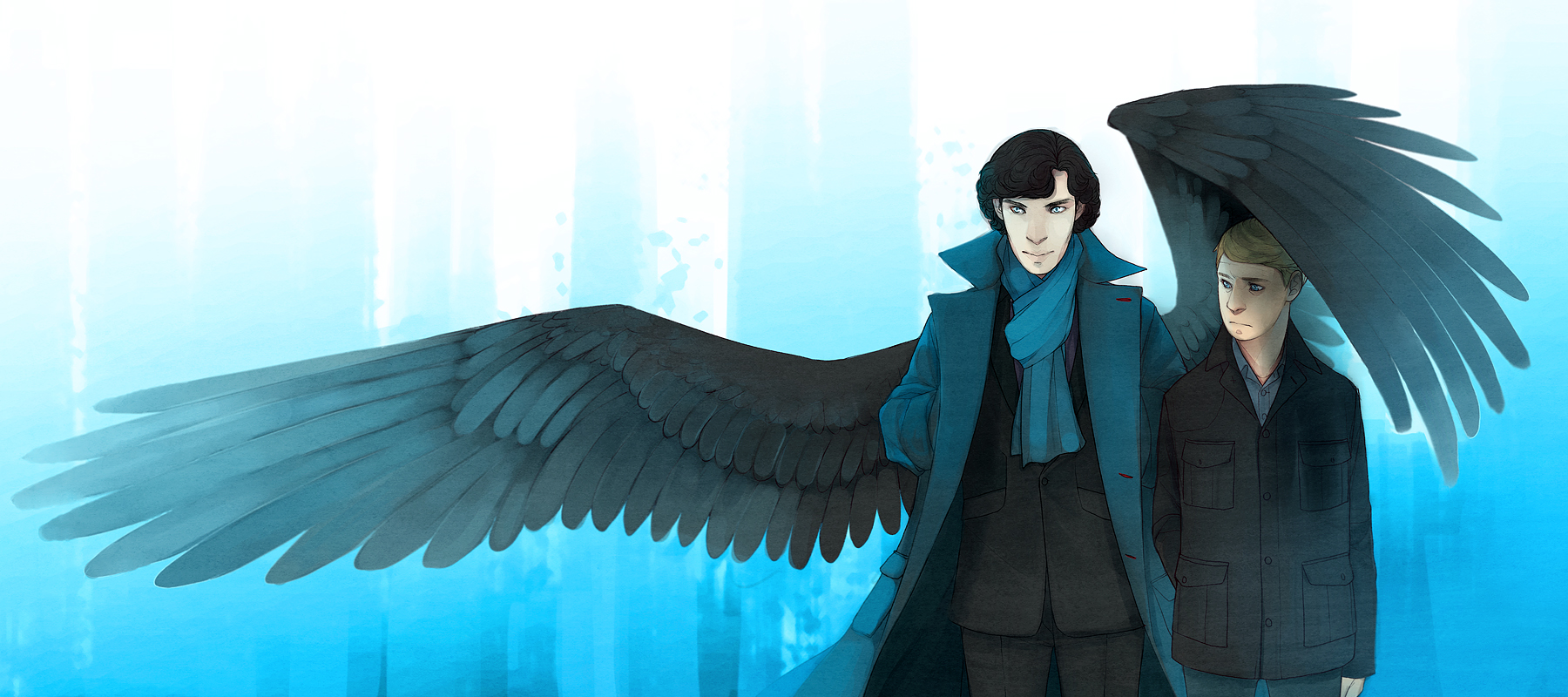
http://www.zerochan.net/user/ImpactAlchemist     - lots of interesting Sherlock Fan Art out there      

As a man, John Watson is powerfully moderate and civilized.  And this show seems to suggest: quintessentially British.  There is a scene in season 3 episode 3 in which an antagonist is belittling England as a whole.  Saying that they are the most 'domesticated' people in the world, that England is a proving ground for his economic manipulations.   He suggests that if he can get away with something in England, he can take it to a 'real country.'  He says all this while pissing into the fireplace at Baker Street as his hosts look on-- to further illustrate his point.  

Without saying too much more: John is able to stand by and do nothing while this incredible insult is levied against him and his entire people.  Like in many scenes, John is not clear why this is happening, and why he needs to wait, but he does.  He trusts that Sherlock has a plan and a response, and that when it is time for action, Sherlock will let him know.  It is this trust and tenacity that allows their team to function.  And for us to enjoy all of their merry adventures. 

John Watson is capable of swallowing his pride in heaping amounts.  Next to Sherlock, he sometimes appears weak, given Sherlocks tendency to walk all over him.  However, this season brings their relationship into focus, showing that while Sherlock may walk over John, he walks over everybody all the time, and this treatment is not personal to John Watson.  What is personal is John's ability to tolerate it.  He is the smaller man, the less commanding, less ingenious.  And he is frequently placed in a position to look like the inferior man.  But he is not weak:  his ability to be tolerant and forgiving of Sherlock's incredible inability to get along with people is shown to be a great strength in Season 3.  

In addition, these qualities of Johns are not limited to Sherlock.  He is capable of selfless forgiveness toward the other people he loves as well.  His greatest moment does not involve Sherlock at all, and I will leave it to you to watch.  

Four stars.  

-D


P.S. as a fun aside, have a listen to the opening theme of Sherlock (provided above) and the Final Fantasy Airship theme, below.  


also, congrats to us on our 300th posting.  yay!


Friday, February 7, 2014

First Impressions: The Elder Scrolls IV: Oblivion (PC)


The Elder Scrolls IV: Oblivion has a sordid history with me, which is why I didn't jump on the bandwagon back in 2006 when the game first came out.  Prior to 2006, I had heard nothing about The Elder Scrolls series on any platform, most likely due to the fact that I wasn't a big PC gamer until recently and I didn't own a 360 or PS3.  
The symbol for the school of Conjuration.

I recall seeing the boxes in Target and upon first inspection, I thought that I had stumbled across a video game series based around H.P. Lovecraft's Cthuhlu mythos.  The cues for me were the similarity between the "Elder Gods" and the "Elder Scrolls," as well as "Oblivion" being a frequent theme of sorts in Lovecraft's writings about the various.  Even the logo I thought was an artistic relic based around the image of Cthulhu.  Granted the symbol looks a bit more like fangs, but now that you have Lovecraft in your mind, seeing what I had thought might become a bit more clear.  So at this point, I figured I would get around to playing this Oblivion game.

The house I live in during 2006, we had a housemate whom we will simply call OnlineGamblerGuyWhoLivesInAMercedes, or Axe for short talked a bit about the game then showed myself and Chreekat what the game was like.  He described it as a kind of fun fantasy game played in first person and I immediatly thought of the Neo Geo game, Crossed Swords.  Axe said that by the end of the game it had gotten repetitious and that you can simply jump while moving and you raise in experience levels.  He said that it while it was a decent game, just that by the end, it got pretty boring.

This was my first impression of not only Oblivion, but of this apparent Elder Scrolls series.  It was not a favorable impression.

Ring in 2012.   Skyrim had been out a year by the time I bought the game and delved deep into it's depths (not nearly as much as Conklederp has mind you).  Thus my impression of The Elder Scrolls forever changed and for the better at that.  In March of 2013 I began playing Morrowind (Chapter III) and this January (just over a month ago), I began playing Oblivion.  

My feelings about this game continue to be conflicted.  I understand the immense leap from Morrowind to Obilivion, the changes in gameplay mechanics (the ones I know about anyway), the graphical improvements over the four years between the two games.  However, in the back of my mind are those first feelings of negativity because of the review of a housemate and finding out that the conjuration sigil had nothing to do with anything related to H.P. Lovecraft.

One other sad thing, for me at least, is that I'm not a fan of the intro song, which is just a fanfaric and slightly sped up version of "Nerevar Rising" from Morrowind.  Yes, I know it was used again in "Dragonborn" from Skyrim, but there it's done with a choir and all bombastic, which I tend to like.  Basically the song, "Reign of the Septims" using the "Nerevar Rising" theme, plays it too fast for what the song is doing.  I don't know if that really makes much sense, but that's how I feel.  The rest of the music in the world I do enjoy as it is very Jeremy Soule and fitting for Cyrodiil.

Presently, I am 14 hours into the game, which isn't far by Elder Scroll standards and for those of you who know, I just joined The Blades at Cloud Ruler Temple and that is where I have left the game since the middle of January.  Rather than be all rhetorical, I have not stopped playing, but felt that I could now diverge from the main storyline to do any half dozen of those side quests that always populate these open world games.

There are certain things that I do like so far in Obilivion such as the lushness of the land.  I mean, just look at all these lupins (??)


and I just escaped (was allowed to escape) from prison!  I like the facial feature-thing mechanic that I will/might get to in a later post.  I like building my character and having them focus their abilities along certain paths.  And as is the case with any game, there are certain aspects that I'm not too fond of such as the menu system, the pudginess of faces due to the facial feature-thing mechanic, the ability to fast travel to locations you have not yet gone to but know of their existence and how small Cyrodiil feels, but maybe this last part is normal having come from such a vast expanse in Vvardenfell.

I will come back to Obilivion very soon, I think I just needed some time to figure out my current feelings for the game and how they conflict with how I first felt about the game.  Well, that's about my quota for the month for talking about feelings.  


~JWfW/JDub/Jaconian
I Shall Return From Out Of The Fire
P.S.  Have a good (snowy?) weekend all.

Wednesday, February 5, 2014

Tetris Dreams part II

This is an old post I started a few months back when I was playing the first Final Fantasy.  I decided to return to the post, and I think I found something worth fleshing out.  I often use this phrase:  'as I'm riding the American River Bike Trail', which is where I often come up with video game ideas.  I like to imagine dynamic systems of life in terms of video games, and riding that bike trail tends to bring them to mind.  I enjoy doing this.  It's sort of like Tetris Dreams.  


The Iconic Fighter Guy

"Tetris Dreams" is a phrase I have heard a bunch.  Lately I've noticed that I get daydreams about different games.  Especially those with a simple interface.  For example:  I'm playing FF1 right now, and I'm sort of dreaming about it.  Stray thoughts at work, zoning out doing data entry, and I see the battle screen.  And the iconic fighter guy.  The others are there too, but he's the easiest to pick out.  It's sort of floating in the distance.   

Bagging groceries is like Tetris, kind of.  More complex, actually.  Because there is shape, weight and surface tension.  In Tetris, it's just shape.  I mention this because I've been bagging groceries at the local food co-op as means to keep me occupied and earn a discount on groceries. 

I think that some video game day dreams come from staring at the same screen for long enough.  Thats' why Tetris lends itself so easily, because of the simple patterns and repetition.  However, it may be more than that.  The images from Tetris or Final Fantasy may come easily because of their simplicity, but there are other video game daydreams that I have, which are based on mechanics instead of graphics.

Tony Hawk is the prime example.  After dumping countless hours Tony Hawk's Pro Skater 2, I couldn't ride in a car without imagining myself grinding on every available edge, doing kickflips as I hop from edge to edge.  It's tons of fun, and oftentimes I imagined the car itself doing these tricks.  Come to think of it, when really bored riding in a car, I used to imagine Mario (from the first game) running alongside the car, jumping over the fences, buildings and other obstacles along the side of the road.  It seems that there is something triggering about moving along the road at an even pace, watching the scenery go by.  


In further support of the connection between motion and video game dreams, a lot of my little video game ideas come when I am riding my bicycle, or riding the train.  In fact, when I used to commute by train, I would stare out the window at the Yolo causeway and imagine wandering around exploring.  Watching the seasons change and the effect it had on the plant life made me want to develop a game that had this sort of dynamic scenery.  It was very peaceful.  Around that time I discovered Proteus, which did a very similar thing to what I was imagining. Of course, I wanted to stick the environment into an RPG, because that is probably my favorite video game genre.

When it comes to RPGs, I often day dream about player statistics.  Levels, experience, strength, durability, attack damage and so on and so forth.  I imagine my experiences playing RPGs in my youth have become such a part of me, that the process of balancing equations in order to achieve in-game actions is just a part of me.  I enjoy pondering human systems in terms of RPG status sheets, hunger, thirst, tiredness, allergies, illness.  In the end, it's just tossing dice and applying meaning to the results.  Which is a great deal of fun.


-D


Monday, February 3, 2014

Monthly Update: February 2014

Looking back at January for a moment, it was a pretty productive month and by productive, I mean that I finished (came to the end) of a couple of games and started a few others.  Actually no, I only finished one game as the other was finished yesterday, which was and still is, February.

Yes, yesterday I achieved what will be my gaming achievement for February: I finished BIT.TRIP RUNNER.  
Picture included because I said so.
After spending I don't know how much time on the last level (3-12: The Source), I was finally able to take out Timbletot, well, sort of since he comes back in Runner 2: Future Legend of Rhythm Alien, but the point is, is that I bonked him and he flew off while flew away!  This happened yesterday, or more importantly, two days after I had a dream about looking up the level on youtube to see what came after a particularly difficult series of jumps that I just couldn't make.  Yesterday I did actually look up The Source and was a little surprised that my dream was actually pretty accurate.

But enough about BIT.TRIP RUNNER for now and onto more important matters, like that game event of the year yesterday, Super Bowl XLVIII, or whatever number they're on.  Well, since I'm expressively forbidden to recount anything about the game without the consent of the NFL, I'll just give you a glimpse of what a number of us did yesterday while at a sports bar while the Super Bowl was going on:
The drawing started out with just the head that SRSnoopy11 drew followed by the "Luigi" name.  That prompted me to "draw" the Luigi hat to which SRSnoopy11 did the body to which I added the bleeding boney arms.  It was all down hill from there.  Also, the fact that the Question Mark Block is backwards is because I was drawing it upside down and became confused.  I'd also had at least a pitcher of beer and I was sitting at an angle.

Something exciting that's happening in less than a week (Friday actually), is the 3DS game Bravely Default, which I've surprisingly not talked about, will be released.  I've been playing the demo which is a stand alone quest that can earn you items when you start the full retail version.  The graphics look a lot like Final Fantasy: 4 Heroes of Light, both in appearance as well as the word map, but the towns are all side scrolling of sorts.  Anyway, the game looks great and the music is fantastic and kudos to whomever the composer is.

In other news (not really news anymore), Bethesda and Zenimax released the final trailer to the Elder Scrolls Online and holy damn is that thing gorgeous.  Yes, I know it's a trailer that does not represent the way the game actually looks/plays.  I'm just talking from the standpoint of holy damn is that thing gorgeous.  And whomever directed that piece of beautifulness needs an award or something.

The rest of this month I anticipate playing a lot more on Tactics Ogre: Let Us Cling Together, Castlevania: Lords of Shadow, Assassin's Creed, some Portal 2 c0-0p with Dr. Potts and hopefully delve a bit into Monaco with Vorlynx and Company.  Oh, and La-Mulana, which is a 2D side scroller that looks like Indiana Jones meets Castlevania and maybe a bit into the PC remake of Dementium II.

So let's all try to have a nice February, and while we're at it, not kill anyone at the Olympics in Sochi on Friday (I also had a dream that I was in Sochi watching women's short court doubles tennis for the "Winter" Olympics; I don't know what that means).


~JWfW/JDub/Jaconian
Instrumental


P.S.  Also, there were sloths:


Saturday, February 1, 2014

Full Review: Assassin's Creed: Altaïr's Chronicles (DS)

Well, due to Salty Liver only bringing up Assassin's Creed II a couple of times in the past, this renewed my interest in the Assassin's Creed series.  This lead me to the Wikipedia article which is where I found out / looked up the chronology for the series.  Being the kind of person that I am, I wanted to start the series in the beginning, even though the first Assassin's Creed came out on the PS3 and 360 back in 2007 (2008 for the PC).  The story in Assassin's Creed chronology begins with the DS game that came out in 2008, a year after the initial release.  It should also be noted that AC:AC, the DS game has been ported to Windows Phones, iPhones and Android phones, so a good portion of this review will be relevant for those OS' as well, just not the control schemes.

The nitty-gritty: AC:AC, while a Ubisoft property was developed by Gameloft, a French company who worked a lot with the Prince of Persia reboot series in the early/mid 2000s.  The company now mainly focuses on mobile and portable gaming, so it is not too surprising looking back that they were given the rights to develop this title, especially with their PoP background.

So let's get down to it shall we!


STORY
Assassin's Creed: Altaïr's Chronicles takes place in 1190, one year before the events in Assassin's Creed.  You mission is to recover "The Chalice," which has been recently acquired by the Templars and it is believed that The Chalice will bring victory to whichever side has it in their possession; so basically it's The Ark in The Raiders of the Lost Ark, and instead of events leading up to World War II, it's the Third Crusade.

Knowing from somewhere that the Assassin's Creed series had a rich backstory (how else could it have so many sequels that have spanned centuries?), I was ultimately a  little disappointed with the storyline in this game.  A lot of the missions were something a long the lines of, "Get info from this guy."  So you would go to City A, which we'll call Damascus, by way of fast map travel, followed by a linear (not an issue for me) level where you would traverse a city by way of leaping from building-to-building all the while avoiding spike traps and swinging axe pendulums. . . Yes,  apparently 12th century cities in the Middle East were very well equipped to deal with infiltrators.  So you would find the guy, get the info and then move onto City B, which we'll call Jerusalem.

For most of the game, it felt as if I could be playing any action adventure game.  It didn't overly feel like I was playing an Assassin's Creed game, although being the "first" game in the series that I have played, I guess my opinion is a bit void.  Regardless, the story is not what kept me playing the game, but my desire to play Assassin's Creed.

I thought it interesting that there was very little set up for the organization that you are a part of.  The game felt as if I were to have already played through the first game so why then bother with setting up the character and/or the setting?

GAMEPLAY
You can't tell, but the apple and scroll are moving.
 You basically move between glowing points in the play area, occasionally come across a much desired checkpoint, then follow the glowing dots through some traps/hazards, often times jumping over gaps/water/sticky oil slicks, et cetera to the next checkpoint: occasionally you will fight a bad guy(s) and kill them.  That is the basic gist of the game.

The game itself is played (in regards to the DS version) on the top screen while a city map is pictured on the lower screen.  You also have the option to switch out weapons when they become available.  One of the first things I read about was how the touch screen was going to play a part in the game in a way that game elements were not be used in the first game.  This included pick-pocketing which really excited me.  The other mini game was interrogating people, which consisted of tapping numbers on the back at the correct time and pulling an arm up behind the shoulder blades.

The controls themselves were pretty straight forward for this type of game on the DS.  I will add that playing on the 3DS, I had the option to use either the directional pad or the joystick to move around.  I instinctively chose the joystick and much preferred this option to the directional pad as the joystick simply felt more natural. 

While researching AC:AC, one aspect of that stuck in my mind: that a number of reviewers wished that they could move the camera.  Initially I felt that going into this game as a DS game, I knew that there were going to be limitations compared to either a PS3/360 or PC game.  After a short while playing, I understood the desire to have a controllable camera.  The camera does frequently move, but it only moves along with you and you have no control over where it goes and what it does.  There were also times when Altaïr was obscured by a building or while travelling from left to right, Altaïr would be on the far right, unable to see exactly what was ahead of me.  If anything, a button to recenter the camera would have been nice.

A lot of AC:AC is jumping from one thing to another thing.  Things include buildings, pillars, levitating platforms, rope nets, floating platforms, rafter/support beams.  And at times, you even get to jump over things, such as pits, pits filled with spikes, city streets and cobras; although the cobras could be easily dispatched with your sword.  So basically, knowing where you were going to jump was very important and just about half of the time I could not tell either how far away my target was or if I was jumping onto onto something at my own level or below me.  I cannot tell you how many times I over/under jumped a target, but it happened a lot.
I guarantee that you will see this screen a lot.

Ultimately, my biggest issue with the game was the gameplay.  While traversing a beam that I had to climb upon in order to jump to the following rooftop, I would sometimes let go of the beam and fall (often to my death; see above picture), I would wobble off the beam, although still grasping it or I would jump to my target and either make it (more often than not I would make it if the target were a rooftop) or I would miss it, if I were aiming for another beam.

Fighting also became somewhat tedious.  You start out the game with basic attacks and as the game progresses, you (somehow) learn different button mashing combos (X-X-X, X-X-Y, Y-Y, et cetera) as well as a couple differing ways to block and parry (of which I rarely used as I found them to be ineffective; or I was just doing it wrong, which is also very possible).  The system isn't bad, it's just that by the point where you frequently ran across the stronger Templar Knights [There are five different types of Templar that you fight: un-helmeted grunts, helmeted grunts, Templar Knights (with and without shields) and crossbowmen], I would almost exclusively use the X-X-Y combo to kill them (after four to five hits) as they seemed to block everything else I tried and counter attacks never seemed to work.

GRAPHICS
Keeping in mind that this is a DS game that came out six years ago, I liked the graphics.  They fit in with the setting.  All the enemies and NPCs intermingled without one being brighter than the other also meaning that both groups blended well.

My only gripe with the graphics partially relates to not being able to move the camera.  At times I could not tell where the platform was in relation to where I was jumping and I would frequently dying from a missed jump because I couldn't tell what I was looking at.

Of the few cutscenes in the game, those that bookended the game itself, each looked about alright.  They do not really stand up to the cutscenes/graphics of the PS3/360/PC versions, but nobody should be expecting them to hold up to comparison.  They look good for what they are: DS in-game cutscenes from 2008.

Overall though, I was quite pleased with how the game looked.

SOUND & MUSIC
I was happy with how the music sounded.  Sadly, after going through the credits twice, I was unable to find out who composed the music for this release.  Even a pseudo-broad search of the internet (including IMDb, VGMPF and VGMDb) turned nothing up.  It might have been Jesper Kyd, the composer of a number of the entries in the  Assassin's Creed series, but that is just speculation.

I really enjoyed the sound editing for the game too and as is the case here too, there was no sound editor of any sorts to credit here.  A lot of the sound effects, the background noise of the various cities were all very fitting.  I don't know if I would say that I was impressed, although I will leave it by saying that I was very pleased.

FINAL THOUGHTS
Overall, Assassin's Creed: Altaïr's Chronicles was a game.  I played that game and completed that game and that game took me 16 hours and 38 minutes from start to finish, most likely because I died very frequently.  Saying that it was a "good" game might just be a little too much credit.  There were times when I enjoyed what it was that I was playing and other times when I was simply frustrated by the gameplay, level design, camera angle, et cetera and had to put the game down.  If you were to look at my statistics for the game, you will see that I would frequently play the game for about half-an-hour before (having to/needing to) putting it down.

It is only mildly tempting to pick the game up again once I complete the first Assassin's Creed, but I most likely won't.  I guess my recommendation would be that if you haven't played any of the games in this series and you have a DS/3DS, don't spend more than $10 as the end result will most likely just leave you upset.  In the end, Assassin's Creed: Altaïr's Chronicles is a somewhat solid action/adventure game if you don't care about a storyline and can handle/deal with a computer controlled camera and repetitive killing of enemies.


~JWfW/JDub/Jaconian
Bewildered On Enchanted Ways