In my ongoing series of posts about Game Design informed by Gardening, or general Garden Simulation, I have yet to touch on the subject of Pest Management. This is due in part to my own feet-dragging approach to dealing with garden pests in my own garden. Still, as I prepare to break down and buy an insecticidal spray, I reflect on some of the things that have been working so far, and how they might play into a Gardening game.
The first, and most compelling method of pest management comes in the planning stages of gardening. The idea is to grow plants that will attract beneficial insects, which will do the work for you. I've leaned on this approach pretty heavily, however, this came about by happenstance, not by careful planning. Now I obsess about my next garden and how I'm going to plan it better. What's nice about Vegetable gardening is that the plants are all annuals, which will die off after a season, creating an opportunity to start over again. This can be a good thing .
This is very similar to how I've approached Sim City 4. I've made maybe eight different cities in that game. The first was a disaster, and I just ran and hid from the havoc I had unleashed. The second city went much better, but still, I learned some things which I was eager to apply on my next city. By the third city, I hit a plateau, and, try as I might, I couldn't really improve on my model. That didn't stop me from trying a few more times, though. There's something captivating about those beginning stages, designing a layout to avoid typical pitfalls.
I have a similar experience when I play Settler's of Catan. I find that during the early stages of play, I feel compelled to start the game over again - to place my tokens differently, because I know what I did wrong. I wonder if this might be a palpable experience of the oft-talked-about Learning Curve.
Learning can be fun! I said it. But seriously, maybe that's what's going on here. Thinking about Knytt and Starseed Pilgrim, those games had the most delightful learning curves. Starseed is highly cryptic; really all it tells the player about their goal amounts to a hill of beans. Yet, through repeated play, I was able to figure out goals, and increase my skills many fold. This growth in my play experience drove me to begin again time after time, until I hit a plateau and dropped the game. Up to that point, Starseed Pilgrim was a very potent gaming experience.
Knytt lays out very basic goals and controls. Then reward the player with an unfolding world of many environments. The learning curve here is to learn what the purpose of the game really is (hint: to enjoy yourself!) My compulsion to restart Knytt was based on finding out where I could explore that I didn't before. This curve was considerably shorter than Starseed Pilgrim, but still delightful and also free of charge.
Here's a random list of games with Learning Curves I have particularly enjoyed:
Starseed Pilgrim (PC)
Settler's of Catan (Board Game)
Blokus (Board Game)
Tony Hawk's Pro Skater series (Playstation)
Wave Race (N64)
Goldeneye 007 (N64)
Final Fantasy XI (PC)
Okay, those are a few to get the ball rolling. It occurs to me that there are a variety of different Learning Curves of different character. And it is possible to reach the end of a learning curve - the final plateau, so to speak, but how often do we actually get there? There are people who can do things in Street Fighter games that I have never had a hope or a prayer of ever doing. But it seems to me these games boil down to reflexes, rote memorization and practice, practice, practice.
Then on the other hand, there are games that start easy and stay easy, and just amount to a slog from point A to point Z. I felt God of War was kind of like that - good thing the visuals were so great. I've been complaining that games were too easy since the snes days, and it's usually these games that are very easy with one or two tough spots.
What are some of the best Learning Curves you have encountered?

Showing posts with label game design. Show all posts
Showing posts with label game design. Show all posts
Thursday, August 7, 2014

Wednesday, July 9, 2014
The Great Garden Nursery Game
 |
| click this totally sweet image to link to the makers page |
It seems to me I am determined to design games based on my life. These days I'm always thinking about Gardening and gaming. To that effect, I was thinking of gamifying my job. That is to say, my job has just a few dynamic elements, but they keep me busy all day.
First there is watering. Plants start to die if they are not watered. Many of them can bounce back without any trouble, but some of them don't bounce back so well. And if they go long enough without water they lose their ability to hold water effectively, thus requiring more water. This also takes place when a plant is in a pot for too long and becomes root bound. In both instances, the plants run out of water quickly. A final thing that happens when a plant is not appropriately watered is that the plant will die partially, and become ugly. Ugly plants don't sell.
It's important to keep the plants healthy. However, the primary reason to keep the plants healthy is so that customers will purchase them. Thusly, customer service takes priority over watering. This conflict of interest can be very challenging, as customers do not respect the greater needs of the nursery, they are singularly focused on their own needs. (there are rare customers who see the bigger picture, and they are wonderful people).
Sometimes customers will simply pick out plants on their own, purchase them, and be on their merry way. Other customers require a great deal of song and dance before they will make a purchase. This comes in the form of simple questions, obscure questions and shopping buddies. Simple questions require only a moment of time, obscure questions require research, and shopping buddies require full devotion of attention for an extended period of time. The flipside of the devotion of time for shopping buddies is that they often will make the biggest purchases.
 |
| Y'know, kinda like this |
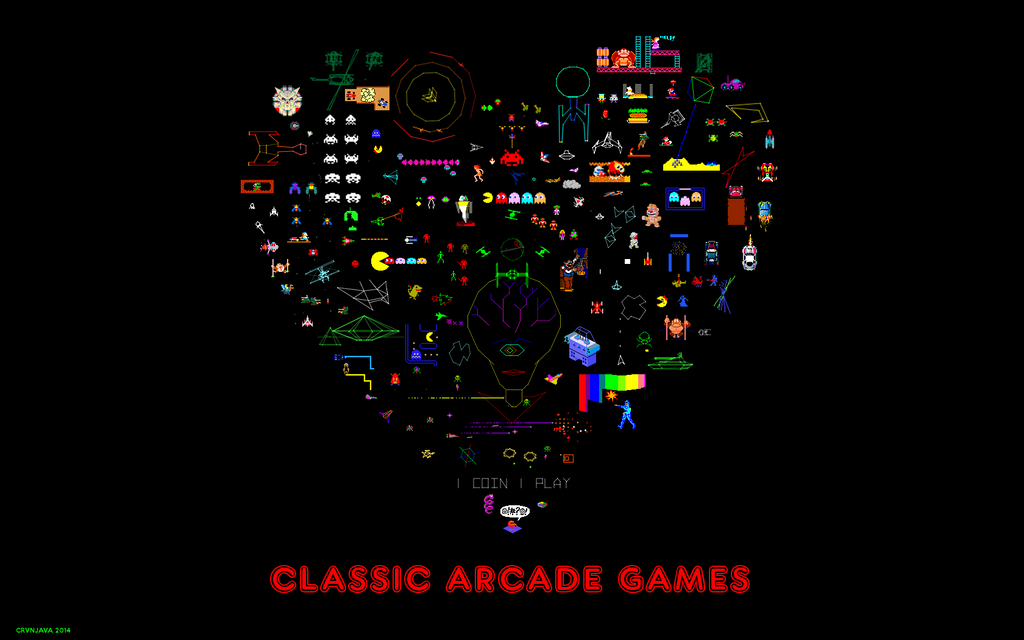
When I imagine these systems in the form of a video game, I'm thinking of a one-screen game, with basic pixel art, using color to attach meaning. In the basic stage of the game, you simply have to water all of the plants. Plants are represented by green icons, which, over time, degrade to yellow, red and then brown. If a plant turns yellow, it needs water. The player icon simply has to walk to each yellow plant and press the 'water' action button to resucitate the plant. I imagine little blue and white pixels for water.
If a plant turns red, it has received damage from dehydration, and now is not able to water back up to green. If a plant turns brown, it is dead. Dead plants will not change when watered, and must be removed using the 'deadhead' action button. When a dead plant is removed, it will be replaced, in time, by a new, green plant. However, every new plant results in a negative penalty to the score.
While the player is busy watering plants, customer icons will wander into the screen. I imagine these as shaped and colored differently from the plants, however, with variation. The basic customer will enter the screen, randomly collect green plants, and leave the screen. For every green plant collected, the player gains points, equal to at least double the potential penalty points.
I also imagine different customer behaviors. Some customers target you, and while they are within a certain proximity you are unable to water plants. These customers can be avoided, but may best be dealt with. One customer simply needs to be handle by pressing the action button a few times. Another type will not be shaken, and you must walk across the screen, through the plants, unable to water, but the customer will pick up plants along the way. After the customer has five plants, they will leave, and you can collect your points.
 |
| Maybe something like this, but with higher resolution? |
The goal is very simple, in classic arcade style: gain points. Each stage will have the same time limit. Essentially from open to close. Points carry over from one stage to the next. The game is lost when the player runs out of points. Players are ranked based on the number of stages they can complete, and the highest number of points they can acquire at any one time.
But the dynamics will increase with every level. I imagine a temperature meter, with a low of 70 degrees. The temperature can increase level to level, thus increasing the rate of dryout for the plants. I imagine larger plants which are slower to dry out, but also slower to water. These plants are also worth more points. As you gain in levels, the days get hotter, the customers heavier and the plants larger. You can conceivably go on forever, or until the temperature gets up to 150 degrees and all the plants die instantly. Fun times.
Seems vaguely fun to me. And I get to do it every day in real life! Wow! Anyway, I have no idea why anyone would have read through all that stuff I wrote up there. I just like to come up with basic game ideas and describe them. If I had the attention and dedication, I'd even program them myself. Until that happens, this is what I've got. Sayonara,
-D
Saturday, June 21, 2014
Chess Variants
The more I play, the more I think that Chess may very well be the greatest board game of all time. As I play, I notice the incredible amount of narrative possibility in a game of chess. If you stop to analyze and converse about every move in a game, then you can make a story around it.
You can also use multiple games to make multiple scenarios. Imagine one board represents two warring countries, while another board represents a single battle. This is, of course, the obvious example of war and battle. However, you could say one game represents the actions within a place, such as a high school, and the other board is a given classroom. And while the pieces are placed in a way where they are opposing one another, the individual pieces may not understand why they are making the moves they are making. Their awareness might be very limited.
Lately I've noticed a tendency in my play: I like to move my pawns, and I like to protect my pieces. Frequently I end up with very complicated boards with lots of pieces in random locations. This makes it tough to keep track of everything, which can be an advantage or disadvantage depending on the relative skill at spacial management of the players. I don't claim to have a lot of this skill, but I do like to test it regularly, and I think I may be getting better.
I noticed this because a different game I played involved a lot of trading of pieces, and now the board is nearly bare, but the game seems to be pretty balanced. It's like we're starting the game with fewer pieces.
On that note, here are some Chess Variants. The Wikipedia article on chess variants archives hundreds of different versions of chess. I want to play them all and invent my own! Just to see how they turn out.
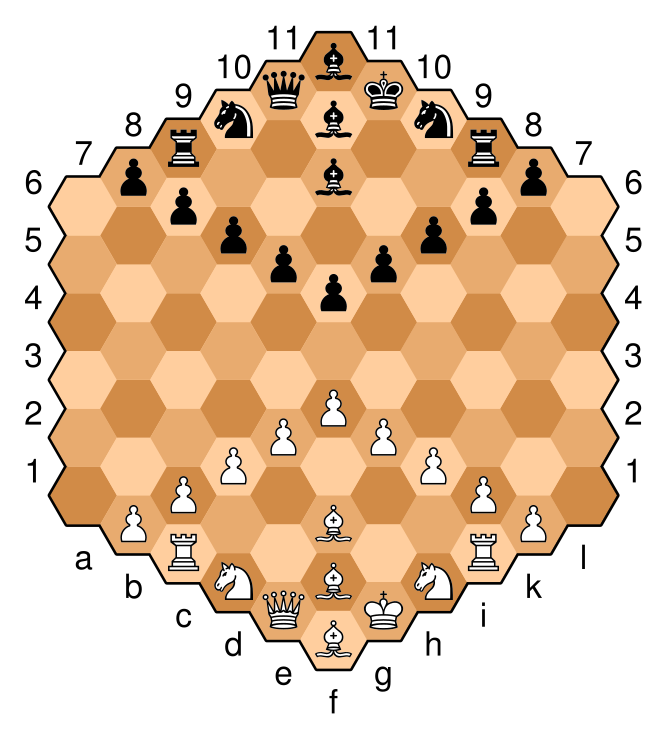
Actually, I have participated in the invention of a couple different chess games. When I was a teenager, my friend Cortez and I made 'super chess' one day, using my giant (32" x 32") chess set. Just for fun, we changed the rules of chess, inflating the abilities of each piece. Pawns can move like kings, still kill diagonally. Bishops gained the ability to move to one adjacent space, thus changing which color tile they are on. The knight can now skip over any number of pieces during the 'L' shape, thus allowing it to make really long moves if there are enough pieces in the way. And the rooks could explode, killing themselves and all pieces adjacent to them. We only played 'super chess' a couple of times, and it was fun, and strategy was completely out the window.
A final Chess Variant came from a roommate of mine, who invented Beer Chess. The rooks were replaced with beers, and the owner must drink the rooks when they are captured. The deviousness of this game is that my roommate would be really really drunk when we started, and I would feel very guilty making him drink more, and this affected my strategy.


You can also use multiple games to make multiple scenarios. Imagine one board represents two warring countries, while another board represents a single battle. This is, of course, the obvious example of war and battle. However, you could say one game represents the actions within a place, such as a high school, and the other board is a given classroom. And while the pieces are placed in a way where they are opposing one another, the individual pieces may not understand why they are making the moves they are making. Their awareness might be very limited.
Lately I've noticed a tendency in my play: I like to move my pawns, and I like to protect my pieces. Frequently I end up with very complicated boards with lots of pieces in random locations. This makes it tough to keep track of everything, which can be an advantage or disadvantage depending on the relative skill at spacial management of the players. I don't claim to have a lot of this skill, but I do like to test it regularly, and I think I may be getting better.
I noticed this because a different game I played involved a lot of trading of pieces, and now the board is nearly bare, but the game seems to be pretty balanced. It's like we're starting the game with fewer pieces.
On that note, here are some Chess Variants. The Wikipedia article on chess variants archives hundreds of different versions of chess. I want to play them all and invent my own! Just to see how they turn out.
Another time, my friend Ghost and I worked out a game that we ended up calling 'Samurai Showdown' in which we used a chess board and index cards to create a combat game involving fantasy classes. This game was more akin to Final Fantasy Tactics, as each player had two actions: movement and attack. Free movement within a number of steps, attack and defense power. Unfortunately, we balanced the game such that the Samurai was the only character with greater attack than defense, resulting in every game coming down to a battle of Samurai.
A final Chess Variant came from a roommate of mine, who invented Beer Chess. The rooks were replaced with beers, and the owner must drink the rooks when they are captured. The deviousness of this game is that my roommate would be really really drunk when we started, and I would feel very guilty making him drink more, and this affected my strategy.
As a past time, Chess Variants are a lot of fun, and I am happy to be reminded of the possibilities. I think I will buy my chess sets in pairs from now on. The game of chess has enough depth in it to survive and thrive on a world-scale for hundreds of years. People know this game so well, that there is a book containing every move ever made in professional play. That's a lot of play testing and also a lot of narrative possibility. But with dozens of available Chess Variants, and hundreds more possible, there are that many more narratives to explore. Perhaps most will self-destruct, as our Samurai Showdown version did. But the search has its own rewards of joy and entertainment.
-D
-D
Wednesday, April 30, 2014
Pruning in the Game of Life
 |
| that's chlorophyll on a leaf! Click for source. |
Meditations on life while pruning away at some plants. I imagine now that I work at a Garden Nursery, I'll be writing more about plants. Today I spent some time pruning away the dead leaves on some of our various shade-loving plants. I reached a fantastic meditative space while doing this.
It's not strictly pruning, and, technically, I don't know much about the subject of pruning (it's not like ignorance has ever stopped me from sharing my opinion before). I guess maybe it's closer to 'dead heading' rose plants, which is the process of cutting away dead blooms. In so doing, you send a message to the plant to give up on those blooms, and concentrate its energy elsewhere. This is what I was thinking of as I was cleaning up these plants. It's like life-coaching for plants. As a human, I can move much quicker than can a plant, and I can sort of force the issue by cutting a little twig or limb off at the source.
Of course, this must be done with the requisite amount of care. Cut away healthy leaves and you may be stunting the plants growth by removing a good source of sunlight catching chlorophyll. The idea is to help the plant with maximum efficiency. A goal that is not unlike the goals in various video games, primarily of the puzzle or RTS variety. These are games that you play to improve and get better at. Your actions become swifter and more efficient. You learn a balance of good resource management and appropriate dexterity, timing and planning for the future.
I also want to take a minute to mention a particular plant I encountered, on which almost no viable leaves remained, except a tiny little red leaf at the core of the plant. I checked with my manager, and he confirmed I should remove all the leaves and leave only the core, and then move it to our plant 'sick bay' for convalescence, mostly because nobody would buy an 8 dollar plant with only one tiny leaf. However, I did get to thinking that in the system of the plant, there is stored energy in the core, so that even when a plant is not able to absorb through its leaves, it can produce new, healthy leaves to start harvesting energy.
I guess its' like in Plants Vs Zombies, if your sunflowers are being chewed on by the zombies, and you lose energy, but you have done a good job of saving up your sun points, so you can make more. I don't entirely like this comparison because I always protect my sunflowers at all cost, and spend all my sun points as quickly as possible.
Either way, I think these cool biological systems write themselves in terms of making video game transliterations. There is, of course, a limit to the amount of depth that you can portray in a viable gaming system, but that's okay. Self imposed limitations, such as scale and time can do a lot to create a fun game.
Water, light, positioning, pruning, time. Resources and gameplay toward a stated goal of maximum flourishing. Yay Gardening game!
-D
Saturday, December 14, 2013
Zelda Fan Art
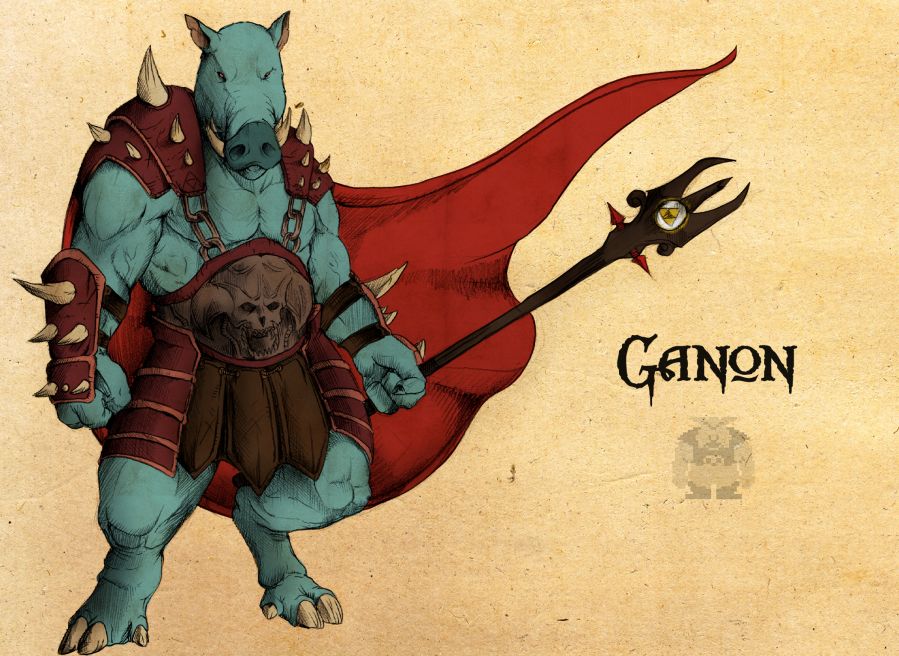
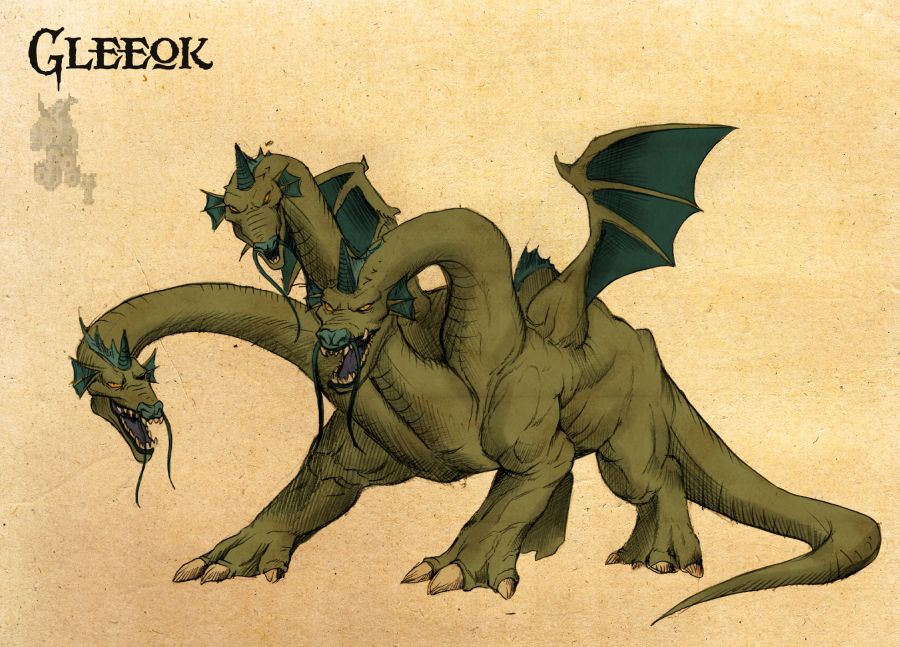
Well, I don't have a post for you all, so I thought I'd just go through some of my bookmarks for some sweet video game art. Fan art, on a whole, is an incredible thing. Some amazing stuff bubbles to the surface on the internet. Like that sweet Ganon picture up there. Isn't it totally awesome? That image is part of a series of of Legend of Zelda images I found over at this place called the Zelda Dungeon.
I really appreciate the art style, and I also appreciate that it is all images from the original Legend of Zelda game on NES. We've waxed about nostalgia for this series before, and about the potential it may have lost over the years. Images like this remind me of that potential, of how these simplistic critters could look totally sweet and how there could be a rich mythology behind the happenings in the Zelda games.Also, it reminds me of all the cool names the baddies in Zelda have: Gleok, Dodongo, Keese.
The artist is called Deimos-Remus at deviantart.com.
Also at Zelda Dungeon, I found an interesting article about Skyward Sword that used terms like 'skill scaling' 'sub optimal dominant strategy' and the like. I love this game theory stuff, and I harbor dreams of being that kind of a smarty pants and getting to talk about video game design all day.
The writer for this article GaroXIcon, and I like him so far. In addition to the above article, he pitches a direct sequel to A Link To The Past, and says that Majora's Mask is his favorite game of all time. How do you like that? GaroXicon is my new video game critic crush. and Deimos-Remus is my new video game art crush.
-D
Wednesday, November 27, 2013
Game Design Idea: Narrative Walk Through : Statement of Purpose
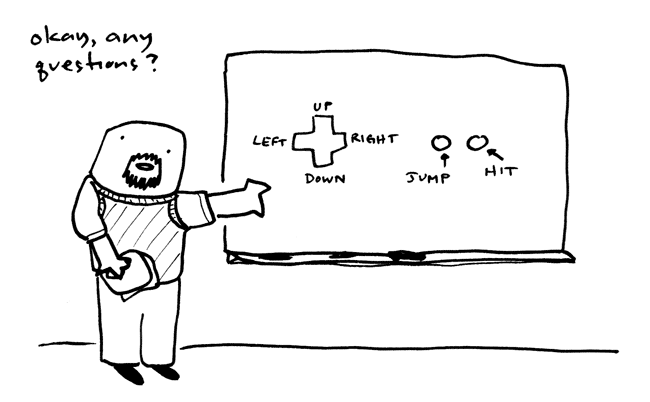
For example, I think it would be great to design a game, where the levels progress with programming milestones. Like, the first screen is just a crappy looking block guy, moving around -- success! Then the next screen maybe you can slash a sword! And then by the third screen, maybe you can cut down a bush! Hooray! Then there's an enemy. And then, by then you might have the hang of it enough to have like, a whole series of screens, with a treasure box at the end, hooray!
I imagine a narrator the whole time, describing the process of creation to the little character on screen. The challenges, and progressions. Creating a weird meta-fiction author dynamic. Did I mention I love meta-fiction? I've noticed this stuff is pretty big these days as well, with games like Thomas was Alone and the Stanley Parable Demo. Also, with the regular use of the term 'meta' to describe things. But being a fancy English major, I've been familiar with the term for some time.
Specifically, I was introduced to meta-fiction with the book 'At Swim Two Birds' by Flann O'Brien (pen name Brian O'Nolan - meta!) . It's a book about a guy who's writing a book. Meta level 1. Then the characters in that book decide they don't like what's going on in their story, Meta Level 2, and they go to to the authors house to talk some sense into him. Or some such thing. It's a lot of fun, and very old, published in 1939.
Further Meta ideas come from the 'fourth wall' concept in theater, whereas the actors aren't supposed to acknowledge the audience, and when they do so, they're breaking the 'fourth wall.' I've always loved to play with that, though.
Of course, my idea of a video game about its own creation is silly for a couple reasons. One is that I still don't actually know what the process is like. I'm just guessing. And whenever I read interviews with game creators, they always describe all sorts of things they weren't expecting. So I expect that would happen to me too. Expecting the unexpected, I'm so ready!
Anyway, I think the process would be to work on different concepts, enemies, items, procedures, etc. And make careful note when something interesting happens. Then, when I've got the hang of the whole programming thing, go back and fake it. There's no need for my authentic practice screens to be in a game, just something resembling them. Throw a kookie narrator with a british accent on the thing, and I'm set!
Man, I love my own ideas! And it's so much easier to write about them than to actually push them through my metaphorical loins, spank breath into them, cut their metaphorical umbilical chord, hold them close and feed them from my metaphorical teat! I'm unemployed, and *still* that sounds like too much trouble! Maybe it's the way I described it... Actually, wait, this reminds me of the conclusion of the play "Slag" that I saw in college. My girlfriend was one of the three principle actresses, and her character gets miraculously pregnant, but her character was insane, and it was actually just a food baby. (Oh man, I am *such* an English Major.)
Anyway, I realize I spoiled the ending for you, which is a high crime, but don't worry - the enjoyment of that play came from the performances. Three fantastic Actresses with really great chemistry. The plot wasn't really very important, and I saw it more than once, I think. It was performances like that that gave me a love of the theater. And has subsequently fueled my curiosity about the connection between theater, film and video games. Specifically around minimalism - I love how fantastic some performances are with minimal set design. I can't help but wonder if a similar elegance can be applied to game design, programming and execution.
 |
| http://www.andysowards.com/blog/2012/70-epic-map-design/ |
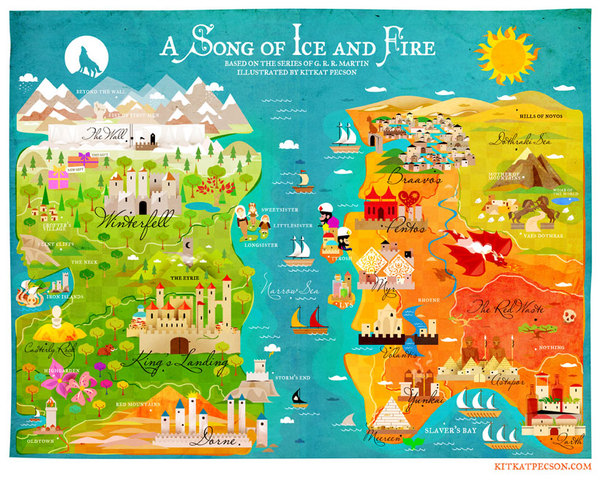
When I was young, I wanted to create epic fantasy. Nothing but. Alright, maybe an occasional side-scroller. But, the biggest piece of my creative pie was taken up with 50+ hour Role Playing Games. And the reflexive version: novelizations of already existing RPGs. High Fantasy, Tolkein and Dungeons and Dragons ruled all. And the bigger, longer and more epic, the better. It is still like a security blanket or a favorite stuffed toy. I can go back there just by closing my eyes and relaxing.
However, in these days following the Box Office and Academy Award domination of the Lord of the Rings movie Trilogy, it seems pretty damned clear to me that the High Fantasy World is covered. You can't throw a stone without hitting a two to three hour epic something. I missed riding that wave, and now I'm wonder when it will subside.
These days, I am most interested in minimalism, in peeling back all of the glitz and the glamour and the huge set pieces, to find out what's in the core of genre, theater, creativity. I want to take a chisel to the edifice of the modern High Fantasy Blockbuster and see if there isn't something beautiful underneath it all. I believe that minimalism is more raw, and prompts the viewer to fill in the gaps with their own imagination. More than that, it is much, much more inexpensive to produce. And therefore can be done with a smaller team, which allows for much more creative control and input by the principle few. And that serves my starving little creative ego, I think.
Hmm, caffienne high is faltering. love of my own ideas is waning. autumn is passing into winter. power down. boooooooop.
-D
P.S. follow-up question: does this need to be published? Our blog quality standards aren't like, super-high or anything, yet I have a bunch of ideas that are important to me here, and I could maybe turn them into something real. But if that's the case, what does it matter if I publish now or later?
P.P.S. Mine the brainy gamer for theater-game connection. I think he's really into that.
P.P.P.S Interdisciplinary study called 'Performance Studies' at UCD, Berkeley. Looks pretty darn close to what I'm looking at
P.P.P.P.S Adaptation and American Movie are both examples of movies about the making of movies. Adaptation with much more creative license - and a big favorite of mine!
P.P.P.P.P.S. I think I'll just keep all these post-scripts. Why not? I'm feeling silly. Also, I heard that there was a game that progresses through the history of RPGs. That's sort of what I'm talking about, but not the same thing.
Subscribe to:
Posts (Atom)