Showing posts with label graphics. Show all posts
Tuesday, June 23, 2015
A Blurb on the Remake of FFVII
The recent announcement of a Final Fantasy VII remake has got me thinking about that classic title. I have a mixed relationship with Final Fantasy VII. As Jaconian has said in the past, I think it's one of the most overrated games of all time. You should read his post on the subject for further thoughts. However, I have played through the game several times, and when I take a moment to daydream about the games aesthetic, I find myself welling with pleasant nostalgia.
It's not to say I don't like FFVII -- I do! Heck, I've revisited it several times throughout the years. My issue is that, right from the start, it was hailed as the greatest game ever, or the greatest RPG ever or some other expression of the highest possible praise. And, often enough, this praise game from people who had not played previous iterations of Final Fantasy games.
At the time of its release, it was the first Final Fantasy on a non-Nintendo System. I had to buy a Playstation just to play it! So I was already a little annoyed. Actually, wait, I was a teenager, so I was actually shocked and betrayed and hurt. I think I stamped the game as tainted or something, and I became an outspoken Final Fantasy VII critic. But I do really like it.
I guess I don't have much to say about the potential remake, except that I really hope for a remake of the Super Nintendo game, FFVI(III) to follow. Additionally, I want to say that I really like the blocky graphics and rendered backgrounds of the original VII. I think the characters look like little puppets and are fairly expressive; enough to get the job done. On the other hand, the soundtrack should be great!
But I get it. FFVII is the legendary greatest of all games. Of course this one will get the remake, simply from a business standpoint. It's not the game that has the most to gain from a remake, but it is the one that is most likely to sell copies. That's fine. But I'll cross my fingers for Final Fantasy VI(III)
-D
Tuesday, November 25, 2014
What I mean when I talk about Graphics
The body of this post was originally composed about two years ago when this blog was brand new. Because of my difficulty in articulating my thoughts, opinions and convictions, this post sort of floated around in draft form for those two years. I recently read an essay over at Gamasutra on the same subject and decided to dredge this old post up, dust it off and finally publish it. I think the subject of graphics has long been an important one in Video Games, though it does seem to be pretty much the same story as when I was a teenager. Bigger, better, higher, faster. If this subject interests you at all, have a look at the Gamasutra article I've linked here, and share any thoughts or resources you have on the subject. Thanks. -D
When it comes to Graphics, I have always been and will always be, something of a hypocrite. At least, it will seem that way to everyone who isn't inside my head, or doesn't understand me in that special "nerd" way. I will, on the one hand, whine endlessly about graphics. About too much focus on good graphics. Too many bells and whistles, and not enough depth. And then, on the other hand, I will dance a jig and praise halleluja to the graphics of games I like. This is a pattern I plan to never break.
![]() |
| no denying this is purty, but is it enough? |
When it comes to Graphics, I have always been and will always be, something of a hypocrite. At least, it will seem that way to everyone who isn't inside my head, or doesn't understand me in that special "nerd" way. I will, on the one hand, whine endlessly about graphics. About too much focus on good graphics. Too many bells and whistles, and not enough depth. And then, on the other hand, I will dance a jig and praise halleluja to the graphics of games I like. This is a pattern I plan to never break.
For example: in the case of Minecraft: it’s hard to call the graphics ‘good’ per se, on some
sort of linear scale of supposed ‘quality’
- however, it’s easy for me to call the graphics ‘awesome’ because they
are. It’s more a design thing than a
photo-realistic thing. Photorealism is a
keyword here. There is a belief
somewhere that this is the pinnicale of graphic representation, and I have to
disagree with that.
When
I was younger, I believed in photorealism.
I believed that was the sort of art that required skill, and that
abstract art was just nonsense. Funny thing though: I have no memory of cartoons as art, or my opinion
of cartoon art. Cartoons were simply
alive, and I loved them. It never occurred to me that they might be art. Maybe this is one of the best
measures of art.
Bridging
the gap from cartoons to realism is comic book art. I thought Jim Lee and Mark Bagley were the best comic artists of the 90s. This was in
part because of their ability to convey realism, but, growing older, I see that
their version of realism was highly stylized and not really photo realistic at all. But even that level level of realism isn't necessary for enjoyment.
![]() |
| Quintessential Jim Lee artwork from my childhood |
It would be nice to have a better vocabulary for these things. To better be able to explain what I mean. I'm going to work on that in this post. Jac, I'm sure you know what I'm talking about. Little help?
Jaconian's Interjection: I totally get/agree with what you're saying. I'll argue that with some Final Fantasy games, that they've moved away from story and focused too much on the look and graphics of the game. "It's not all about graphics!" But then, when I play say, Wave Race, I'll be like, "It's a pretty standard racing game, nothing overly special. But dear god man, look at the water! It looks fucking real!" That might not be a great example, but I understand where you're coming from. Another one is the "updated" graphics in Dragon Warrior in the US from Dragon Quest in Japan.
In the image you can see the difference in sprites and in the article is says that the character always faced that direction, regardless of the direction. I tell myself now that that would bother me and the "better" graphics are better for game play, even though graphics aren't a big part of why I find that game/series to be so awesome.
Another thing that I've found myself being a hypocrite about, in a similar manner to graphics, is the quality of music in games. I can listen to the Legend of Zelda overworld theme for hours on end, with it's simple three tone musical awesomeness. But then with the music from Ocarina of Time, I'll go on for hours about how the music sounds like not-so-great MIDI. Additionally, the sound quality between the two is different and while there are sound quality improvements over the original soundtrack, ultimately I feel that there was a shift away from melody to atmosphere
OR, staying with Zelda, the graphics and design of the game (like what you said in your previous post) are perfect for he game. BUT, if there was an updated remake with either the Wind Waker or Majora's Mask engine, I would be singing its praises even before I got a chance to play it. Maybe that's because it's something we've been talking about since Ocarina of Time came out.
Yes, graphics sure do represent a mixed bag of experiences. And it seems like that is the key to the whole thing- how do the graphics affect your experience of the game? Arguably, with the Dragon Warrior example, your play experience probably wouldn't have been affected much by the graphical updates. If nothing else, the fact that the character always faces the same direction may have been slightly distracting. But, then again, it may have been more distracting than I imagine. I always accepted that the 'open world' style design of Dragon Warrior is a place with four cardinal directions, and that the characters within have a front, sides and a back. The idea of every character sort of 'strafing' along is kind of distasteful. But I'm probably over thinking it, which is okay; I like doing that.
I guess when thinking about graphics, it is good to think about how they are used. In the case of Wave Race, it may be good to note that the game took place in many different settings. The first that come to my mind is 'Drake Lake,' which has the most dynamic graphics in that game. Here, the fog-lifting action on the third lap sort of 'shows you what you've been missing' to great effect.
However, even without the fog-trick from Drake lake, the water effects on Wave Race are awesome. More than any other racing game, Wave Race gave me the desire to drive off of the course and just go exploring. I think the water effect had a lot to do with that. A water environment is so much more interesting than a racetrack environment. I only wish they had actually supplied an open world track. Or, hey - you know what would be awesome? A Jetski option in Pilotwings! For close examination and exploration of the coastlines and islands.
Alright, I'm getting distracted here with another one of my random 'you know what would be cool?' game ideas. Ultimately, I'm not sure what my point is here. Except maybe that 'my opinion is my opinion and that is that.' Which is kind of... a moot point to begin with. Anyhow, when I look at the industry, I see a lot of hyper-realistic big AAA games, but then I also see some really cool artful and abstract indie games. So, I keep my attention on the indie games, but I do wish that the masses being catered to by the big-industry could see and appreciate the games I love. And that's normal, isn't it?
-D
P.S. Since I originally wrote the bulk of this post, I had the great pleasure of reading Scott McCloud's fantastic 'Understanding Comics' series. I highly recommend this book to anyone who is interested in comics, art and design. I found the contents relevant to subjects outside comics; including video games. He puts forth this idea of Realist vs Iconic graphics, and puts them in this nifty Triangle (below), which he cleverly calls the 'Big Triangle.' He has a breakdown of the Big Triangle on his website. Go check it out, why not?
Friday, May 2, 2014
First Impressions: Mirror's Edge & Bioshock 2
Dr. Potts has already talked a bit about Mirror's Edge so I won't go into a whole lot of detail about the game, just my general thoughts after having played for just about four hours. And last month (technically in March), SneakyTiki got me Bioshock Infinite for my Nameday so that influenced me to have a go at Bioshock 2 and after five hours, I would like to talk at you about it. Yes, I ended a sentence with it. Again.
I can fully understand the appeal of this game as it fulfills one of the core reasons why I play video games: Mirror's Edge allows me to do something I cannot do in real life.
Presently, I have played through the tutorial and, I think, the first four levels. The tutorial threw a lot at me, almost too much for my liking. I agree with Dr. Potts that Portal does a better job of introducing the player to game mechanics and I feel that the tutorial stage should have been a whole series of levels and not just a series of jumps (good, now you know that one), wall climbs (now you know that one), falling rolls (good, you didn't die, moving on) and wall-to-wall jumps (did you accidentally make it up the wall and not really know what you did, that's okay, moving on). And that's just dealing with the terrain. You are also given a very rudimentary crash course in assailants, disarming said assailants and avoiding them. The tutorial/training course takes maybe 10 minutes and at the end, I feel like the game expects that I now have a firm grasp on being able to complete the game. Not true, at least in my case.
So far, I get the impression that the game is broken up into sections. First, there are the sections where you are chased by Blues (coppers) and shot at extensively by them and helicopters. I somewhat understand them being included so that the player doesn't linger and they add a sense of urgency to get through the stage. The down side is that I am not having fun. I feel like these stages I could play in any first person video game and are not special to Mirror's Edge. The other sections are chase stages, where you have to get from point A to point B while following someone who is just a hair faster than you. There is still that same sense of urgency, but instead of being shot at, you run the risk of losing sight of your target. This is what is keeping me playing the game, to have the chance to free run through a level with the only threat of death being my own stupidity as I jump a fence only to fall thirty flights down and hear by bones shatter and body splat as it greets the pavement.
One very interesting thing that I had to do with the game was lower a lot of the video settings. This game came out back in 2008 and I would like to believe that my laptop is capable of running a game that was released four years before the components were created could handle the graphic requirements. Initially I had "everything" turned up to max (except Anti-aliasing which was at 2x), but I began experiencing sever lag whenever I was being shot at by more than one source. The skipping/lag became so bad that I was unable to time my jumps, which is a rather important ability in a game that centers around parkour. I then went back into the settings and turned down texture detail and graphics quality to medium and was forced to turn off anti-aliasing and "phy sx" support. I can now play the game while being shot at by five coppers and a helicopter without having to worry if the game is going to start skipping as I approach that highlighted red board leaning haphazardly over the side of the building leading me to that other building across the street and two stories down.
Oh, and lastly, I have noticed, perhaps not too surprisingly, that I get motion sickness after playing for about 3o minutes. The effect is more pronounced when I play on my laptop, but on the TV, I can play for about an hour. So there's that too.
I won't talk to much about Bioshock 2 as I ended up talking more about Mirror's Edge than I had planned and I don't feel like editing down or breaking this up into two posts. In short, I am very much enjoying Bioshock 2. I have played about five hours and after the initial disorientation at the beginning, I am having a lot of fun. I enjoy being back in Rapture and once I figured out that the prologue takes place before the first Bioshock and then the rest of the game begins after those events, I was able to enjoy the game even more.
What I find interesting, is that I had a preconceived notion/impression that Bioshock 2 received bad reviews. That people did not like taking control of a Big Daddy, that the gameplay was redundant of the first game, that the story did not offer anything new to the world of Rapture and that the game needed a constant internet connection all played towards the game being a disappointing followup to the masterpiece that was the first Bioshock.
As it turns out, at least according to Wikipedia, Bioshock 2 was actually a very good game that expands on the universe. As is the case with any game, there are going to be negative reviews so maybe that was where my pre-playing impression originated from. So it turns out I am not as alone as I thought I was going to be by stating that I am currently liking what Bioshock 2 has offered in the way of story, game play, voice acting and music. It feels good to be back in Rapture.
~JWfW/JDub/Jaconian
Saturday, September 14, 2013
First Impressions: FEZ- interrupted
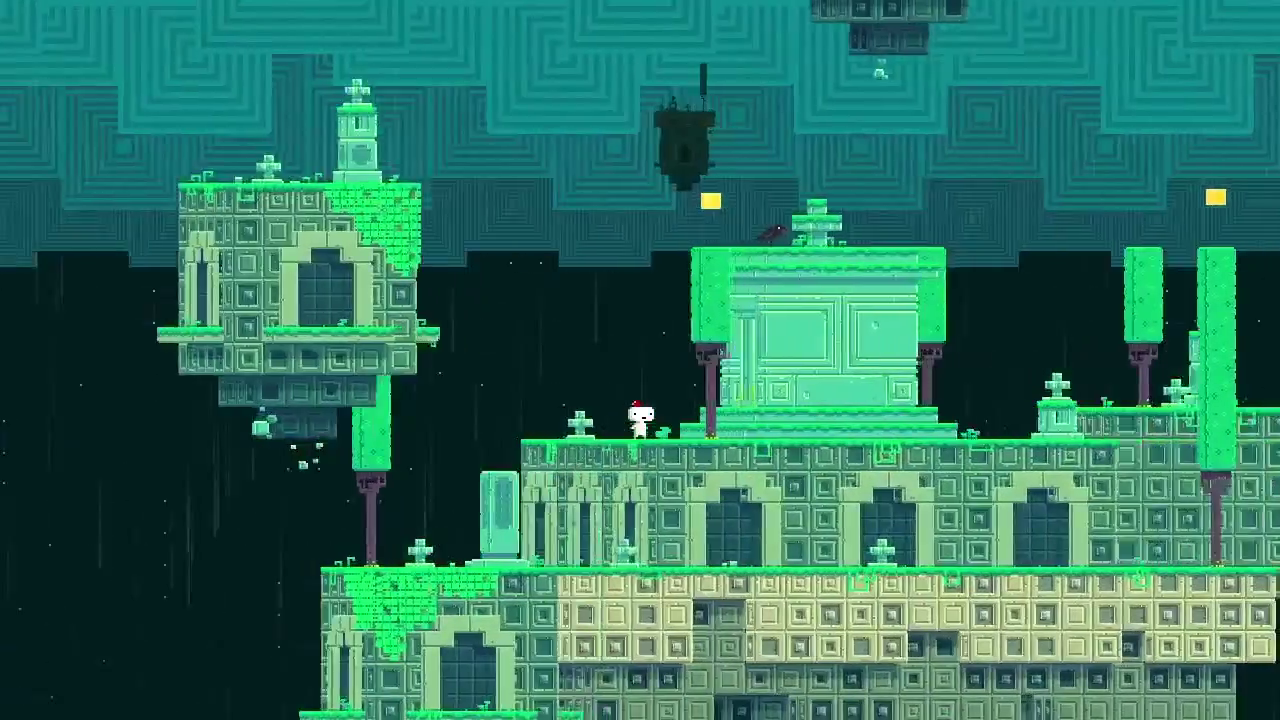
So, after a long time waiting, FEZ was released for Steam. And then, shortly after, it went on sale at 50% off, and I bought it. Even though I don't have a job and should be saving my money. I've been wanting to play FEZ since I first heard of it! But for a long time it was only available on X Box, so I had to hold out for 'some day.'
Well, that day is today. Or, actually it was a few days ago. Anyhow, I installed FEZ, and it runs. It doesn't run great, however. It's a little choppy, really. Not terrible, but not smooth. Playable though. At least through the first two stages. The third stage ratcheted up the image complexity, resulting in a huge cut to the framerate. If I had to guess, I'd say it's down to about 5 frames per second. I believe film runs at 24 frames, and fancy high def film runs at 60. I've also heard that the human eye can't perceive more than 60. That's neither here, nor, there-- I guess the point is that I can't really play FEZ. damn.
Having seen Indie Game the Movie, I am tempted to judge FEZ harshly. Mostly because the creator, featured heavily in the movie, comes across as too hyperbolic. But also, I know that he went back and remade all the tiles in the game, to a greater graphical complexity. I think his efforts show, FEZ is very pretty, but it doesn't do me any good, because that same complexity is very likely contributing to my difficulty in playing the game. I'm a strong advocate for gameplay first, graphics second. Otherwise the graphics are a bit more of a window dressing for a game that doesn't play all that well.
I'm concerned that FEZ has a bit high of a window dressing component. On the other hand, the central gameplay mechanic - rotating a 2D world - is fantastic. It really is brilliant, and it appears to be executed pretty effectively. My biggest argument for this is that I had FEZ dreams the first night after playing it for about an hour. There's just something so satisfying about the rotating Platforms. The platforming isn't that great, however. The jumping is unwieldy, and I find I miss jumps I think I should make. On the other hand, there are lots of fun references to classic games, such as Ocarina of Time and the Super Mario Series. These are done well without seeming overdone. More window dressing, perhaps, but it's really good window dressing.
So, bottom line, based on my impression of the first couple of levels: The creator may have some issues he needs to work out, but FEZ is, thus far, delightful. I hope I can get a hold of a better graphics card and finish playing before too long.
-D
P.S. Oh look, and now it's available for the Humble Indie Bundle 9 - wouldn't you know it? If I had just held out, I could have gotten FEZ and a bunch of other games for the same price I paid for FEZ + soundtrack. Oh well, that's how it is with the Humble Bundles: you win some, you lose some. Really, you mostly win. Pretty much always.
P.P.S. And look again! It turns out my janky ol mac laptop can actually play FEZ better than my desk top! whodathunk? This machine is full of surprises. Except the overheating after a half hour of play. That is like clockwork. In the meantime, I will at least get a chance to take a few more bites out of FEZ. For this, I am grateful.
Saturday, May 25, 2013
Ultima Exodus: Graphics and Exploration
I want to take a moment to site a couple of significant elements outside the challenge of the game. First is the party construction. In Exodus, you are allowed up to 20 characters, each of which can be custom created. You form a party of four of these characters each time you play. These characters level up independently during play. This element really lent itself to some of the household participation I experienced with this game, as 20 characters was more than enough for everyone in my family to have their own party of four. That way we could contribute to a greater whole, while still remaining independent. And we could just have fun creating custom characters and stocking the barracks, as it were. That way different classes can be available to the main players who are out accomplishing goals and progressing through the game.
Another thing I'd like to point out is the music. I think it's pretty damn good for an NES game. The songs tend to be long and varied, much more so that their contemporaries. There aren't a lot of tracks in total. I think that Exodus is often forgotten about in the annals of NES music.
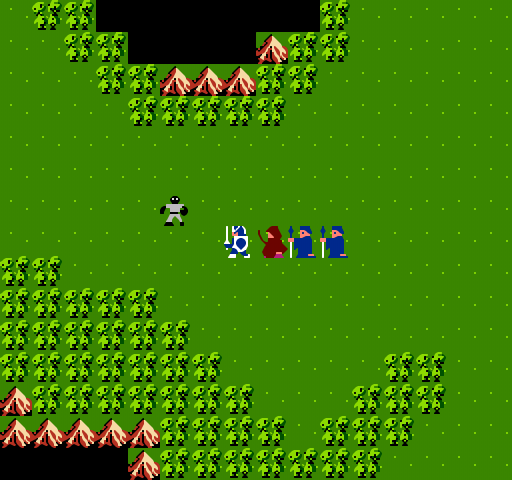
Finally, the graphics. Sure, they're pretty crappy (though still way nicer than the PC version IMO). But one graphic design element that I really like is the line of site shadowing. Opaque objects such as walls, or mountains or deep woods, will hide portions of the screen in shadow, because they cannot be seen through, so the characters don't know what's on the other side. I think this really deepens the sense of exploration in the game. I'd love to see what Final Fantasy, or even better, Dragon Warrior would play like with this design aesthetic.
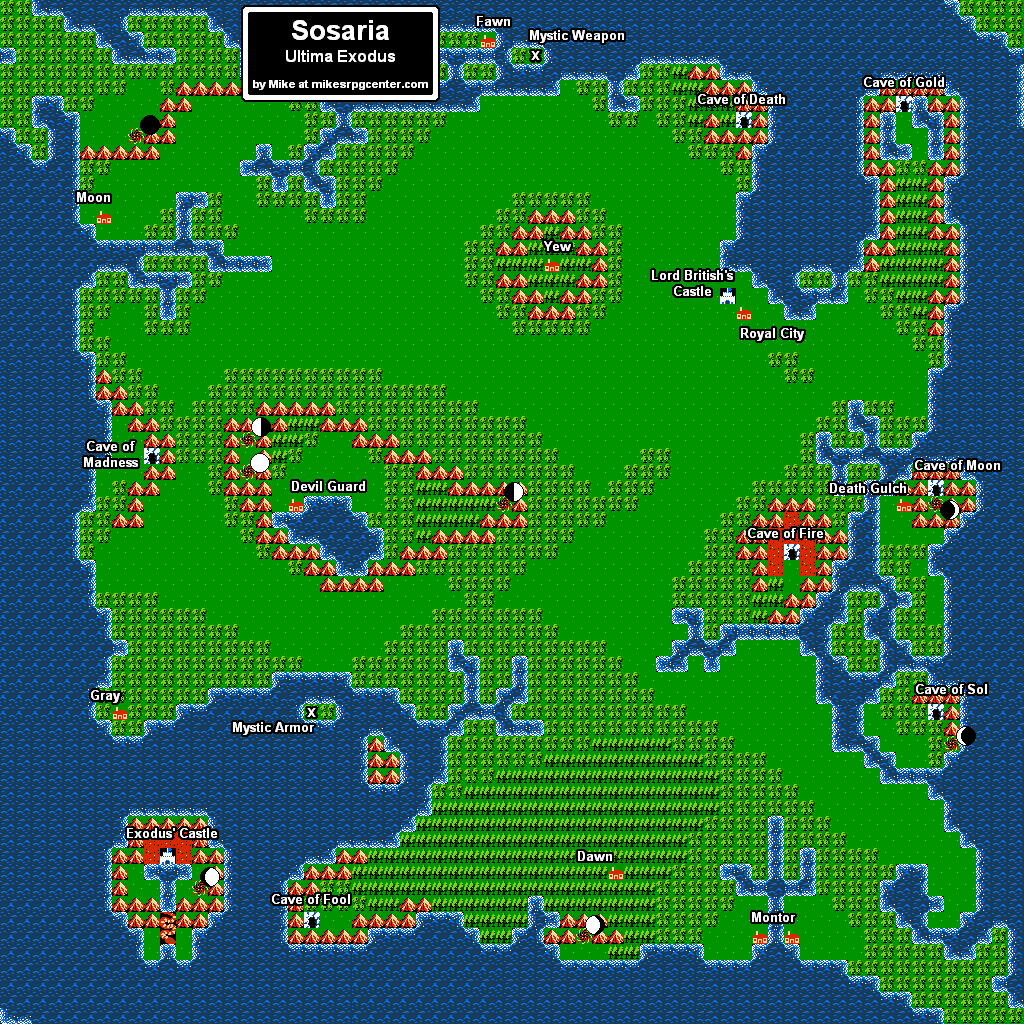
In parallel to that, I'd also like to point out that the general map design in Exodus is nice. There is a progression of wilderness that informs travel decisions. The party starts out in a plain, where movement is unhindered. Winding rivers creep in from the sides. Bordering the plain is some heavy growth roughage, where movement gets a bit slower, making the party more vulnerable to attack. Beyond the roughage is deep forest, which obscures visibility and beyond that are impassible mountains.
I feel a definite sense of danger the farther I wander outside of the open plain. However, it is clear that I will need to explore the darker, more confined spaces of the game if I am ever to get anywhere. I think these elements add up to a more active world map, rather than a passive one of many of Exodus' NES contemporaries. Though the Exodus map is rather small, in comparison.
Exodus is not without its many flaws. Of which, I forgive all. I am happily biased, and give the game the benefit of the doubt at every turn. After all, this was an important and formative game for me, and I wouldn't have it any other way. But hey, just for fun, I'll list a few of these flaws and make excuses for each of them.
Most of the character classes aren't worth playing. But they're still fun to build, and I appreciate having the option to explore the strengths and weaknesses of a class. The map is small, but well designed. The objectives are confusing, but the challenge to explore is its own reward. The story is non-existent, sort of. The difficulty at times seems as though its from bad design. Which is in the eye of the beholder, bad design can be viewed as another challenge to be overcome, if you so choose. And I do.
-D
Read Part 1 of my Ultima Exodus review.
Sunday, March 17, 2013
Emulator Hour: Faxanadu (NES)
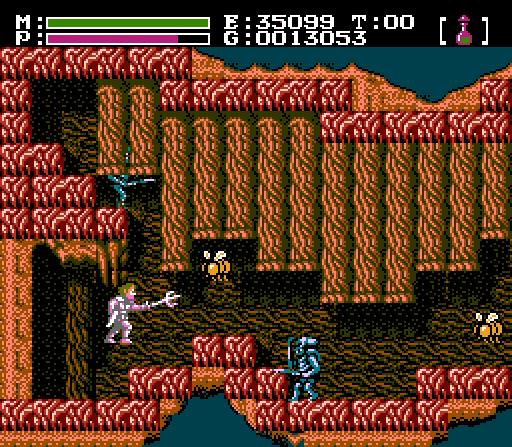
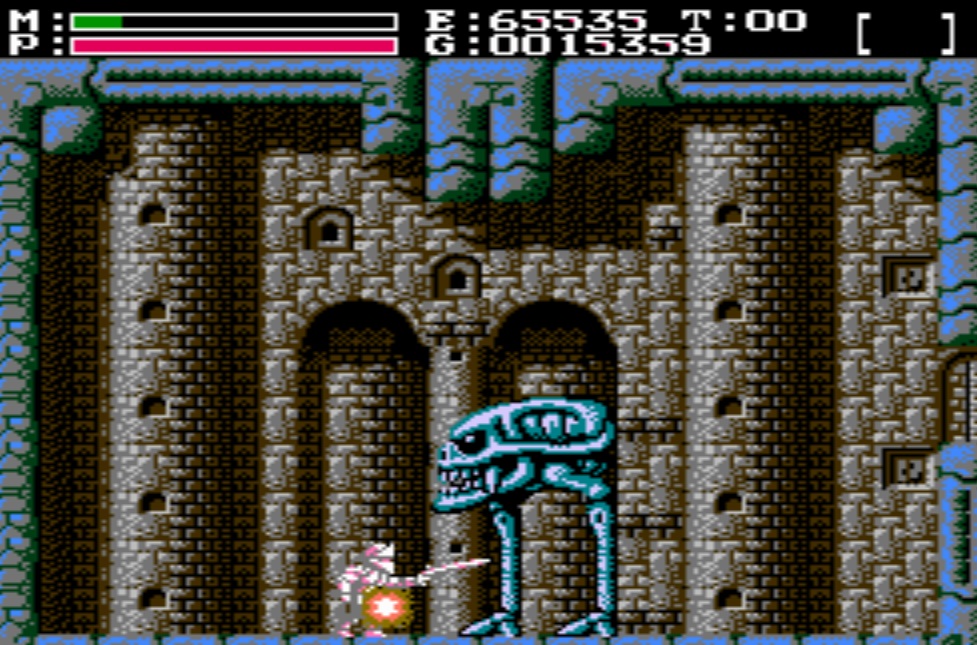
Below I show a progression of some of the different pallets and musical themes from Faxanadu. The game's action starts at the base of the World Tree, travels up the tree a bit, goes inside the tree, comes back out, then ends up in the branches. I love the idea of fighting through a giant tree. This is a game that warrants a good remake. Emphasis on good.
Muddy brown brick and a sky with a greenish hue characterize the town Eolis, cut off from their source of water and life.
Eolis theme.
Eolis theme.
The contrast is kicked up at the trunk; bright orange and green dominate, with a deep blue sky. The music picks up a bit.
Purple foggy good times. This was the furthest I ever made it on a rental. Delightfully spooky musical accompaniment.
Mist Theme
Mist Theme
Here we are in a branch of the great world tree. The music gets a bit more serious in tone.
World of Branch Theme
Somehow there's a stone dungeon in the branches of this tree. Another new pallet. The music is a variation on the previous dungeon theme.
Labrynth Theme
Labrynth Theme
Wednesday, February 27, 2013
Proteus: Graphics and Exploration
I'd like to start off with a nice video walkthrough/commentary on Proteus. Just in case my gushing and images aren't enough, this walk-through will give you some idea of what it is like to play Proteus. That said, this video is basically one big spoiler. So if you haven't yet played Proteus... maybe just ignore me until it goes on sale (I'll let you know), and then buy it and then play it.
I've played Proteus through a couple times now, and I think I've made some basic determinations about this game: Proteus is an easter-egg hunt. No one is keeping score - and there is a complete lack of achievements. The purpose of the game is to play it and enjoy it, the player decides how much they enjoy it. I am one who has decided to love it. There are others who decided not to. That is ok with me. But if you choose to play, you can spend your time looking around, and you will find some things that may catch your attention and interest, and possibly provide you with some delight.
Actually, funny thing-- I have been thinking about making a game based on the causeway which connects Sacramento to Davis. I ride over this causeway on the train all the time, and when I'm looking out the window, I have observed a lot of beauty and subtle differences. Because I love games and thinking about gaming, I've wanted to depict this environment through gaming.
My initial idea was to make a minecraft of the causeway. This I still may do if I come into a boatload of time and patience. The things that I observe from out the train window are mostly: the weather and the animals. The causeway is sometimes foggy, sometimes clear, sometimes flooded. Sometimes I see egrets and ducks floating in the water, sometimes I see geese in the air, and little swarms of tiny birds. Sometimes I can see the mountains in the distance and snow on top. Sometimes the fields are full of wheat or squash or some other plants. The colors can be many shades of brown, or contrasting shades of bright green, blue mountains, stark-white farm buildings and bright blue sky.
As I've observed the world of the causeway through the window of a train, I've wanted to share this form of peaceful joy with the world. And as I imagine an artistic rendering of this landscape, I've thought of doing so with a video game. This video game would need to pay special attention to the landscape, animals and weather. The purpose of the game would be to travel through and observe a world of beautiful sights and sounds.
Proteus has done just that. My playing experience is akin to looking out the window at the causeway, imagining what it would be like to wander around there and take in the sights, sounds and smells. It really is amazing to me, to capture such a sublime experience, and I am very glad I found this game. Sorry to gush.
Two of the most outstanding features of Proteus are: the practiced restraint on the part of programmers, and the synchronization of the sound and visual space. There are musical cues triggered by the environment in a variety of ways. Some triggers come from being near something: the hoot of an owl, the croak of a frog. Some are triggered by looking at something, such as the sun on a hot summer day, or a shooting star.
Sometimes I think that Proteus is too sparse, and could use more of everything. More birds, more bugs, more trees, more weather. But one thing it does wonderfully is to balance what it does have into a consistently interesting gaming experience. I believe it is through restraint on the part of the game designers, that this balance is achieved. I would be very sad if there was a sequel or expansion to Proteus that, perhaps with a zeal to improve and expand on the game play, was to disrupt the balance so that the sense of wonder and joy were lost or significantly diminished.
It is possible that this game can be so much more than it is, but it is also possible that what Proteus is - is the best thing it can be, and that this feeling I've gotten from playing, of so much more, is best for me to hold, and relish and used for inspiration to create something beautiful myself, rather than to demand it from the creators of Proteus or the industry in general.
I think it may be that the very sparseness of Proteus lends itself to the need for a player to explore. For example, if I'm feeling aimless while playing, I find a good strategy is to chase a frog until I find something that catches my interest. Sometimes this leads to finding something unexpected.
RockLeeSmile highlights indie games in a series of videos called 'Indie Impressions.'
====================================================================
I've played Proteus through a couple times now, and I think I've made some basic determinations about this game: Proteus is an easter-egg hunt. No one is keeping score - and there is a complete lack of achievements. The purpose of the game is to play it and enjoy it, the player decides how much they enjoy it. I am one who has decided to love it. There are others who decided not to. That is ok with me. But if you choose to play, you can spend your time looking around, and you will find some things that may catch your attention and interest, and possibly provide you with some delight.
Actually, funny thing-- I have been thinking about making a game based on the causeway which connects Sacramento to Davis. I ride over this causeway on the train all the time, and when I'm looking out the window, I have observed a lot of beauty and subtle differences. Because I love games and thinking about gaming, I've wanted to depict this environment through gaming.
My initial idea was to make a minecraft of the causeway. This I still may do if I come into a boatload of time and patience. The things that I observe from out the train window are mostly: the weather and the animals. The causeway is sometimes foggy, sometimes clear, sometimes flooded. Sometimes I see egrets and ducks floating in the water, sometimes I see geese in the air, and little swarms of tiny birds. Sometimes I can see the mountains in the distance and snow on top. Sometimes the fields are full of wheat or squash or some other plants. The colors can be many shades of brown, or contrasting shades of bright green, blue mountains, stark-white farm buildings and bright blue sky.
As I've observed the world of the causeway through the window of a train, I've wanted to share this form of peaceful joy with the world. And as I imagine an artistic rendering of this landscape, I've thought of doing so with a video game. This video game would need to pay special attention to the landscape, animals and weather. The purpose of the game would be to travel through and observe a world of beautiful sights and sounds.
Proteus has done just that. My playing experience is akin to looking out the window at the causeway, imagining what it would be like to wander around there and take in the sights, sounds and smells. It really is amazing to me, to capture such a sublime experience, and I am very glad I found this game. Sorry to gush.
Two of the most outstanding features of Proteus are: the practiced restraint on the part of programmers, and the synchronization of the sound and visual space. There are musical cues triggered by the environment in a variety of ways. Some triggers come from being near something: the hoot of an owl, the croak of a frog. Some are triggered by looking at something, such as the sun on a hot summer day, or a shooting star.
Sometimes I think that Proteus is too sparse, and could use more of everything. More birds, more bugs, more trees, more weather. But one thing it does wonderfully is to balance what it does have into a consistently interesting gaming experience. I believe it is through restraint on the part of the game designers, that this balance is achieved. I would be very sad if there was a sequel or expansion to Proteus that, perhaps with a zeal to improve and expand on the game play, was to disrupt the balance so that the sense of wonder and joy were lost or significantly diminished.
It is possible that this game can be so much more than it is, but it is also possible that what Proteus is - is the best thing it can be, and that this feeling I've gotten from playing, of so much more, is best for me to hold, and relish and used for inspiration to create something beautiful myself, rather than to demand it from the creators of Proteus or the industry in general.
I think it may be that the very sparseness of Proteus lends itself to the need for a player to explore. For example, if I'm feeling aimless while playing, I find a good strategy is to chase a frog until I find something that catches my interest. Sometimes this leads to finding something unexpected.
Wednesday, February 13, 2013
First Impressions: Proteus
Wow.
Attention everyone: Proteus is my new favorite game.
You may remember this game as Crazy Atari Graphic Style First Person Game from my little shpiel on the PBS video The Creativity of Indie Games. For a preview of this game, watch that video, as there are clips of it throughout. Not to mention a bunch of other games I plan on trying.
Proteus is a game I would like to go on and on about. But I would rather you play the game, and come talk to me, and then we can both go on and on about it. For now I'll mention some facts: It is available here, for $10. I suggest you buy it. It plays Mac and PC and Xbox 360 and is available on steam.
Here's a picture:
The first impression I had was one of relief when I realized nothing in this game is trying to kill me.
It is a first person game, and Jaconian: You will be happy to hear that you can invert the Y axis. Generally, the menus are minimalist, so I am glad they included this little option. The controls can be a little slippery, so I hope it doesn't trigger motion sickness.
Here's another pic:
If you go to the website for the game, you can download it. You can also read all sorts of acclaim for Proteus. It's all true, but I think, rather then spending your time reading that, you should just buy it, play it, get your significant other to play it, if you have one.
I think you could probably buy this game as a valentines present and get away with it. More pics:
I've put in about two hours, and I'd like to put in some more.
I want to also mention that this game does an excellent job of mixing the music, sounds and graphics together. If I had to sum up the effect in one word it would be: Pleasant. I think this game might be a really good winter time game, and there's not much winter time left, so download it now. Thanks. And you're welcome!
-D
Attention everyone: Proteus is my new favorite game.
You may remember this game as Crazy Atari Graphic Style First Person Game from my little shpiel on the PBS video The Creativity of Indie Games. For a preview of this game, watch that video, as there are clips of it throughout. Not to mention a bunch of other games I plan on trying.
Proteus is a game I would like to go on and on about. But I would rather you play the game, and come talk to me, and then we can both go on and on about it. For now I'll mention some facts: It is available here, for $10. I suggest you buy it. It plays Mac and PC and Xbox 360 and is available on steam.
Here's a picture:
The first impression I had was one of relief when I realized nothing in this game is trying to kill me.
It is a first person game, and Jaconian: You will be happy to hear that you can invert the Y axis. Generally, the menus are minimalist, so I am glad they included this little option. The controls can be a little slippery, so I hope it doesn't trigger motion sickness.
Here's another pic:
If you go to the website for the game, you can download it. You can also read all sorts of acclaim for Proteus. It's all true, but I think, rather then spending your time reading that, you should just buy it, play it, get your significant other to play it, if you have one.
I think you could probably buy this game as a valentines present and get away with it. More pics:
I've put in about two hours, and I'd like to put in some more.
I want to also mention that this game does an excellent job of mixing the music, sounds and graphics together. If I had to sum up the effect in one word it would be: Pleasant. I think this game might be a really good winter time game, and there's not much winter time left, so download it now. Thanks. And you're welcome!
-D
Friday, June 1, 2012
The Legend of Zelda - Graphics and Exploration
I think Zelda 1 is my favorite game of all time. The reason for this is that I can very easily daydream myself into the world of Zelda 1. All I have to do is take a breath, and Zelda 1 appears in my mind. And it's always in a nice, dream-state, imprecise version of it. It's like I can *smell* Zelda 1. The visual representation appears the strongest, the colors and the general shape of the game, which are both very distinctive. I'm going to try to describe and analyze what it is about Zelda 1 that makes it so distinct. *I would also like to note that this post was not inspired by Jack's Memory Post - it was serendipity that we were both thinking at the same time, about the same phenomenon; of being transported into a game memory.
There are some clear contributing factors to how easily I can imagine the Zelda world. I played it when I was very young, and highly impressionable. I played it a LOT. But, in addition to these things, it is also a great game. And it is on that fact that I wish to focus. Yes, Zelda has been done before, but that's what makes it a great trial run for game analysis, that is, for game analysis on a good game. The Legend of Zelda has a very distinct and consistent aesthetic, and it is an open-world exploration game. I think these are the components which make the game particularly engaging.
Today I want to focus on the overworld map. Particularly about the sense of exploration and how the visual style helps to facilitate that sense of exploration. The game is viewed from top-down, and is divided by screens. So when I enter a screen, I can see everything in the screen that I can affect or can affect me. The game map in Zelda is essentially a series of rectangular pictures of screen size, positioned side by side and top to bottom to form a larger rectangle. I can only view one picture at a time, and I can move freely within the picture I presently inhabit. Passing between screens is an important part of the game, allowing me to run for safety if danger lurks in my present screen. The transition between screens is, for everyone who plays the game, a signature part of the visual aesthetic.
Each screen is made up by mostly tile-based images. Bushes, Rocks, and Enemies all fit within small 16 x 16 pixel squares, as do all hearts, rupees and items (I discovered these dimensions when playing Mario Paint for the Super NES). This consistent size and use of simple, primary colors creates a simplistic design that might be called minimalist. There were never any real surprises, in a given screen, but there were always different arrangements of the small number of tiles. The simplicity and limitations allow for everything to be placed purposefully, the consistency makes it so that the player is never pulled out of the game by bad design.
A great deal of my time playing Zelda has been spent wandering the map. Just kind of looking around. Early on in the game, it's pretty tough, because the enemy is tough, and Link is weak. But after gaining a few more heart containers and a few more weapons, the world begins to open up. Enemies and combat represent obstacles to be overcome, you have to earn each new screen you explore. Because the games graphical consistencies, I can size up a screen in an instant. I really want to look around in that forest area, but is crawling with Moblins. I'll stick to the Octorocks on the beach.Or I'd love to check out death mountain, but all those Centaur guys make that really tough to do. It's fun to look around just for the sake of looking around, but if that's not enough, there's also a large number of hidden goodies to find.
It is possible to know this game completely; to literally leave no stone unturned. No wall un-bombed, no bush unburned. Jack points out that there was no visual cue as to when a bush was burnable or a wall was bomb-able. You just had to give it a try an hope for the best.This method is was out of vogue by the time Zelda III came out, but I don't think it was necessarily a bad mechanic (Though it would have been nice to have gotten the red candle just a little earlier in the game -ed). With no visual cue, I would burn every bush, but I would start with the ones that I thought made aesthetic sense, as though I could figure out and understand the programmer's visual style and thus, save myself time in the never-ending search for a new cave. I felt more of a sense of exploration, knowing that I just might find something, and sometimes did find hidden caves that were secrets to everybody.

coming up next: The Legend of Zelda: Combat and Sound
Subscribe to:
Posts (Atom)